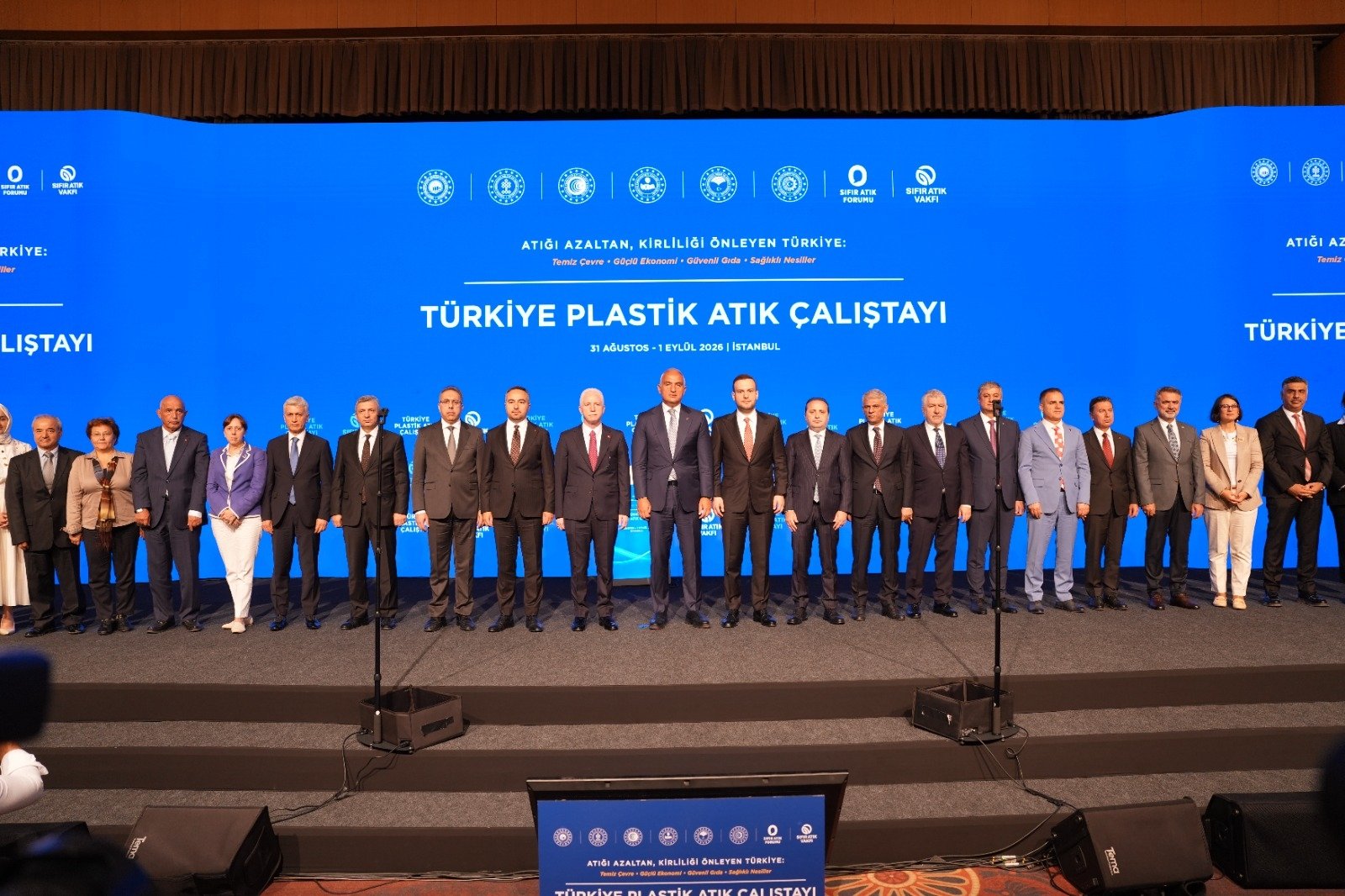
The Zero Waste Foundation brought together around 600 participants representing 17 ministries, public institutions, local administrations, academia, civil society and the private sector in Istanbul on Monday for a two-day workshop aimed at developing a national roadmap to tackle plastic pollution and strengthen Türkiye’s circular economy.
Held under the “Zero Waste for the Future – Common Mind Platform,” the Türkiye Plastic Waste Workshop brought stakeholders together to assess the country’s plastic-waste challenges and discuss concrete policy measures and solutions. The workshop will continue through Tuesday, with participants focusing on strategies to reduce plastic waste, prevent pollution, improve resource efficiency and support the transition toward a circular economy.
The event is being held as Türkiye prepares to host the U.N. climate conference COP31 from Nov. 9 to Nov. 20, with organizers saying its outcomes are expected to contribute to the country’s climate action agenda and provide a basis for policies and practices to be advanced during the COP31 process.
The opening session was addressed by Culture and Tourism Minister Mehmet Nuri Ersoy, who said the world was undergoing a period of major transformation and warned that waste, environmental pollution and the climate crisis threatened to make the planet increasingly uninhabitable.
Highlighting the scale of the plastic problem, Ersoy said global plastic production had exceeded 460 million tons over the past 70 years, while plastic waste had reached 353 million tons.
Of that amount, only 9% is ultimately recycled, while 19% is burned, 50% is stored and 22% enters the environment, according to figures cited by Ersoy.
He said around 78 million tons of plastic remain uncontrolled and enter nature, contaminating soil, rivers and oceans and harming ecosystems.
Ersoy also said Türkiye needs to make further progress in addressing the issue, emphasizing the importance of developing environmentally compatible alternatives and examining the entire plastic cycle through the use of secondary raw materials.
Zero Waste Foundation President and COP31 High-Level Climate Champion Samed Ağırbaş said the goal should not be to eliminate plastics entirely but to determine where they are genuinely needed, where they are being overused and what happens to them after use.
He said plastic pollution is not limited to seas and coastlines, noting that the issue also affects agriculture and tourism and therefore needs to be addressed across Türkiye as a whole.
Ağırbaş said the Zero Waste movement promotes preventing, reducing, reusing and returning waste to the economy, with stakeholders from the public sector, local administrations, universities, private sector and civil society consulted in Türkiye cities Adana, Mersin, Muğla and Antalya ahead of the workshop.
He said Türkiye should question the consequences of importing plastic waste before sufficiently collecting and bringing its own waste back into the economy. “We have to discuss whether imports should be banned if necessary,” he said.
Ağırbaş also called for tougher penalties against those who pollute the environment with plastic waste, including prison sentences. “We should be able to discuss heavier sanctions, including prison sentences, for those who pollute the environment with plastic waste,” he said.
Discussions in those provinces had focused on problems encountered in the field, ranging from agricultural areas and waterways to industrial facilities and ports; these experiences are to be combined with expertise from across Türkiye during the workshop.
The workshop, he stressed, should not focus only on issues where stakeholders can easily reach consensus. “Common sense is not just about discussing the questions on which we can easily agree. Common sense means being able to discuss difficult questions around the same table,” Ağırbaş said.
Plastic pollution, Ağırbaş emphasized, does not remain where it is discarded, as waste can travel from streams to seas and oceans and cross national borders. Over time, plastics can also break down into microplastics, making the issue relevant not only to the environment but also to food security, human health, climate, the economy and competitiveness.
Participants will address the issue across six main areas: waste, pollution, the environment, the economy, food security and human health, through high-level sessions and 15 thematic working tables.
The discussions will be organized into four thematic blocks covering plastic production, design and economic transformation; plastic consumption, waste, pollution and the environment; plastics, food security, human health and social transformation; and governance, financing, data and future vision.
Topics under the first block include sustainable raw-material production, eco-design, sustainable products and packaging, resource efficiency, clean production, industrial symbiosis, green transformation in the plastics industry, exports and competitiveness.
The second block will cover single-use plastics, sustainable consumption, reuse systems, plastic-waste collection and recycling, plastic management in tourism, education, health and public spaces, as well as plastic pollution in seas, inland waters and natural ecosystems.
The third block will focus on plastic use in agriculture, microplastics, food safety, the effects of micro- and nanoplastics on human health, exposure and risk assessment, along with education, communication and behavioral change.
The governance-focused block will address legislation, enforcement and institutional governance, green finance and investment mechanisms, data and monitoring, digital transformation, the 2053 Türkiye Plastic Vision and international cooperation.
Deputy Industry and Technology Minister Dönmez said the government supports Türkiye’s industrialization while seeking to ensure that industrial growth does not result in environmental pollution.
He noted that Türkiye had made progress in developing more environmentally friendly industrial zones, with 31 organized industrial zones receiving green labels. He also said $450 million in international financing had been mobilized to support green industry projects.
Dönmez said the government also plans to provide an additional $485 million in support for companies pursuing digital and green transformation.
The workshop is expected to produce thematic table reports, a Türkiye Plastic Circularity Results Report, a final declaration and ministry-based policy and assessment reports based on the responsibilities of relevant institutions.
Organizers say the outputs will contribute to the development of national legislation and strategy documents, strengthen cooperation among institutions in combating plastic pollution and help establish a stronger roadmap for the 2053 Türkiye Plastic Vision in line with international developments.
The workshop is ultimately intended to bring Türkiye’s environmental, economic and social priorities together through a comprehensive approach to the plastic life cycle, turning the “common mind” approach into concrete policies and action.