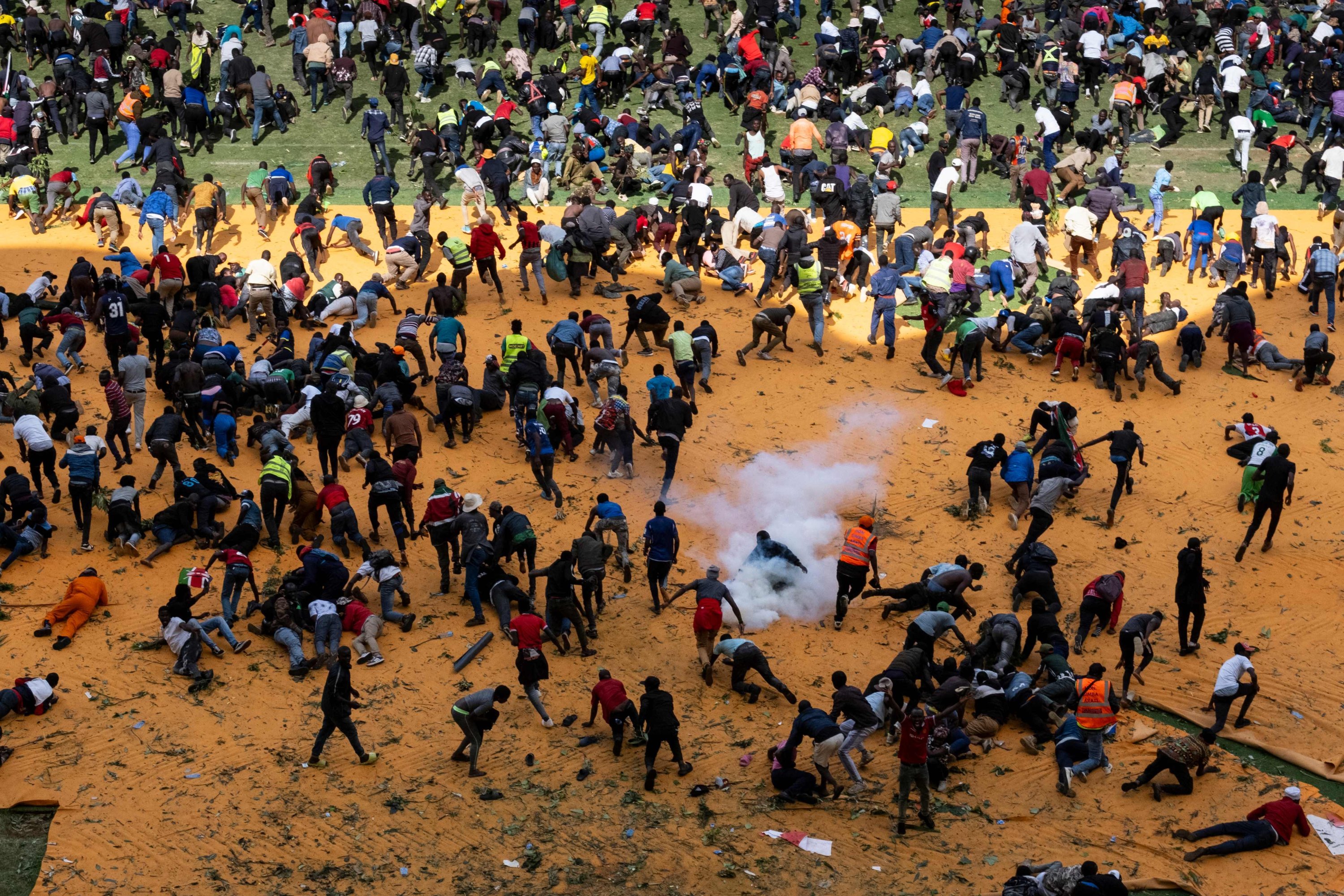
Four people were killed and scores more injured Thursday as security forces fired bullets and tear gas to disperse thousands of mourners in Nairobi mourning former Prime Minister Raila Odinga, one of Kenya’s most influential political figures.
The violence unfolded at Kasarani Stadium, where Odinga’s body lay in state following his death Wednesday at age 80 in India, where he had been receiving medical treatment.
Odinga, a former political prisoner and five-time presidential candidate, commanded deep loyalty, particularly among his Luo community in western Kenya.
While mainly known as an opposition figure, he served as prime minister in 2008 and forged a political pact with President William Ruto last year.
His decades-long advocacy for multi-party democracy left an enduring mark on Kenya’s political landscape.
Chaos erupted as mourners breached security gates at the stadium, prompting soldiers to fire in the air, according to Reuters witnesses.
Police then deployed tear gas to disperse the crowds, leaving the venue deserted.
The unrest earlier extended to Jomo Kenyatta International Airport, where thousands of supporters overwhelmed security as Odinga’s body arrived. Flights were suspended for nearly two hours, and some mourners climbed aircraft stairs and even accessed stationary planes to view the remains.
As Odinga’s convoy made its slow procession through Nairobi’s streets, supporters waved branches and twigs – a Luo tradition symbolizing unity and collective mourning.
Many lined major highways, lighting candles and singing liberation songs, paying tribute to a man they view as a champion of democracy.
“He fought tirelessly for multi-party democracy, and we are enjoying those freedoms today because of his struggle,” university student Felix Ambani Uneck said at the stadium.
President William Ruto declared Friday a national holiday in Odinga’s honor and announced a state funeral Sunday at the family home in Bondo, 420 kilometers west of Nairobi. Police have stepped up patrols across the capital as thousands continue to gather at public sites.
The violence underscores the deep passion and tension surrounding Odinga’s legacy.
Social media showed images of the victims, while witnesses recounted panic as gunfire scattered crowds and several people were trampled.
Odinga’s enduring influence, particularly among younger supporters who had not yet been born when Kenya transitioned to multi-party democracy in 1991, highlights the emotional weight of his passing and the fragile dynamics of public gatherings in the capital.