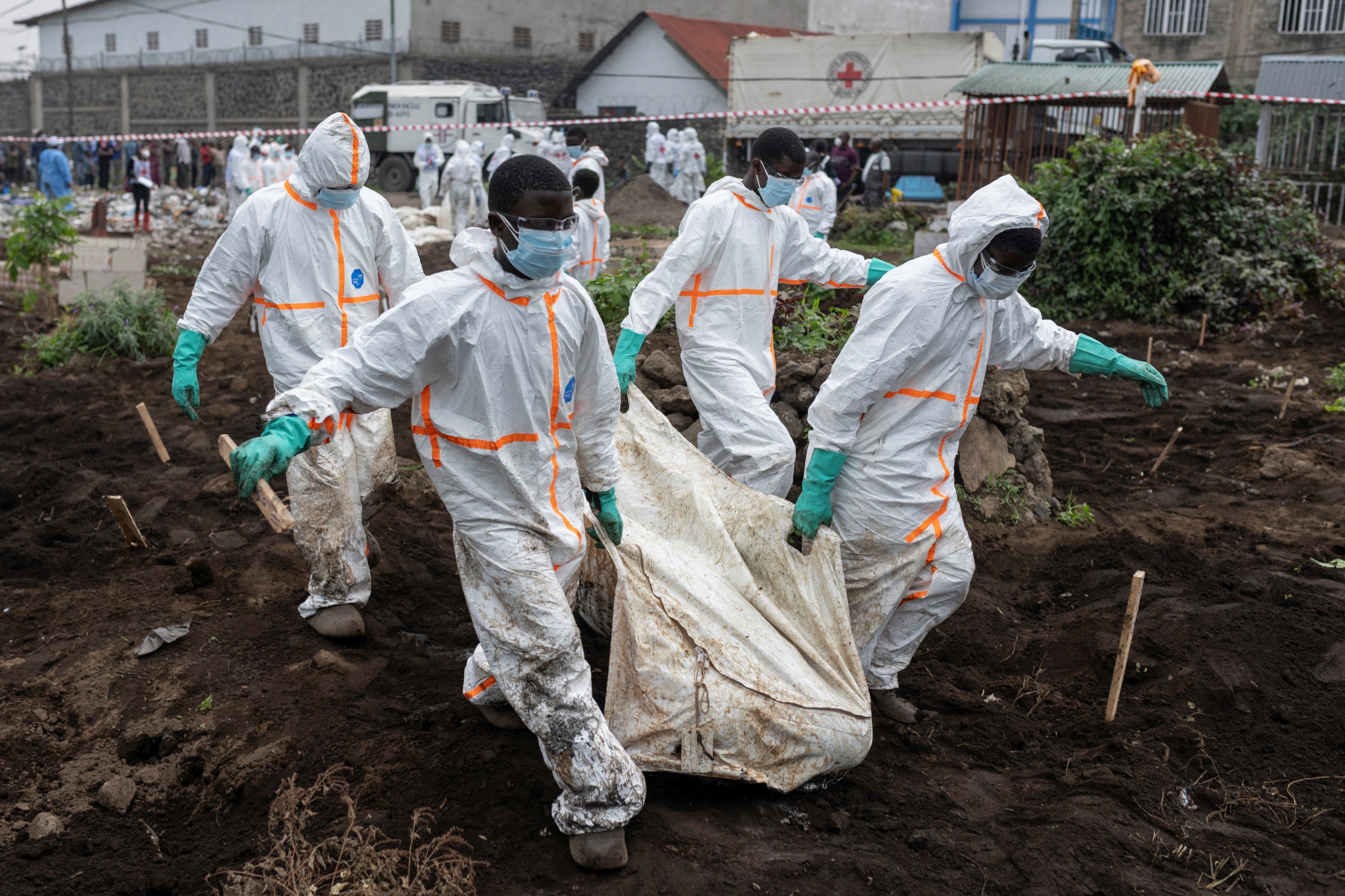
Rebels in Goma, eastern Congo’s largest city, observed a cease-fire Tuesday, allowing residents to hastily bury around 2,000 victims of last week’s battle for control amid growing fears of disease outbreaks.
The Rwanda-backed M23 rebels, who captured Goma, announced a cease-fire Monday and largely upheld it, though sporadic shooting and looting were reported.
As calm settled over the city, residents assessed the damage, with bombed-out buildings and overwhelmed morgues revealing the scale of the destruction.
The Democratic Republic of Congo’s (DRC) communications minister said more than 2,000 bodies required burial, while the United Nations reported at least 900 deaths and nearly 3,000 injuries. The reason for the discrepancy in death tolls remains unclear.
Hospitals struggled to cope with the influx of casualties, while bodies lay in the streets. Julienne Zaina Barabara, a resident of the Katoyi neighborhood, said one of her children was killed and two others were wounded by shrapnel when an explosive struck their home.
"We took them all to the hospital, where one of them died after three hours. The other two are still receiving treatment. They had scans, and one still has shrapnel in his head," she said.
Aid groups have been assisting authorities with overcrowded morgues and burials to prevent disease outbreaks. Power outages last week disrupted morgue refrigeration, creating a "race against time" to identify bodies, according to Myriam Favier, head of the International Committee of the Red Cross sub-delegation in Goma.
"The land where bodies can be buried in Goma is extremely limited," Favier added.
The renewed fighting has displaced approximately 700,000 people in and around Goma, the WFP said Monday, raising fears of a broader regional conflict.
Bruno Lemarquis, the top U.N. aid official in Congo, called for the urgent reopening of Goma’s airport to allow humanitarian flights to resume.
For many in Goma, the cease-fire has offered a brief respite. "These families have suffered so much in this war: no food, no passable roads," said Faustin Habimana, a 28-year-old motorcycle driver who fled from the nearby town of Kivumba.
Despite the destruction, life slowly resumed. Street vendors in Katoyi sold goods near a burnt-out petrol station and torched cars, while buildings with blast marks and twisted metal roofs bore witness to last week’s intense clashes.
A rebel alliance, including the M23, vowed to restore order in Goma and stated Monday it had no intention of advancing toward Bukavu, the provincial capital of neighboring South Kivu. However, Oxford Economics noted that the announcement contradicted previous rebel statements, suggesting potential internal divisions.
Congo army spokesman Sylvain Ekenge and government spokesman Patrick Muyaya expressed skepticism about the cease-fire. "They call for a cease-fire to reorganize and reinforce their ranks," Ekenge told Reuters, referring to M23.
The U.N. Human Rights Council announced a special session to address the crisis, while leaders from eastern and southern Africa are set to meet in Tanzania this week to discuss a resolution.
Rwandan President Paul Kagame confirmed his attendance at the summit, while Congolese authorities did not comment on whether President Félix Tshisekedi would participate.
Meanwhile, Kinshasa has called for sanctions against Rwanda, accusing Kigali of using M23 to exploit the region’s mineral wealth, including gold, coltan, and tin. Rwanda has denied the allegations, insisting its actions are in self-defense and aimed at protecting ethnic Tutsis.