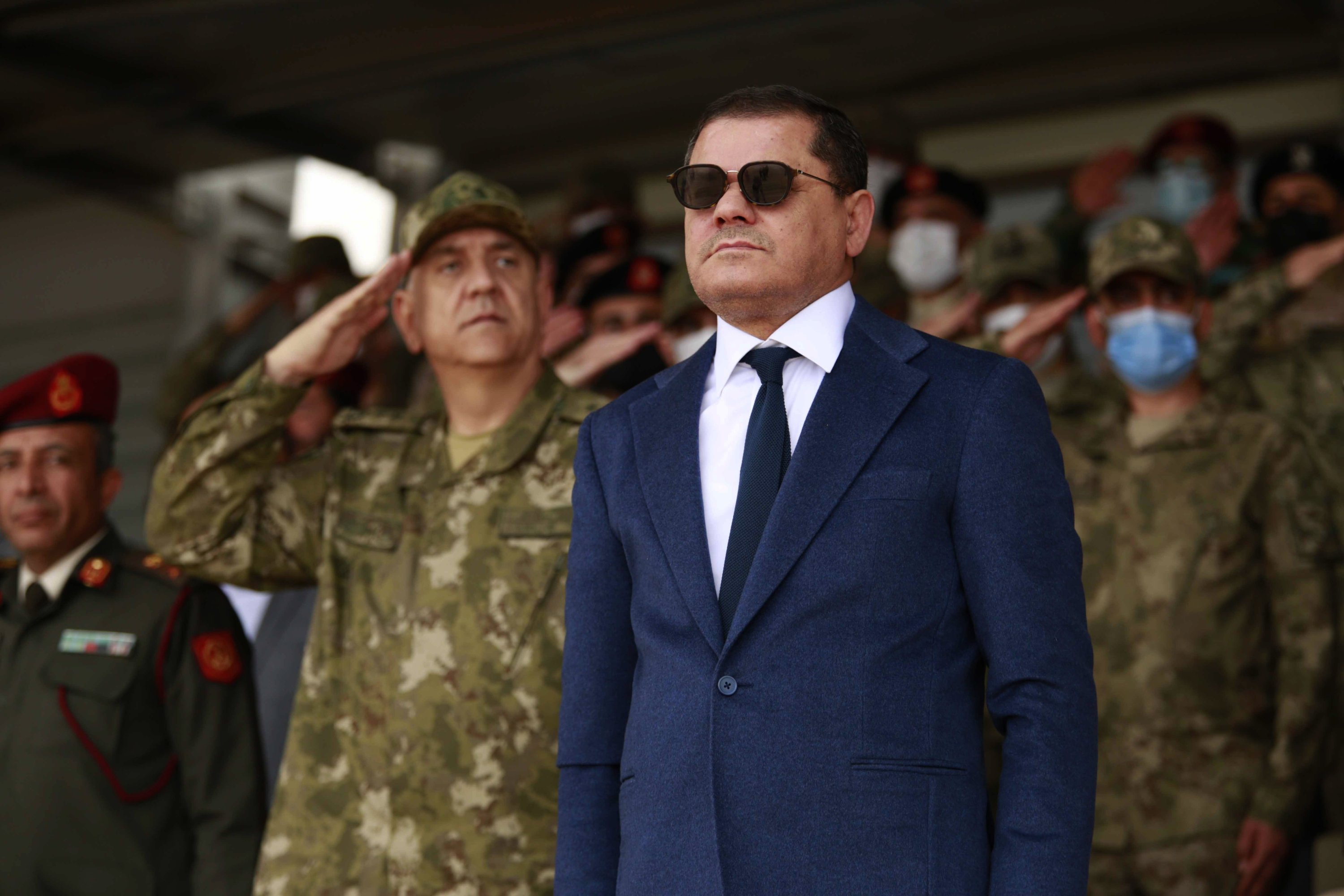
Libya’s interim Prime Minister Abdul Hamid Dbeibah announced that he has handed over the draft election law prepared by the government to the committee formed to reach national dialogue, a statement by his press office said Wednesday.
The government expects the committee to launch a national dialogue initiative and gather information about people's opinions. The statement further noted that Dbeibah aims to expand the scope of participation and represent the majority of society with the contributions of “patriotic political figures.”
Dbeibah had instructed the formation of a national committee comprising independent figures from and around Libya on March 20.
Last month, Dbeibah announced plans for elections in the summer as he rejected the east-based parliament's push to oust him, as he repeated his vow to step down only after a national vote, defying the eastern-based parliament's designation of former Interior Minister Fathi Bashagha to replace him as prime minister.
Dbeibah also said the interim government would hold a parliamentary election followed by a presidential election in June seen as an attempt to slow down the momentum of a bid spearheaded by parliament to replace him.
Many Libyans fear the dispute will revive the years of divided government before Dbeibah was installed a year ago when warring administrations ruled in the east and west.
Political problems have intensified in recent weeks with rival armed forces mobilizing in the capital, heightening fears of clashes.
The political chaos in Libya has undermined an internationally backed peace plan aimed at ending the violence and division since the 2011 NATO-backed uprising against former President Moammar Gadhafi.
That plan was meant to culminate in parliamentary and presidential elections in December, but the process fell apart soon before the scheduled vote as rival factions squabbled over the rules and how to enforce them.
Parliament said Dbeibah's term had expired with the December election date and it has moved to establish a new interim government to oversee a referendum on a temporary constitution and new elections within 14 months.
Dbeibah said parliament itself is no longer valid some eight years after it was elected and that its longer schedule for elections is aimed at prolonging its own position of power.
Parliament Speaker Aguila Saleh, who like Dbeibah and Bashagha had been a presidential candidate, has since spearheaded efforts to replace the unity government.
Both Bashagha and Dbeibah have the support of rival armed groups in the Libyan capital.
The United Nations, Western powers and even some members of parliament have backed Dbeibah to stay in his role until the elections, for which a new date has not yet been set.