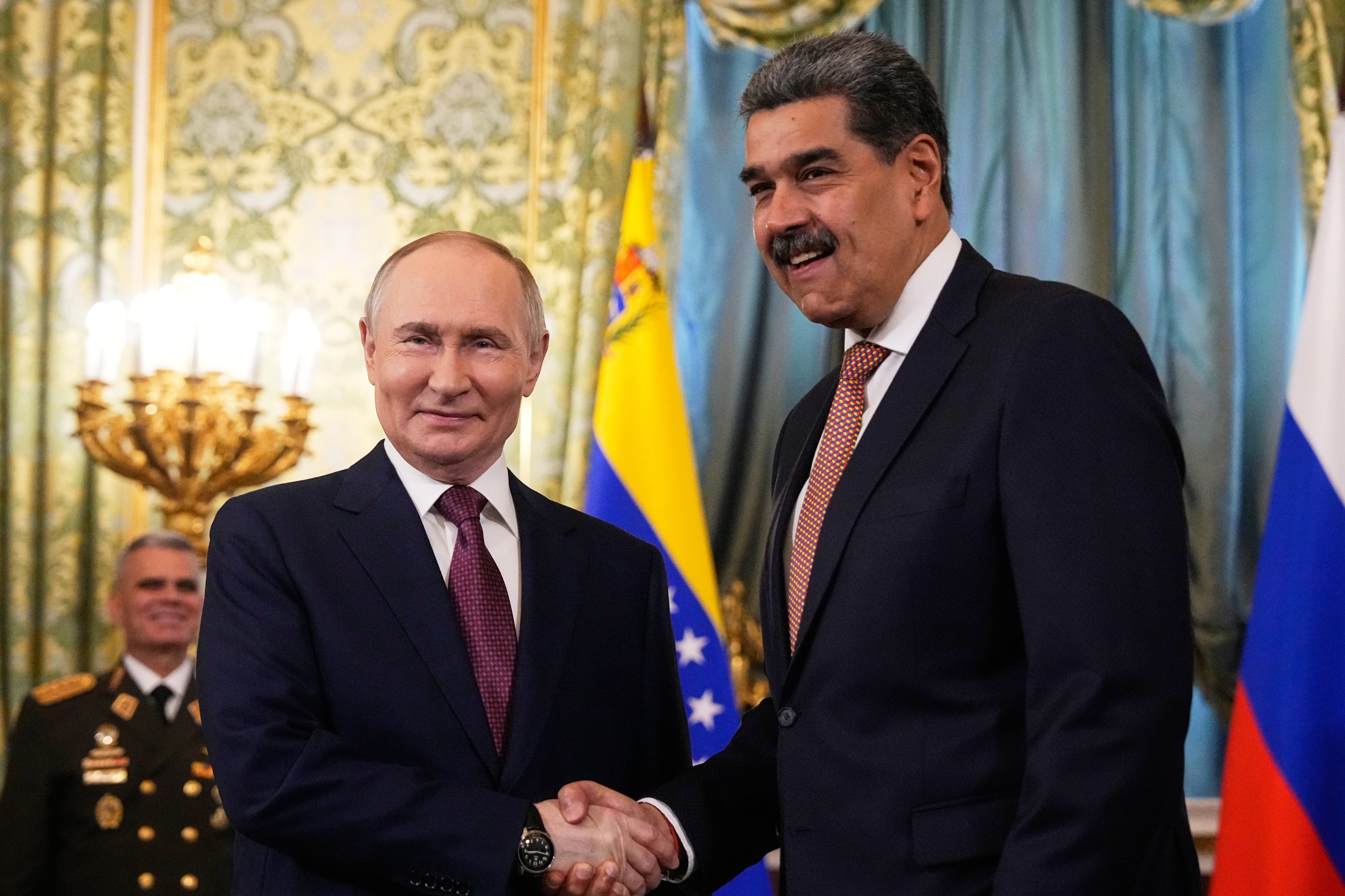
Russian President Vladimir Putin on Thursday reaffirmed his support to Venezuela in a phone call with long-time ally President Nicolas Maduro in the face of growing external pressure, the Kremlin said.
Maduro has been under pressure from U.S. President Donald Trump to leave office, with the United States conducting a huge military build-up in the Caribbean.
The U.S. lastly seized an oil tanker off the Venezuelan coast.
Russia has fostered warm ties with Venezuela, with Maduro earlier this year visiting Moscow, where he attended an annual military parade and signed a broad partnership agreement with Putin.
In a phone call on Thursday, Putin "expressed solidarity with the Venezuelan people," the Kremlin said in a read-out.
The Russian leader had also "confirmed his support for the Maduro government's policy aimed at protecting national interests and sovereignty in the face of growing external pressure," the statement added.
Putin and Maduro spoke of their desire to act on their strategic partnership agreement and implement various joint projects related to the economy and energy sector, it noted.
Separately on Thursday, Belarusian President Alexander Lukashenko, Putin's close ally, held his second meeting in 17 days with Jesus Rafael Salazar Velazquez, the Venezuelan ambassador to Moscow.
According to the Belarusian state news agency Belta, Lukashenko told the envoy on Nov. 25 that Maduro was always welcome in Belarus and it was time for him to pay a visit.
On Thursday, Belta quoted Lukashenko as reminding Velazquez they had agreed at the first meeting to "coordinate certain matters" with Maduro.
"We agreed that, after resolving certain issues, you would find time to come to me and meet again so we could make the appropriate decision, which is within our competence. And if necessary, we will then involve the president of Venezuela."
On Wednesday, the U.S. military seized a Venezuelan oil tanker – troops rappelled onto the tanker's deck from a helicopter and entered the ship with rifles raised.
Washington has accused Maduro of leading a drug cartel, which he denies. Maduro has said the U.S. is seeking regime change because of Venezuela's vast stores of oil.
Trump has deployed warships within striking distance of Venezuela, and at least 87 people have been killed in at least 22 strikes on boats in the Eastern Pacific and the Caribbean Sea.
In an interview with Politico this week, Trump said Maduro's "days are numbered," while declining to say whether he would be willing to send U.S. troops into Venezuela.
Russian Foreign Ministry spokeswoman Maria Zakharova told reporters on Thursday: "We hope that the White House will manage to prevent a further slide into a full-scale conflict, which threatens to have unpredictable consequences for the entire Western Hemisphere."
Lukashenko, the veteran authoritarian leader of Belarus, has friendly ties with Venezuela and has also this year entered a dialogue with the Trump administration, after years of being shunned by Washington and other Western governments over his human rights record and support for Russia's invasion of Ukraine.
Trump has started to ease U.S. sanctions on Belarus and last month named a special envoy, John Coale, to pursue further negotiations with Lukashenko on the release of political prisoners.