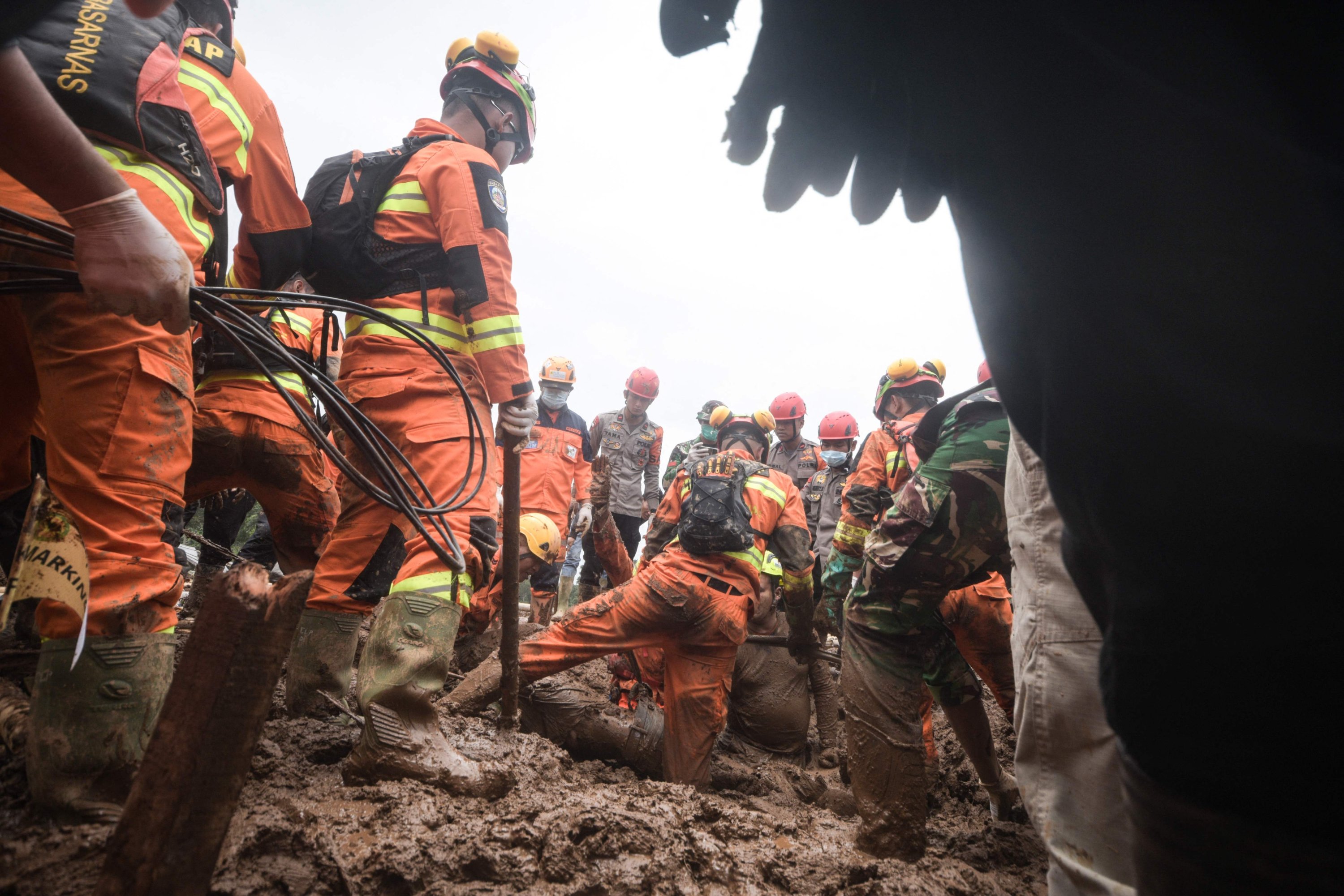
The death toll from a massive landslide in Indonesia rose to 17 on Monday as rescuers deployed heavy machinery to search for dozens still missing, days after torrential rains unleashed a deadly torrent of mud.
Families gathered near the disaster site in Java’s West Bandung region, anxiously awaiting news of their loved ones as rescue teams, wary of another possible landslide, scoured the unstable terrain.
The surge of soil and debris tore through the village of Pasirlangu early Saturday, burying homes and forcing dozens of residents to flee.
“It’s impossible that they are still alive. I just want their bodies to be found,” said Aep Saepudin, who has been returning to the village daily in search of news about 11 missing family members, including his sister.
“My heart aches. It’s devastating to see my older sister like that,” he said.
Abdul Muhari, a spokesman for the national disaster agency, confirmed that at least 17 people had been killed, while local officials said 73 others remain unaccounted for.
More than 50 houses were severely damaged by the disaster, which also displaced more than 650 people, the local disaster agency said.
Dozens of rescuers searched the area at the foot of Mount Burangrang on Monday under dark rain clouds, an Agence France-Presse (AFP) reporter observed.
They excavated manually and used heavy equipment but said they had to proceed cautiously for fear of another landslide due to unstable ground and bad weather.
“What we worry about most is the risk of subsequent landslides. Sometimes when we’re in the operation, we aren’t focusing on slopes that still have the potential to collapse,” rescuer Rifaldi Ashabi, 25, said.
The disaster comes after the government pointed to the role forest loss played in flooding and landslides on Sumatra last year, which killed about 1,200 people and displaced more than 240,000.
The government has filed multiple lawsuits following the Sumatra floods, seeking more than $200 million in damages against six firms. It also stripped more than two dozen permits last week from forestry, mining and hydroelectric companies in Sumatra.
West Java Gov. Dedi Mulyadi blamed Saturday’s disaster on sprawling plantations around Pasirlangu, mostly used for vegetable farming, and pledged to relocate affected residents.
“This area should be forested. Local residents should be relocated because the potential for landslides is high,” Dedi said in a statement Saturday.
Forests help absorb rainfall and stabilize soil through their root systems, while deforestation increases the risk of flash floods and landslides, David Gaveau, founder of conservation startup The TreeMap, said in December.
Floods and landslides are common across the vast archipelago during the rainy season, which typically runs from October to March.
Earlier this month, torrential rains battered Indonesia’s Siau Island, triggering a flash flood that killed at least 16 people.