
Eighty years after the atomic bombings of Hiroshima and Nagasaki, many of Japan’s remaining survivors are voicing growing frustration over the global resurgence of nuclear threats and the perceived normalization of atomic weapons by world leaders.
The United States dropped the first atomic bomb on Hiroshima on Aug. 6, 1945, followed three days later by a second strike on Nagasaki.
By the end of that year, more than 200,000 people had died. Thousands more survived, only to endure decades of radiation-related illnesses and lingering trauma.
Roughly 100,000 survivors – known in Japan as hibakusha – are still alive.
Many spent their lives in silence, concealing their experiences to shield themselves and their families from the deep-rooted discrimination that still shadows atomic bomb survivors. Others remained quiet, unable to revisit memories too painful to speak aloud.
But in recent years, a growing number of aging hibakusha have begun to speak publicly, determined to make their final years count by urging the world to abandon nuclear arms.
Kunihiko Iida is one of them. Now 83, he has battled decades of health complications but spends his retirement as a volunteer guide at Hiroshima’s Peace Memorial Park. For Iida, sharing his story is both a form of healing and a mission – to confront global ignorance about the bombings and to demand a world without nuclear weapons.
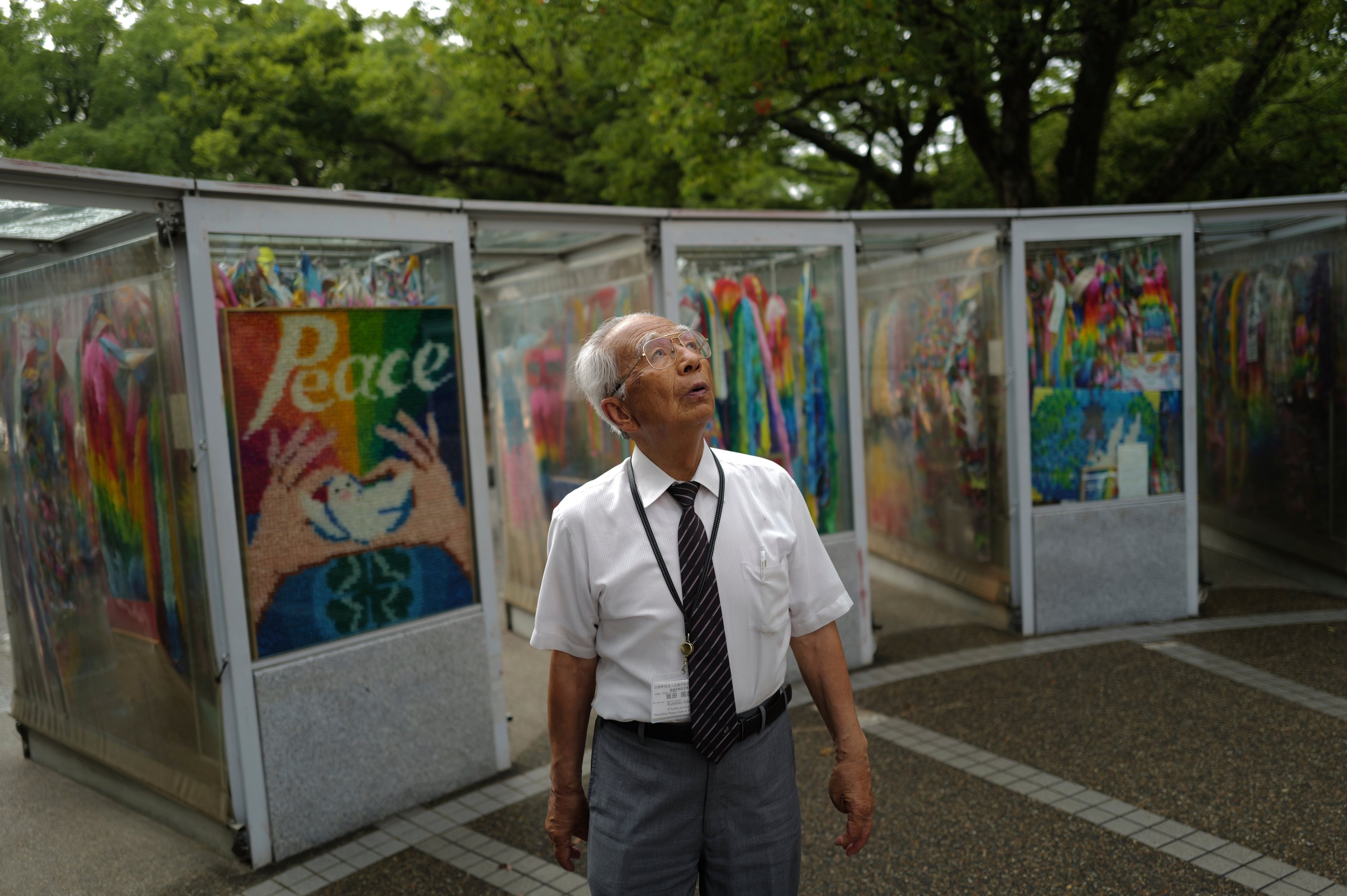
It took him 60 years to find the strength to tell his story. Now, he tells it to anyone willing to listen.
When the United States dropped a uranium bomb on Hiroshima, Iida was 900 meters (about 980 yards) from the hypocenter, at a house where his mother grew up.
He was 3 years old. He remembers the intensity of the blast – as if he had been thrown from a building. He found himself alone under the debris, bleeding from shards of broken glass embedded all over his body.
“Mommy, help!” he tried to scream, but his voice wouldn’t come out. Eventually, his grandfather rescued him.
Within a month, his 25-year-old mother and 4-year-old sister died after developing nosebleeds, skin problems and fatigue. Iida had similar radiation effects through elementary school, though he gradually regained his health.
He was nearly 60 when he finally returned to the peace park at the hypocenter – his first time since the bombing – after his aging aunt asked him to accompany her.
After he decided to start telling his story, it wasn’t easy. Overwhelmed by emotion, it took him a few years before he could speak in public.
In June, he met with students in Paris, London and Warsaw as part of a government-commissioned peace program. Despite his worries about how his calls for nuclear abolition would be received in nuclear-armed nations such as Britain and France, he was met with applause and handshakes.
Iida says he tries to get students to imagine the aftermath of a nuclear attack – how it would destroy both sides and leave behind highly radioactive contamination.
“The only path to peace is nuclear weapons’ abolition. There is no other way,” Iida said.
Fumiko Doi, 86, would not have survived the atomic bombing of Nagasaki if the train she was on had arrived on time. It was scheduled to reach Urakami Station around 11 a.m. – just as the bomb was dropped above a nearby cathedral.
Because of the delay, the train was 5 kilometers (3 miles) away. Through the window, Doi, then 6, saw the flash. She covered her eyes and bent over as shards of glass rained down. Nearby passengers shielded her with their bodies.
People on the street had their hair burned. Their faces were charcoal black, and their clothes were in tatters, she said.
Doi wrote about her experience for her children, but long kept her status as a survivor hidden, fearing discrimination.
She married another survivor and worried their four children would suffer radiation effects. Her mother and two of her three brothers died of cancer, and two sisters have struggled with health issues.
Her father, a local official, was mobilized to collect bodies and soon developed radiation symptoms. He later became a teacher and expressed his sorrow and pain in poetry, a teary Doi explained.
Doi began speaking out after witnessing the 2011 Fukushima Daiichi nuclear disaster, triggered by a powerful earthquake and tsunami that caused radioactive contamination.
She now travels from her home in Fukuoka to join anti-war rallies and speak out against atomic weapons.
“Some people have forgotten about the atomic bombings ... That’s sad,” she said, noting that some countries still possess and develop nuclear weapons even more powerful than those used 80 years ago.
“If one hits Japan, we will be destroyed. If more are used around the world, that’s the end of the Earth,” she said. “That’s why I grab every chance to speak out.”
Following the 2023 Hiroshima G7 summit of world leaders and last year’s Nobel Peace Prize awarded to the grassroots survivors’ group Nihon Hidankyo, visitors to the Hiroshima and Nagasaki peace museums have surged, with about one-third coming from abroad.
On a recent day, most of the visitors at the Hiroshima Peace Memorial Park were non-Japanese. Samantha Anne, an American, said she wanted her children to understand the magnitude of the bombing.
“It’s a reminder of how much devastation one decision can make,” Anne said.
Katsumi Takahashi, a 74-year-old volunteer specializing in guided walks through the area, welcomes foreign visitors but worries Japanese youth are growing detached from their own history.
On his way home, Iida stopped by a monument dedicated to the children killed in the bombing. Nearby, millions of colorful paper cranes, a global symbol of peace, hung from strings, sent from around the world.
Even a brief encounter with a survivor made the tragedy more real, said Melanie Gringoire, a visitor from France.
“It’s like sharing a little piece of history,” she said.



