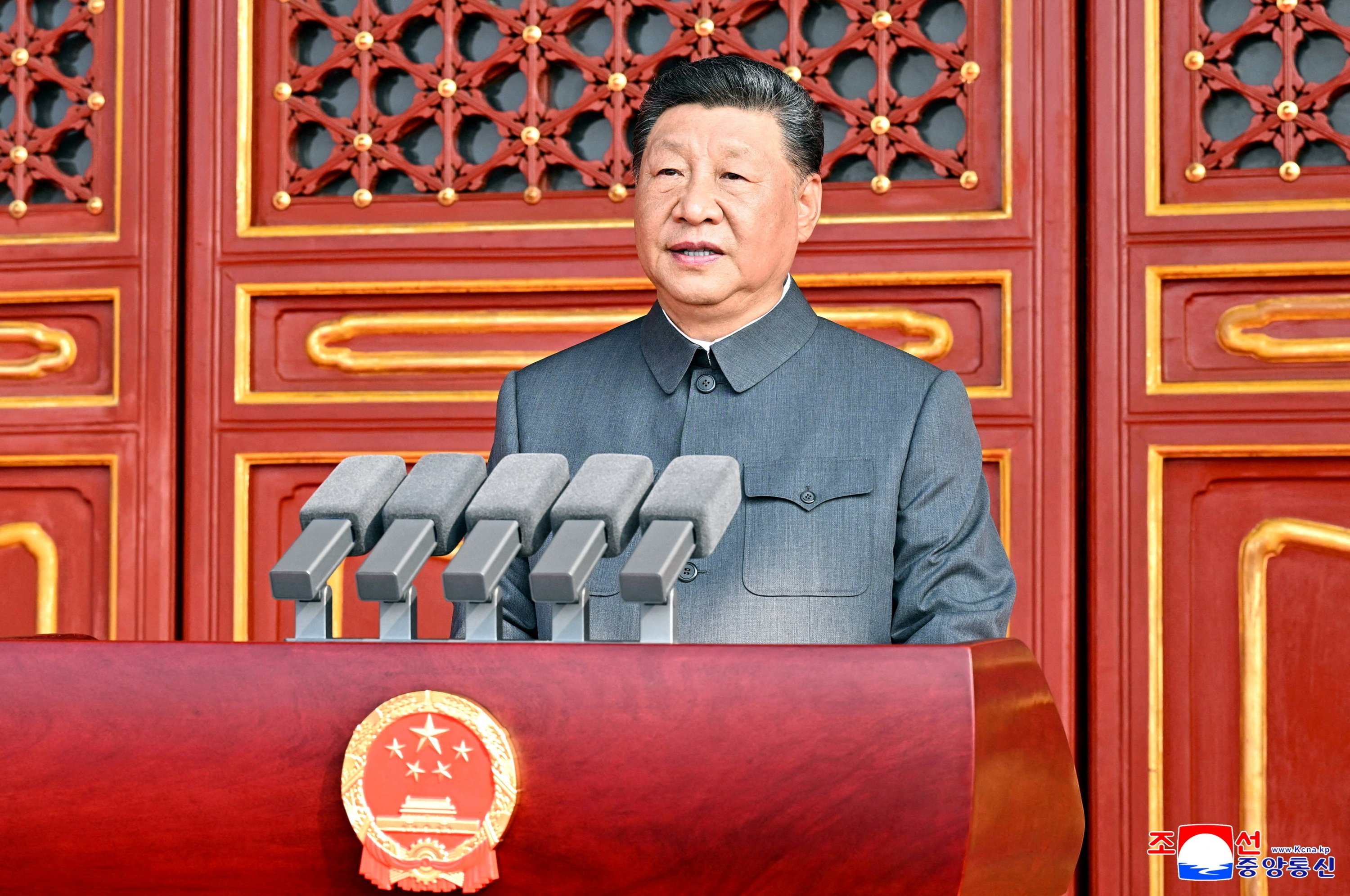
When Chinese leader Xi Jinping staged his first parade to mark the anniversary of the end of World War II in 2015, he stood alongside his two predecessors, signaling respect and continuity in leadership.
A decade later, Xi, having consolidated power and eliminated domestic rivals as he embarks on an unprecedented third term, was flanked Wednesday at the 80th anniversary parade by Russia’s Vladimir Putin and North Korea’s Kim Jong Un.
Chinese Communist Party officials were interspersed among foreign dignitaries, underscoring the mix of domestic authority and international outreach.
The parade followed a high-profile summit with Indian Prime Minister Narendra Modi over the weekend at the Shanghai Cooperation Organization (SCO) meeting in Tianjin, as well as Xi’s rare visit to Tibet last month.
The display of diplomatic influence, personal stamina, and geopolitical ambition has helped assuage concerns among observers about the 72-year-old president’s vitality – questions fueled by sporadic public absences and uncertainty over succession plans.
Experts also note that the spectacle serves to shift domestic attention away from slowing economic growth.
Longevity was on the leaders’ minds as they walked to the rostrum at Beijing’s Tiananmen Square.
Xi and Putin were caught in a hot-mic moment discussing organ transplants and the possibility that humans could live to 150 years old.
“This week of triumphant diplomacy for Xi shows that he remains totally in charge of the elite politics of the Communist Party,” said Neil Thomas of the Asia Society, a New York-based think tank. Unable to gain the same legitimacy from economic growth as his predecessors, Xi has turned toward nationalism “to try and make up for it,” Thomas said.
“It’s a way to divert attention from economic challenges and to make his citizens proud to be Chinese, even if it’s harder to feel that from the day-to-day experiences of unemployment, falling house prices, and stagnant wages.”
Xi underscored his elder statesman image with fashion choices: a gray suit in the style of those worn by Mao Zedong, matching his graying hair, in contrast to the black suits of his counterparts and his own black attire from a decade earlier.
His number two, Premier Li Qiang, whose role has diminished at home, was charged with relatively minor meetings with leaders of Malaysia and Uzbekistan.
High-profile engagements with Kim, Modi, Turkish President Recep Tayyip Erdoğan and several others fell to Cai Qi, who heads the party’s Central Secretariat, responsible for its sprawling administration.
In response to a Reuters request for comment, China’s foreign ministry referred to news conference transcripts related to the recent diplomatic events, showcasing China’s partnerships with developing nations and positioning Beijing as committed to peaceful development and international cooperation.
Many countries that sent their leaders to China in the past week have been hit by U.S. President Donald Trump’s trade tariffs this year, including India, which remains a significant buyer of Russian oil, itself subject to sanctions over Putin’s invasion of Ukraine.
In one of the most memorable moments in the flurry of diplomatic encounters, Modi and Putin walked over for a chat with Xi while holding hands, underscoring personal tensions between Trump and Modi, as well as Washington’s failure to draw historically nonaligned India into countering Russia and China.
“Ultimately, one of the biggest driving factors of the SCO show of solidarity has been U.S. policy,” said Even Pay, a director at strategic advisory firm Trivium China.
Trump, who called the military parade “beautiful” and “very, very impressive,” posted a barbed message on social media saying China was working with Putin and Kim to “conspire against the United States of America.”
The Kremlin responded that they were not conspiring and suggested Trump’s remarks were ironic.
Analysts say Xi’s whirlwind of activity underscores China’s ambition in presenting itself as a reliable partner to developing nations on the global stage, offering advantages such as investment opportunities and a new development bank – a major step forward for the SCO, which has expanded markedly over the past decades to include India, Pakistan, and Iran.
“China’s message as a more reliable, stable alternative to the United States is resonating with large swaths of the world, particularly across Asia, which sees the United States as an increasingly belligerent force in world affairs,” said Eric Olander, editor-in-chief of the China-Global South Project, a research agency.
“A lot of developing countries and middle-power states may still be a bit ambivalent about what China is proposing with its new governance and development initiatives, but at least what China is talking about is forward-looking, which is crucial for economies with large populations of young people seeking better employment opportunities,” Olander said.
Xi faces considerable challenges in managing this large and often fractious coalition as he eyes a potential fourth term in 2027, which could further cement his legacy as the most powerful Chinese leader since Mao.
Entrenched Chinese foreign policy positions, including territorial disputes and industrial subsidies that have flooded foreign markets with cheap exports, will likely remain friction points, experts say, while India’s deep distrust of China will not dissipate because of one brief meeting.
“It’s not necessarily a big-picture shift toward a more China-led international order,” said Thomas of the Asia Society.