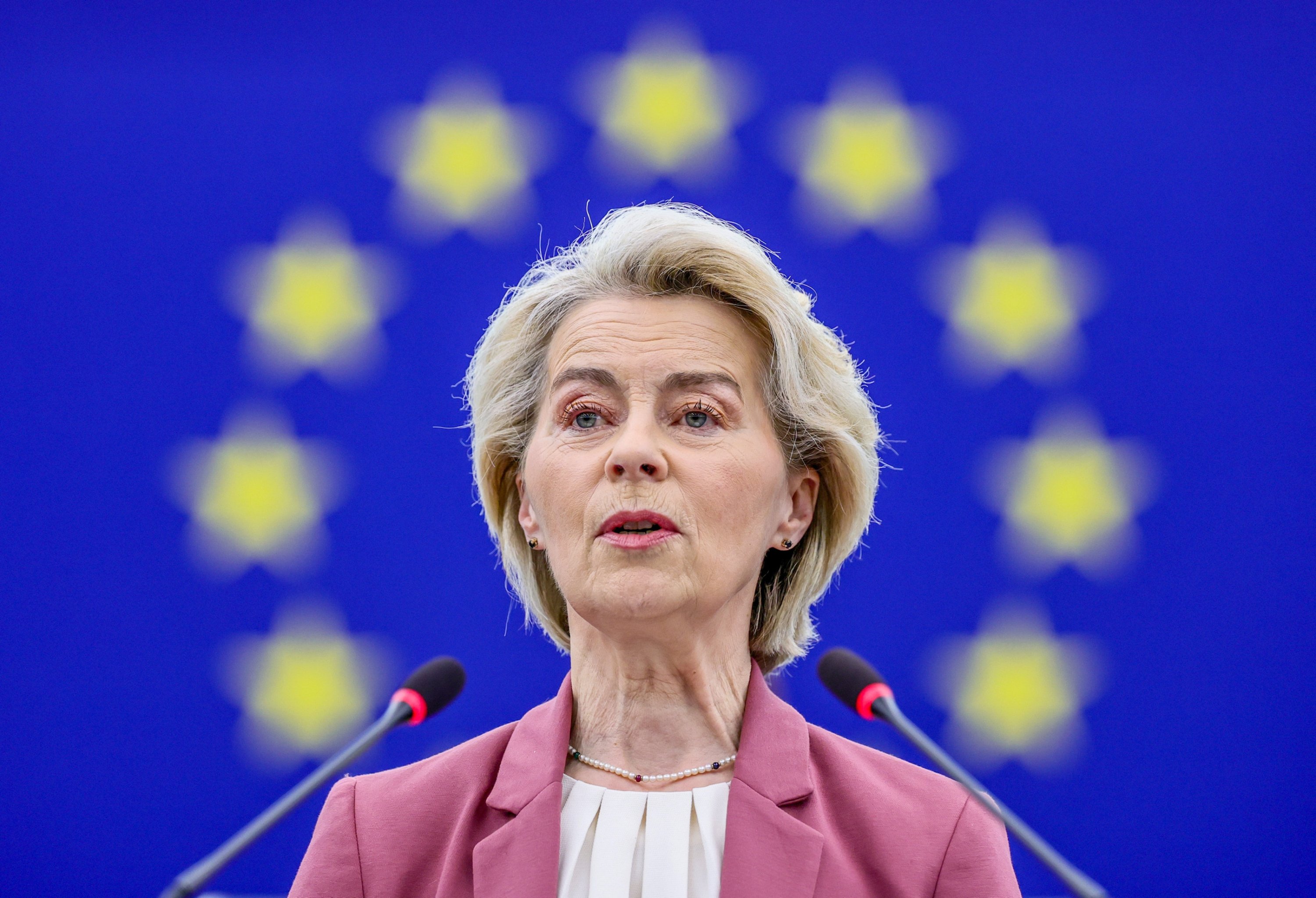
Europe must take responsibility for its own security and reduce external dependencies in today's "dangerous" world, the European Commission president said Wednesday.
Speaking at the European Parliament in Strasbourg, Ursula von der Leyen described today's international environment as "dangerous and transactional," marked by wars and rising geopolitical competition.
"The reality of this world means we Europeans must defend ourselves and we must depend on ourselves," she said, stressing that Europe can no longer afford to rely on "outdated assumptions" about global stability.
"This is no longer an option. It is a must," she told the European Parliament.
She added that Europe "cannot afford to let the worldviews define us," noting that although the U.S. national security strategy correctly points out Europe's declining share of global GDP, the U.S. is "on the same path."
Von der Leyen argued that the EU has already made significant progress on independence, particularly in the energy sector, noting that under the REPowerEU plan, Russian gas imports have fallen from 45% at the start of the war in Ukraine to 13%, coal imports have dropped to zero, and crude oil imports from Russia have declined from 26% to 2%.
"Europe's era of independence must be unstoppable," she added.
Von der Leyen also stressed the need for rapid action in defense and security, saying Europe must be capable of responding to modern hybrid threats.
"The bottom line is simple – Europe must be responsible for its own security. This is no longer an option. It is a must," she said.
Von der Leyen said the EU has significantly stepped up defense efforts, enabling up to 800 billion euros ($937 billion) in investment by 2030, compared with 8 billion euros invested over the past decade.
She described support for embattled Ukraine as "the most important act of European defense," citing her proposal of two funding options for continued assistance – one based on Russian frozen assets and the other on EU borrowing – and urged EU leaders to make a decision at this week’s European Council to secure Ukraine’s funding for the next two years.