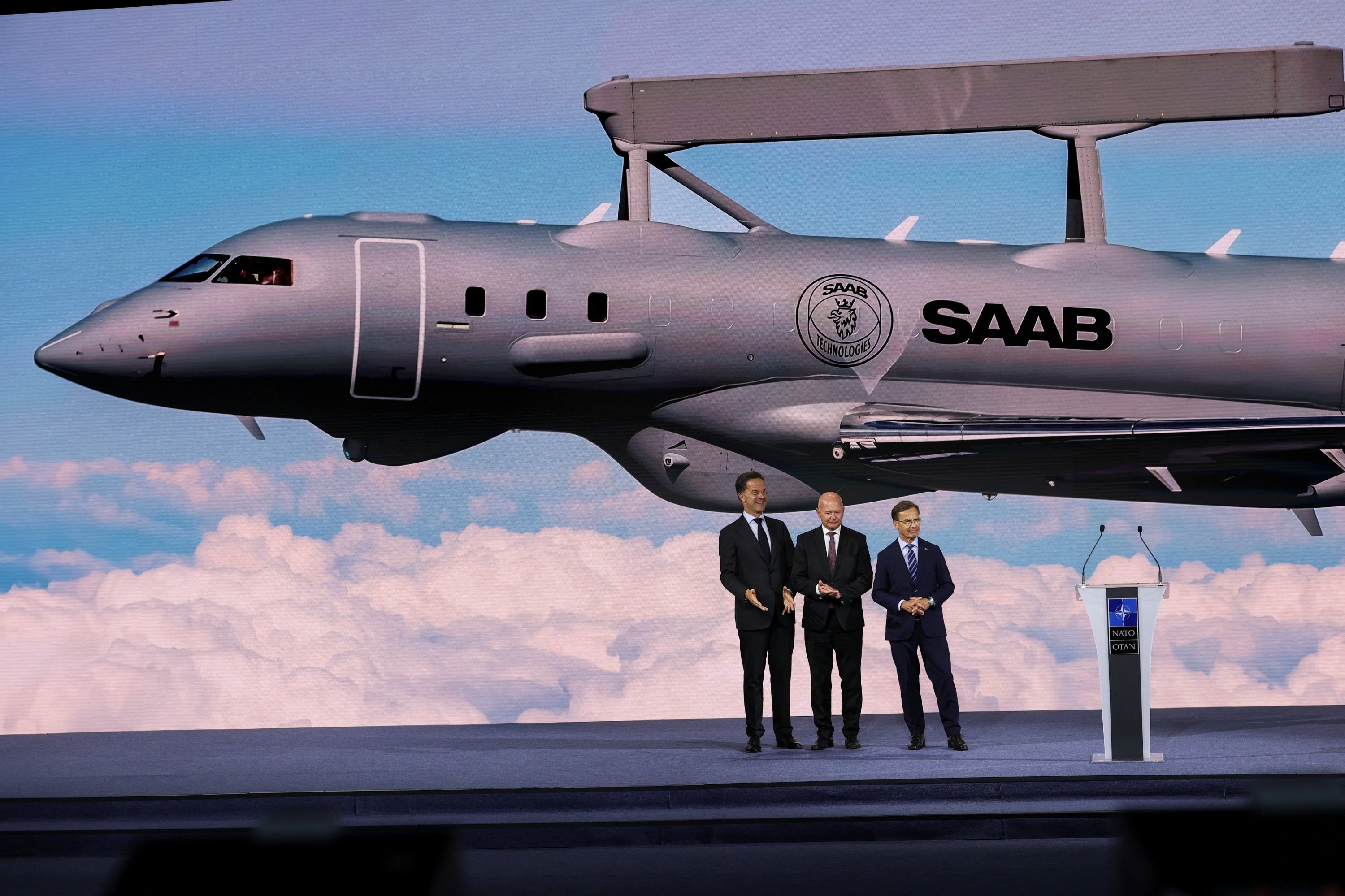
NATO will establish a strategic airlift fleet of Airbus A400M transport planes, add an A330 MRTT tanker to its fleet and spend about $4.5 billion to acquire up to 10 Saab GlobalEye surveillance planes, choosing the Swedish system over Boeing, to replace its aging AWACS aircraft, Secretary-General Mark Rutte announced Tuesday at the Ankara summit.
Rutte was speaking at a defense industry gathering where allies unveiled arms deals worth billions of dollars to show they are heeding U.S. calls to spend more to defend Europe before joining President Donald Trump for the summit starting in the evening.
"It is about air power, which is essential to strengthen our deterrence and defense," Rutte said.
The MRTT project has nine A330s, which can double as troop or passenger aircraft, based at Eindhoven, Netherlands. By adding another tanker, the military alliance will move closer to plugging gaps left in its defense plans after the United States reduced its contributions.
NATO is seeking to expand the fleet to 12 in the longer run. Belgium, Czechia, Denmark, Finland, Germany, Luxembourg, the Netherlands, Norway and Sweden participate in the program.
The U.S. has not publicly disclosed details of its cuts, but they range from refueling aircraft to fighters, drones and ships, according to figures provided by a military source.
Airbus, which builds both the A400M airlifter and the A330 jet on which the tanker is based, said the shared A400M fleet would involve Belgium, Britain, France, Spain, Türkiye, Croatia and Poland.
The announcement is a boost for the A400M, which was designed to meet a European shortfall in military cargo and troop transport to rugged areas. Exports have been slow to materialize, leaving doubts over their long-term future.
Airbus earlier this year toned down earlier warnings to investors over the long-term future of A400M production.
The new pool would initially be drawn from aircraft already in operation and then others in the industrial pipeline. Finally, a spokesperson said, the operation may eventually lead to new orders, though it was premature to speculate on how many or when.
NATO also announced a roughly $4.5 billion plan to buy up to 10 Saab GlobalEye surveillance planes to replace ageing AWACS early warning aircraft, backing a Swedish system over a rival solution from U.S. planemaker Boeing.
Secretary-General Rutte said the replacement of Cold War-era Airborne Warning and Control System (AWACS) planes, best known for their rotating radomes, with a new system based on smaller business jets would tackle threats like drone swarms.
"This will ensure we keep NATO's ... surveillance and early warning capability strong and credible for decades to come," he said.
With U.S. President Donald Trump repeatedly pressing allies to spend more on defense and buy more U.S. equipment, Rutte took pains to underline the international pedigree of the system, which is mounted on top of Bombardier Global 6500 business jets.
"Like its predecessor, GlobalEye is a transatlantic program, delivered by European and Canadian industries with essential contributions from U.S. industries. It is a real success story, again, made in NATO," he told delegates.
Trump has repeatedly criticized European allies for relying on the U.S. for their security, while pressing them to buy more U.S. weapons. He has also threatened at times to quit NATO.
GlobalEye competes with Boeing's E-7 Wedgetail, an early warning and command-and-control aircraft based on the 737 jetliner and designed to oversee and direct battle.
NATO said GlobalEye was a mission-proven system but did not elaborate.
Saab's shares rose by nearly 4% on Tuesday, outperforming the European aerospace and defense index that edged lower.
Reuters reported Thursday that NATO would replace its Boeing E-3 Sentry AWACS jets with Saab's Swedish GlobalEye.
Technically, NATO is now entering into formal negotiations with Saab after making its provisional selection public.
Saab CEO Micael Johansson valued the purchase at up to $4.5 billion and told reporters that the Swedish group would be able to start deliveries in 2030 if a deal were signed soon.
He added that the final price had not been agreed but that it would be between roughly $400 million and $450 million per aircraft.
The final number of aircraft had been unclear as planners debated whether to order a more expensive version capable of mid-air refueling.
A person familiar with the matter said the GlobalEyes would not initially have this capability but that it was expected to be added in a later update.
The current AWACS fleet can be refuelled in flight, a capability that has proved valuable for missions near Ukraine.