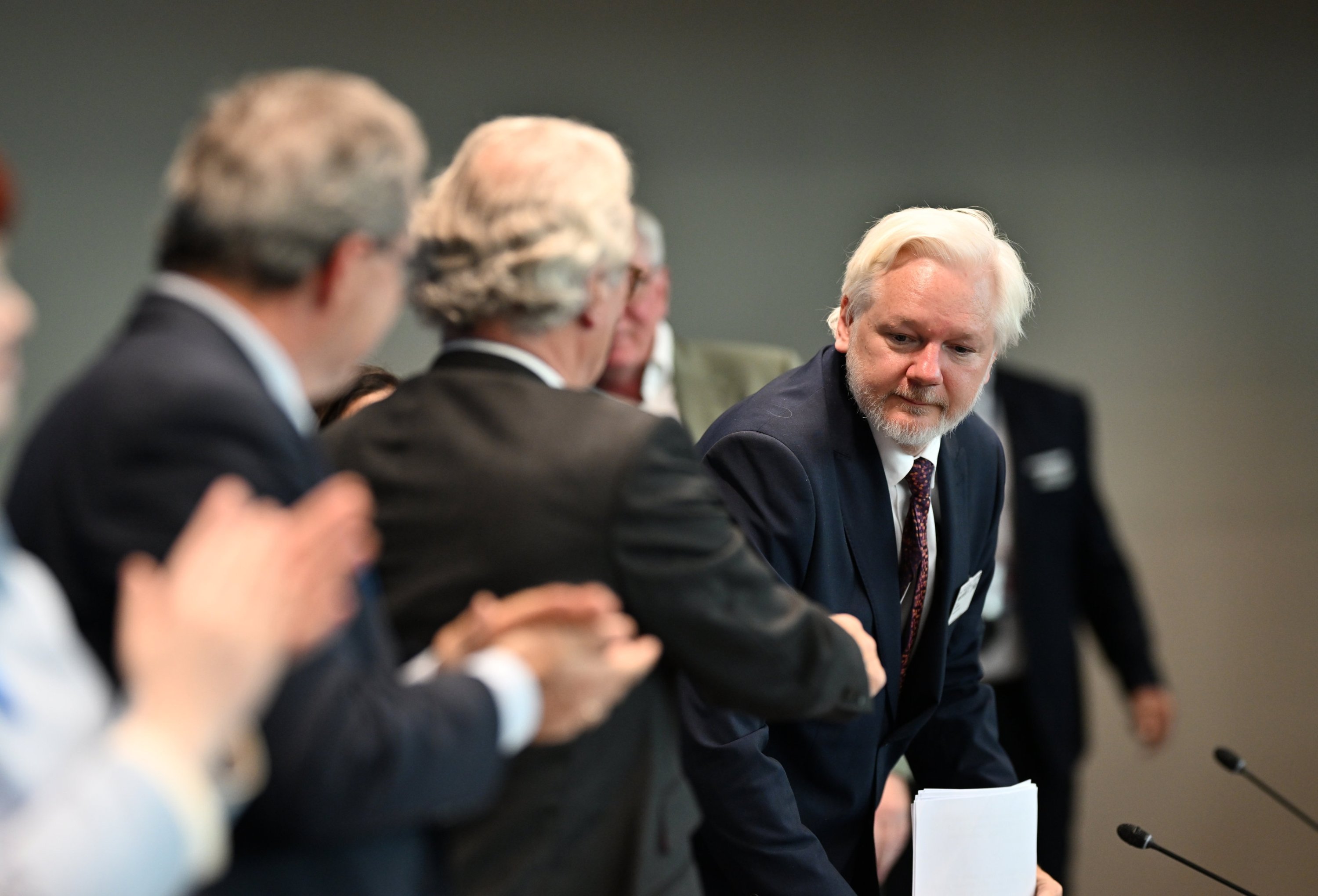
Wikileaks founder Julian Assange, upon his release after years of imprisonment, said Tuesday that he was freed solely for admitting guilt to doing journalism, cautioning that freedom of expression faces a critical and perilous moment.
"I am not free today because the system worked. I am free today after years of incarceration because I pleaded guilty to journalism," Assange told the Council of Europe rights body at its Strasbourg headquarters in his first public comments since his release.
The Parliamentary Assembly of the Council of Europe (PACE) had issued a report expressing alarm at Assange's treatment, saying it had a "chilling effect on human rights."
He spent most of the last 14 years either holed up in the Ecuadoran embassy in London to avoid arrest or locked up at Belmarsh Prison.
Assange was released under a plea bargain in June, after serving a sentence for publishing hundreds of thousands of confidential U.S. government documents.
The trove included searingly frank U.S. State Department descriptions of foreign leaders, accounts of extrajudicial killings and intelligence gathering against allies.
Assange returned to Australia and since then had not publicly commented on his legal woes or his years behind bars.
"I eventually chose freedom over unrealisable justice ... justice for me is now precluded," Assange said, noting he had been facing a 175-year jail sentence.
Speaking calmly and flanked by his wife Stella who fought for his release, he added: "Journalism is not a crime, it is a pillar of a free and informed society."
"The fundamental issue is simple. Journalists should not be prosecuted for doing their jobs," said Assange.
The Wikileaks chief said that he could have lost years more of his life had he tried to fight his case all the way.
"Perhaps, ultimately, if it had gotten to the Supreme Court of the United States and I was still alive ... I might have won," Assange said.
"But in the meantime I had lost 14 years under house arrest, embassy, siege, and maximum security prison."
During that time "ground has been lost," Assange said, regretting that he now sees "more impunity, more secrecy and more retaliation for telling the truth."
"Freedom of expression and all that flows from it is at a dark crossroads," he told the hearing of the PACE legal committee.
"Let us all commit to doing our part to ensure the light of freedom never dims and the pursuit of truth will live on and the voices of many are not silenced by the interests of the few," he said.
Assange's case remains deeply contentious.
Supporters hail him as a champion of free speech and say he was persecuted by authorities and unfairly imprisoned. Detractors see him as a reckless blogger whose uncensored publication of ultra-sensitive documents put lives at risk and jeopardized U.S. security.
Assange is still campaigning for a U.S. presidential pardon for his conviction under the Espionage Act.
U.S. President Joe Biden, who is likely to issue some pardons before leaving office next January, has previously described him as a "terrorist."
But Chelsea Manning, the army intelligence analyst who leaked documents to Assange, had her 35-year sentence commuted by President Barack Obama in 2017.
Assange's timing and his choice of venue for his first post-release appearance have puzzled some observers.
The Council of Europe brings together the 46 signatory states of the European Convention on Human Rights, with little say over Assange's legal fate.
Holly Cullen, a law professor at the University of Western Australia, told AFP ahead of the hearing that Assange might "need to be a bit more restrained until the pardon issue is resolved" in criticizing the U.S.
"The U.S. First Amendment seems pretty black and white to me ... Congress shall make no law restricting speech or the press," Assange said Tuesday.
"However, the U.S. Constitution, those precedents relating to it, were just reinterpreted away" in his case, he claimed.