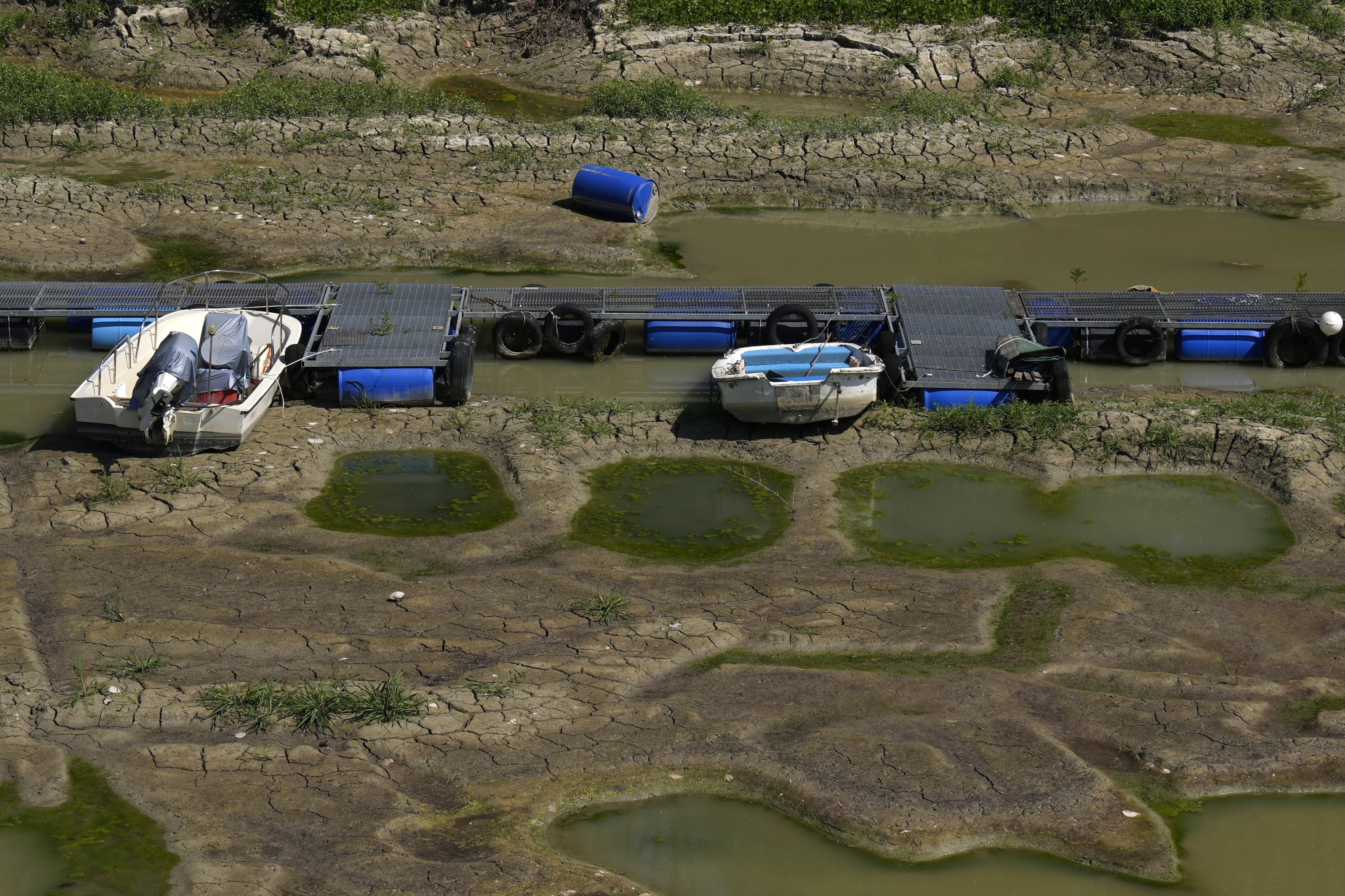
Northern Italy is battling its worst drought in 70 years, with the government recently declaring a state of emergency in five regions due to a lack of rain and sweltering temperatures.
Since the beginning of the year in the northwestern Piedmont region, only 94 millimeters (3.7 inches) of rain has fallen against an average of 376 millimeters (14.8 inches). The Lombardy region alone has 61% less water this year than the average of the 2006-2020 period.
Lakes are at less than half their capacities, including Lake Maggiore at 34% and Lake Garda at 48%. The Po River, Italy’s longest waterway, at 652 kilometers (405 miles), is in a precarious state, with its capacity down 80% compared to the average of the period.
New beaches are emerging, as well as archeological remains from thousands of years ago.
On July 5 the Italian government declared a state of emergency over the water shortage in five regions of northern Italy – Piedmont, Lombardy, Emilia-Romagna, Friuli-Venezia Giulia and Veneto – and allocated 36.5 million euros ($36.58 million) from its fund for national emergencies for initial interventions.
In some mountain reservoirs, the absence of rainfall and low water levels forced the production of electricity to stop. Measures have also been taken in hundreds of municipalities in areas affected by drought. The water supply is cut during the night, while in others, the use of water is allowed only for personal hygiene and cooking but banned for watering plants or washing cars.
But it is agriculture that is facing the gravest consequences. So far, farmers’ losses total around 3 billion euros, according to an estimate by the Italian farm lobby Coldiretti – the biggest organization of farmers at the national and European level, with 1.5 million associates.
Coldiretti thinks that what’s going on is an upheaval that is affecting not only crops but also the environment. The heat – as it emerged from a study presented by Coldiretti head Ettore Prandini a few days ago – has also undermined agricultural yields, with average drops of 30% in 2022 for maize and wheat, threatening to affect future production.
Gigi Tacchini, 50, is a farmer whose fields are located in Santa Cristina e Bissone, around 45 kilometers southeast of Milan. The lack of water is making his crops suffer.
"I irrigated the corn only once this season, while usually it receives water four times, with obvious consequences,” he said. "Instead of having plants 3 or 4 meters high with large corn cobs, we have plants a meter-and-a-half high and with soil so arid that cracks have emerged."
The same applies to soya crops and rice, the most important crop of this farm in its third generation of family farmers.
"This field, cultivated with rice, as well as others, I have to abandon for lack of water. I first had to reduce the sowing and now also the frequency of irrigation. Instead of doing it every eight days, it’s done every 20,” said Tacchini.
"My rice production for this year will be reduced by 30% or 40%," he added, saying he wanted to get some help from the state.
Authorities in Lombardy recently asked the government in neighboring Switzerland to open the Alpine basins in the bordering Ticino canton to drain water and allow it to irrigate the fields of the Po Valley. But they declined, as the Alpine country is facing the same problems.
Due to the drought and the Po River’s low water flow, seawater has advanced by 30 kilometers, increasing the so-called salt wedge – the rising of the seawater in the course of the river – reaching values double those seen in past years, something that threatens to compromise the irrigation of crops already stressed by drought.
The situation is unlikely to change anytime soon, with high temperatures and scarce rains expected for the weeks ahead, said Stefano Cecchin, the head of Arpa Lombardia, the Lombardy environmental protection agency.
"We have no positive expectations for July, when the heat will continue,” he said, but added that late August may see improvement.
To see any rainfall, they "will have to wait for autumn, since even September will be a dry month,” he said.