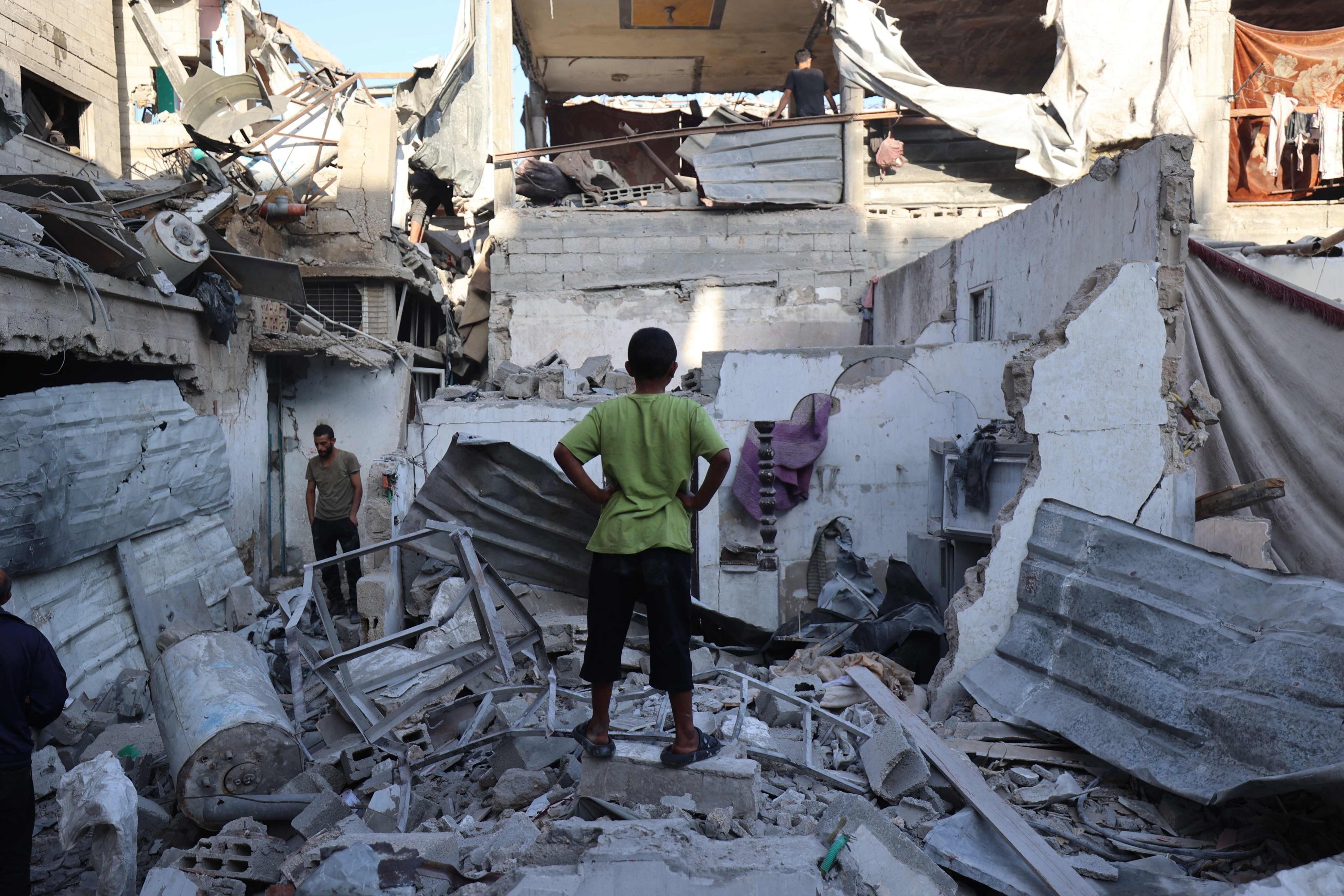
The European Union on Monday said possible sanctions against Israel remain under consideration to maintain pressure for full enforcement of the Gaza cease-fire.
"The cease-fire has changed the context, that is very clear for everybody," the bloc’s foreign policy chief Kaja Kallas said after a meeting of EU foreign ministers in Brussels.
"However, unless we see real and sustained change on the ground, including more aid reaching Gaza, the threat of sanctions remains on the table".
Brussels proposed measures against Israel including blacklisting ministers and curbing trade ties before a truce deal to halt Israel’s war on Gaza was brokered by U.S. President Donald Trump.
"We don't move with the measures now, but we don't take them off the table either, because the situation is fragile," Kallas said.
She said the EU wanted to see Israel take a raft of steps including "the improvement of humanitarian aid reaching Gaza", handing revenues to the Palestinians, allowing journalists into Gaza and registering NGOs.
Israel had been pushing the EU to ditch the proposed measures if the bloc wants to play a greater role in the peace process.
Even before the cease-fire deal, divisions within the EU's 27 countries meant they were not able to find a majority to take the steps proposed by Brussels.
The cease-fire deal came under strain on Sunday when the Israeli military struck dozens of what it claimed to be Hamas positions across Gaza after the group allegedly killed two of its soldiers.
"The cease-fire in Gaza has just faced its first major stress test," Kallas said.
"Hamas attacks on Palestinian civilians and its refusal to disarm make the cease-fire increasingly fragile."
The EU, the biggest international donor to the Palestinians, is weighing up how it can increase its involvement in post-war Gaza.
Brussels has reactivated a mission to help supervise the Rafah crossing between Gaza and Egypt, but it is still on hold while Israel keeps the route closed.
According to the Gaza Government Media Office, Israel has committed 80 violations of the cease-fire agreement since Oct. 10, resulting in the death of 97 Palestinians, the injury of 230 others, and the arrest of dozens of civilians.
These assaults were carried out by military vehicles and tanks stationed on the outskirts of residential neighborhoods, as well as electronic cranes equipped with remote sensing and targeting systems, the office said, noting that warplanes and drones continue to fly daily over populated areas, directly shooting and targeting civilians.
Twenty-one of these violations occurred on Sunday alone, as Israel bombed areas west of the yellow line, which was claimed to be safe, killing 44 Palestinians, Ismail Al-Thawabta, director of the media office, told Anadolu Agency (AA).
Hamas also reported several Israeli violations regarding military activity beyond the yellow line, citing artillery and drone attacks on civilians seeking to return to their homes.
Hamas described the Israeli attacks on Palestinians along the line as "full-fledged crimes that expose the (Israeli) occupation's premeditated intent to target unarmed civilians without justification."
The group called on U.S. President Donald Trump and mediators to follow up on the Israeli violations and compel Tel Aviv to respect the ceasefire agreement and stop endangering Palestinian lives.
Israel and Hamas agreed to the first phase of the deal, which took effect on Oct. 10. The agreement was brokered with the help of the U.S., Türkiye, Qatar, and Egypt.
Since October 2023, Israel's genocidal war has killed more than 68,000 people and injured more than 170,000, according to the Gaza Health Ministry.