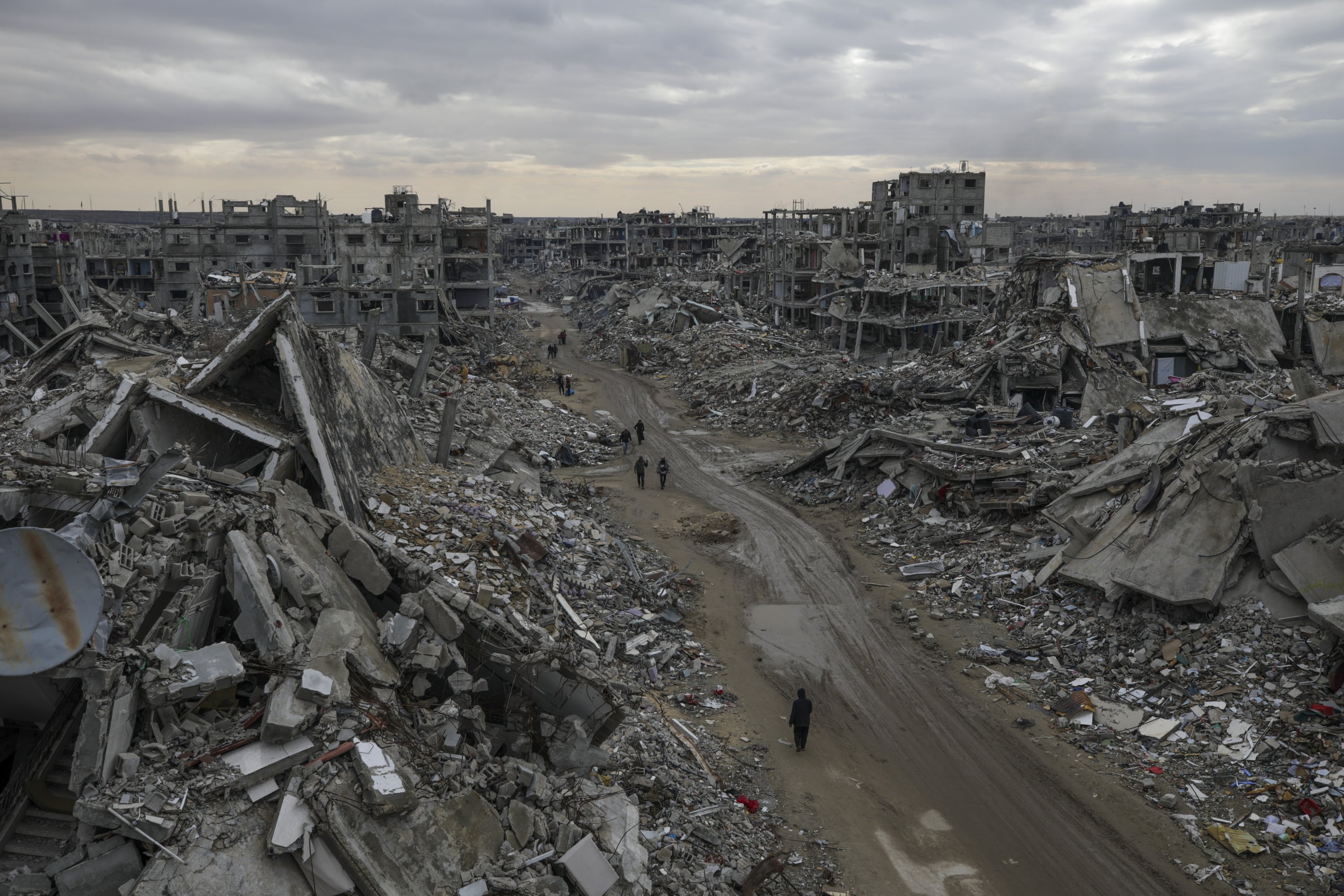
Israel launched airstrikes on Gaza on Sunday, Israeli media reported, undermining hopes that a week-old U.S.-brokered cease-fire would hold as both Israel and Hamas traded blame for renewed violence.
Israel's military said in a statement that the strikes targeted Palestinian resistance members in the Rafah area who had opened fire on its soldiers. It said the attacks destroyed tunnels and military buildings.
Israeli Prime Minister Benjamin Netanyahu said Israel would retaliate forcefully to Hamas attacks on its soldiers.
Senior Hamas member Izzat al-Risheq denied the Israeli claim, stressing his group's commitment to the cease-fire agreement, which he accused Israel of violating by "fabricating flimsy pretexts to justify its crimes."
Hamas' military wing, meanwhile, said that it remained committed to the cease-fire agreement in all of Gaza, adding that it was unaware of clashes in Rafah and that it has not been in contact with groups there since March.
"We affirm our full commitment to implementing all agreements, foremost among them the cease-fire across all areas of the Gaza Strip," the Al-Qassam Brigades said.
Palestinian witnesses on Sunday separately told Reuters of explosions and gunfire in Rafah, tank fire in the southern town of Abassan near Khan Younis, an airstrike in the central town of Zawayda and explosions in the central town of Deir al-Balah, which killed at least five people, according to medics at Al-Aqsa Hospital.
Witnesses in Khan Younis heard a wave of airstrikes launched into Rafah early Sunday afternoon.
8 Gazan killed
Gaza's Health Ministry said Sunday that Israeli attacks had killed at least eight people in the last 24 hours. An Israeli military official said earlier Sunday that Hamas had carried out multiple attacks against Israeli forces inside Gaza, including a rocket-propelled grenade attack and a sniper attack against Israeli soldiers.
"Both of the incidents happened in an Israeli-controlled area ... This is a bold violation of the cease-fire," the official said.
Defense Minister Israel Katz said the "yellow line" to where Israeli forces had pulled back under the cease-fire agreement would be physically marked and that any violation of the cease-fire or attempt to cross the line would be met with fire.
The impact of the Israeli strikes Sunday, the most serious test since an already fragile cease-fire took effect on Oct. 11, was not immediately clear.
The government media office in Gaza said on Saturday that Israel had committed 47 violations after the cease-fire deal, leaving 38 dead and 143 wounded.
"These violations have ranged from direct shooting at civilians, to deliberate shelling and targeting operations, as well as the arrest of several civilians," the media office statement said.
The Israeli government and Hamas have been accusing each other of violations of the cease-fire for days, with Israel saying the Rafah border crossing between Gaza and Egypt will remain closed until further notice.
Rafah has largely been shut since May 2024. The cease-fire deal also includes the ramping up of aid to Gaza, where hundreds of thousands of people were determined in August to be affected by famine, according to the IPC global hunger monitor.
The crossing has in previous cease-fires, functioned as a key conduit for humanitarian aid to flow into the enclave.
Israel and Hamas have been engaged in a dispute over the return of the bodies of deceased hostages. Israel demanded that Hamas fulfill its obligations in turning over the remaining bodies of all 28 hostages.
Hamas has returned all 20 living hostages and 12 of the deceased, but said the process needs effort and special equipment to recover corpses buried under rubble.
Formidable obstacles to Trump's plan to end the war still remain. Key questions of Hamas disarmament, the governance of Gaza, the make-up of an international "stabilization force," and moves toward the creation of a Palestinian state have yet to be resolved.
The U.S. embassy in Jerusalem did not immediately respond to a request for comment.
Renewed fighting in Gaza and concerns over the cease-fire pushed key Tel Aviv share indices down nearly 2% on Sunday.