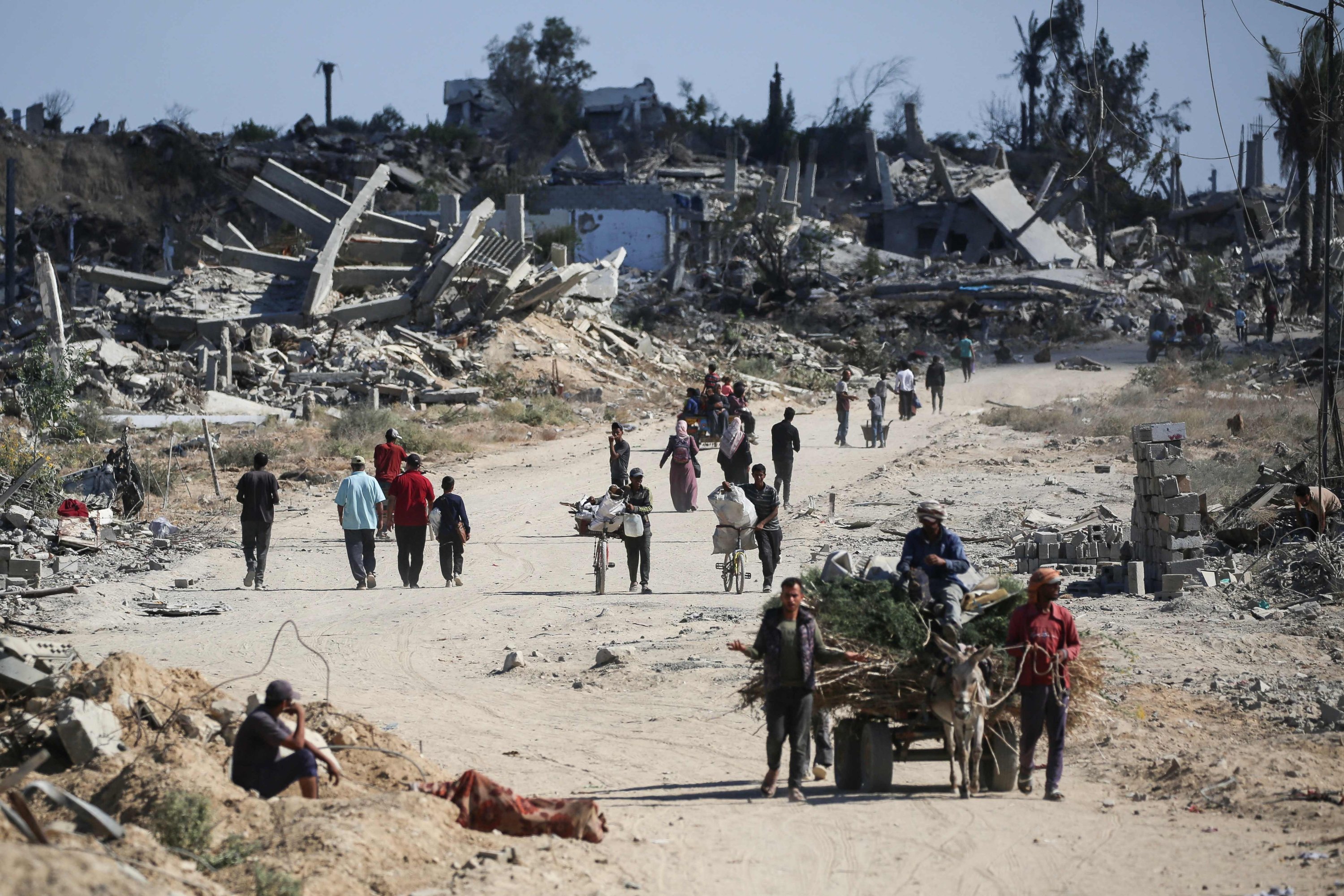
The fragile cease-fire in Israel's two-year genocidal war on Gaza held firm Tuesday, a day after the return of the last 20 living Israeli captives from Gaza and the release of hundreds of Palestinian prisoners, though significant challenges remain unresolved.
The list of more immediate questions includes those on when Hamas will return to Israel the bodies of the 24 hostages believed to be dead in Gaza, as well as the health conditions of the released hostages and freed Palestinians.
Only four of the deceased hostages – whose release is also part of the first phase of the cease-fire deal brokered by U.S. President Donald Trump – were turned over to Israeli authorities on Monday. On Tuesday, the Israeli military identified two of them - Guy Illouz from Israel and Bipin Joshi, a student from Nepal.
The two men were both in their 20s when they were taken captive during the Hamas-led Oct. 7, 2023, incursion that ignited the war – Illouz from the Nova music festival and Joshi from a bomb shelter.
Israel said Illouz died of his wounds while being held captive without proper medical treatment, while Joshi died in captivity in the first months of the war – adding that the National Center of Forensic Medicine would later provide the final cause of death.
The freed Israeli hostages were in medical care on Tuesday and some families said it would be weeks before the men could go home. In the West Bank and Gaza, where hundreds of prisoners were released, several were also taken to hospitals.
Separately, the Israeli military said troops in the northern Gaza Strip had "opened fire to remove the threat" of several people approaching them on Tuesday across the "yellow line" and not complying with orders to stop. It didn't immediately comment on any casualties in the incident.
Gaza's local health authority, meanwhile, said the Israeli military killed six Palestinians in two separate incidents across the enclave on Tuesday.
Part of the cease-fire agreement is that Israel would pull back in Gaza to the so-called yellow line where its forces were in August, before launching their latest offensive in Gaza City in the strip's north.
Longer-term issues also hang in the balance, including whether Hamas will disarm, who will govern and help rebuild Gaza and the overarching question of Palestinian statehood, which is central for Palestinians and many countries in the region.
"The first steps to peace are always the hardest," Trump had said as he stood with foreign leaders in Egypt on Monday for a summit on Gaza's future. He hailed the cease-fire deal he brokered between Israel and Hamas as the end of the war in Gaza - and start of rebuilding the devastated territory.
On Tuesday, the U.N. development agency said the latest joint estimate from the U.N., the European Union and the World Bank is that $70 billion will be required to rebuild Gaza. Jaco Cillers, special representative of UNDP administrator for a program to help Palestinians, said $20 billion would be needed in the next three years, and the rest would be needed over a longer period - possibly decades.
In Egypt, Trump urged regional leaders to "put old feuds aside” as world leaders met to discuss the challenges ahead in securing a lasting peace. Representatives from Israel or Hamas were not at the summit.
Hamas security forces were re-establishing control over Gaza's ruined cities Tuesday, even as global support mounted for a U.S.-backed deal that would see them disarmed.
When busloads of prisoners freed from Israeli jails arrived in Gaza on Monday, fighters from Hamas's Ezzedine al-Qassam Brigades provided crowd control.
In the north of the territory, as Israeli forces withdrew from Gaza City, the Hamas government's black-masked armed police resumed street patrols.
Meanwhile, a Hamas security unit has been conducting operations against armed clans and gangs, some alleged to have Israeli backing.
"Intense clashes broke out – and are still ongoing at the moment – as part of efforts to eliminate collaborators," said witness Yahya, who asked not to be named in full for fear of retribution.
Another Gaza resident, Mohammed, told AFP: "For long hours this morning, there were heavy clashes between Hamas security forces and members of the Hilles family."
The fighting was in Shujaiya, in the east of Gaza City, close to the so-called Yellow Line, behind which Israeli units still hold roughly half of Gaza.
"We heard intense gunfire and explosions and the security forces arrested some of them. We support this," Mohammed said, also asking not to be named in full.
A Palestinian security source in Gaza told AFP that Hamas's security body, a recently established unit whose name translates as "Deterrence Force," was conducting "ongoing field operations to ensure security and stability."
"Our message is clear: There will be no place for outlaws or those who threaten the security of citizens," he said.