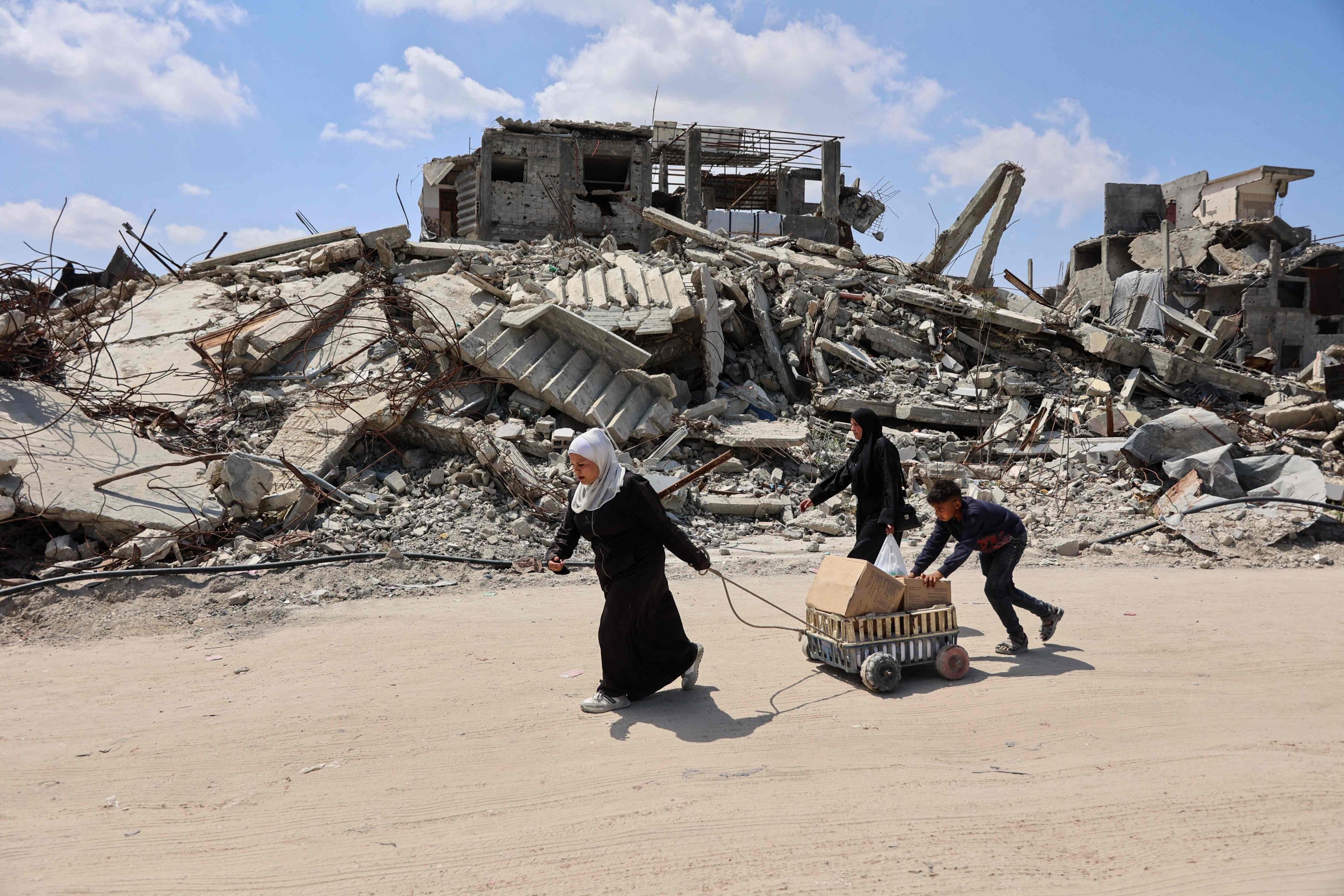
More than $71 billion will be needed over the coming decade to support recovery and reconstruction efforts in Gaza devastated by two years of Israeli attacks, an assessment by the EU and the U.N. revealed Monday.
In their final Gaza Rapid Damage and Needs Assessment (RDNA), the United Nations and the European Union said that more than two years of Israeli war in the Palestinian territory "has led to unprecedented loss of life and a catastrophic humanitarian crisis".
"Recovery and reconstruction needs are estimated at around $71.4 billion," said the assessment, developed in coordination with the World Bank.
Much of Gaza, including schools, hospitals and other civic infrastructure, has been reduced to rubble by a withering Israeli military offensive retaliating to the Hamas attack on Oct. 7, 2023.
The final assessment determined that $26.3 billion would be required in the first 18 months to restore essential services, rebuild critical infrastructure and support economic recovery.
"Physical infrastructure damages are estimated at $35.2 billion, with economic and social losses amounting to $22.7 billion," a joint statement said.
Israeli military campaign has killed more than 72,000 people in Gaza, mostly civilians, according to the territory’s health ministry. Gaza is under a fragile cease-fire agreed last October, although Israel has repeatedly violated the agreement, killing over 770 Palestinians and injuring over 2,100 since then.
According to the RDNA, some 371,888 housing units have been destroyed or damaged, more than 50 percent of hospitals in the territory are non-functional and nearly all schools have been destroyed or damaged.
At the same time, 1.9 million people, nearly Gaza's entire population, have been displaced, often multiple times, and more than 60 percent of the population had lost their homes, the assessment found.
Gaza's economy has contracted by 84%, it said.
"The scale and extent of deprivation across living conditions, livelihoods/income, food security, gender equality, and social inclusion, have pushed back human development in the Gaza Strip by 77 years," the assessment said.
The U.N. and the EU stressed that "given the immense scale of need, recovery efforts must run in parallel with humanitarian action" in Gaza, ensuring a "transition from emergency relief toward reconstruction at scale".
They insisted that the recovery and reconstruction needed to be "Palestinian-led", and incorporate approaches that actively support the transfer of governance to the Palestinian Authority, in accordance with U.N. Security Council resolution 2803.
That resolution, which was adopted last November, welcomed the creation of U.S. President Donald Trump's Board of Peace to support Gaza's reconstruction.
The U.N. and the EU also emphasized that "a set of enabling conditions" were needed for the resolution to be implemented effectively on the ground.
They included in particular "a sustained ceasefire and adequate security", as well as "unimpeded humanitarian access and immediate restoration of essential services," and "free movement of people, goods, and reconstruction materials, within and between Gaza and the West Bank".
Without such conditions, they warned, "neither recovery nor reconstruction can succeed".