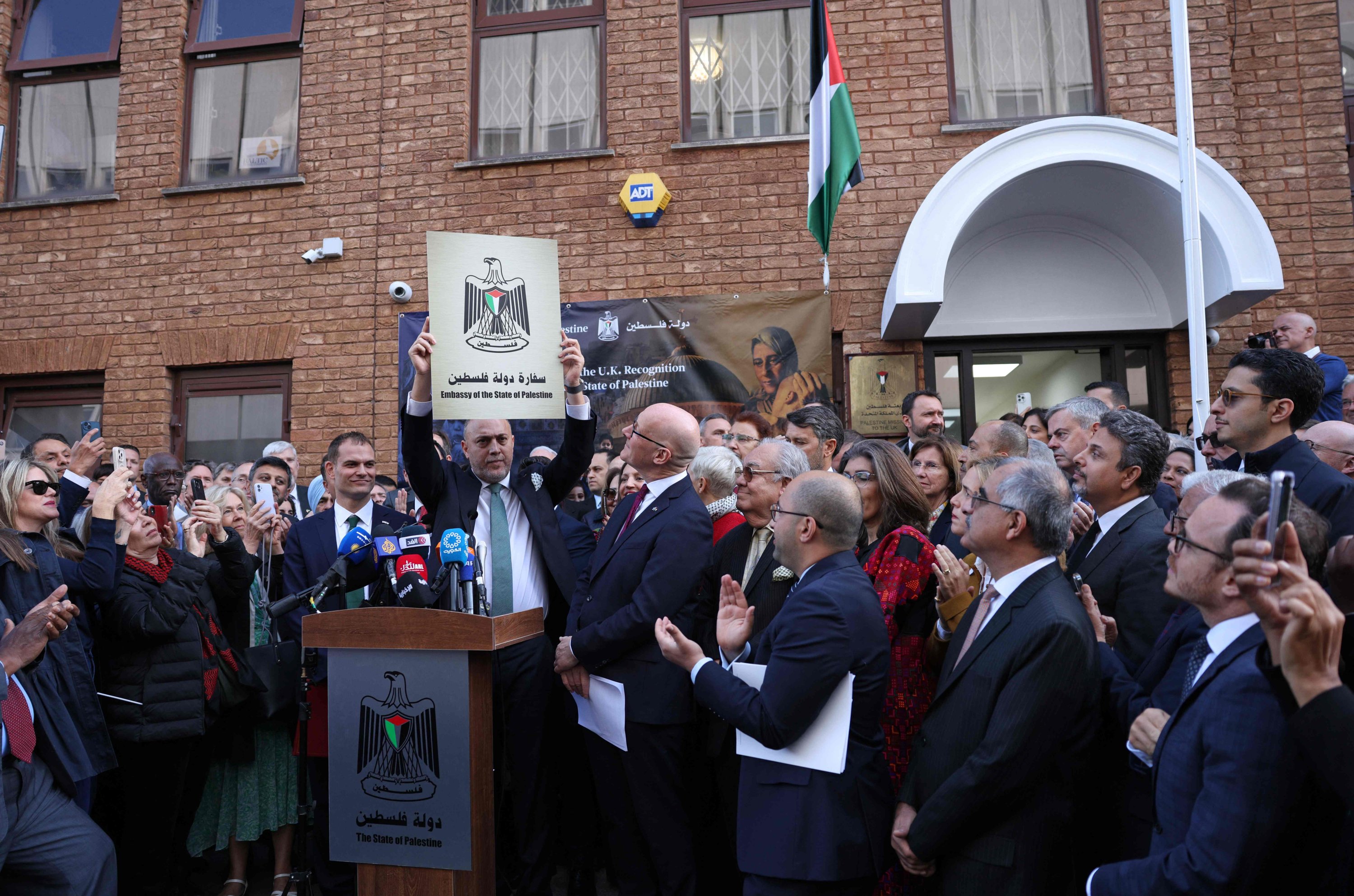
Four major Western countries – the U.K., Canada, Australia and Portugal – formally recognized Palestine on Sunday, marking a significant milestone for Palestinian statehood ahead of the U.N. General Assembly, where more countries are expected to follow suit.
The growing wave of recognition has been welcomed across much of the international community, viewed as part of a wider push to halt Israel's ongoing genocidal war on Gaza. Yet analysts cautioned that while these symbolic moves carry weight diplomatically, recognition alone will not bring meaningful change for Palestinians facing daily realities of occupation and siege.
"The Israeli occupation is an incredibly aggressive and violent one. So, the question isn't simply do we recognize that there are people that deserve the right of self-determination in terms of a state – the question is how do we stop the ongoing aggression and war crimes being perpetrated against those people by the occupier," H.A. Hellyer, a senior associate fellow at the Royal United Services Institute (RUSI) think tank, told Türkiye's Anadolu Agency (AA).
Given the U.K.'s historical role in Palestine, Hellyer emphasized that its decision to extend recognition is "very symbolic."
"The concern I think that many have is that this recognition would not be followed by actual policy steps on the ground to ensure that the occupation of the state of Palestine ends," he said.
The Palestine Liberation Organization declared an independent Palestinian state in 1988, and most of the global South quickly recognized it. Today, about 150 of the 193 U.N. member states have done so.
Israel's main ally, the United States, has long said it supports the goal of a Palestinian state, but only after the Palestinians and Israel agree on terms for a two-state solution at negotiations. Until recent weeks, the major European powers shared this position.
However, no such Israeli-Palestinian negotiations have been held since 2014, and Israeli Prime Minister Benjamin Netanyahu has now said there will never be a Palestinian state.
A delegation representing the State of Palestine has observer status at the United Nations – but no voting rights. No matter how many countries recognize Palestinian independence, full U.N. membership would require approval by the Security Council, where Washington has a veto.
Palestinian diplomatic missions worldwide are controlled by the Palestinian Authority, which is recognized internationally as representing the Palestinian people.
The PA, led by President Mahmoud Abbas, exercises limited self-rule in parts of the Israeli-occupied West Bank under agreements with Israel. It issues Palestinian passports and runs the Palestinian health and education systems.
The Gaza Strip has been administered by the resistance group Hamas since 2007, when it drove out Abbas's Fatah movement after a brief civil war.
Palestinian diplomatic missions in countries recognizing a Palestinian state are expected to be upgraded to the full status of embassies. But countries are not expected to be able to open new, fully-fledged embassies in the Palestinian territories, where Israel controls access.
Around 40 countries have consulates or representative offices either in the PA's West Bank base, Ramallah or in parts of Jerusalem captured by Israel in 1967, where the Palestinians hope to have their capital.
Israel considers all of Jerusalem its own undivided capital. Fully-fledged embassies in Israel are mostly located in Tel Aviv, although the United States moved its embassy to Jerusalem during President Donald Trump's first term.
Countries moving to recognize a Palestinian state say the move is intended to put pressure on Israel to end its devastating assault on Gaza, curtail the building of new Jewish settlements in the occupied West Bank and recommit to a peace process with the Palestinians.
French President Emmanuel Macron, the first leader of a major Western power to endorse recognition, said the move would be accompanied by a commitment by the PA to enact reforms, which would improve Palestinian governance and make it a more credible partner for the post-war administration of Gaza.
Those who see recognition as a mere gesture point to the limited influence in the conflict of countries such as China, India, Russia and many Arab states that recognized Palestinian independence decades ago.
Without a full seat at the U.N. or control of its own borders, the PA has only limited ability to conduct bilateral relations.
Israel restricts access to goods, investment and educational or cultural exchanges. There are no Palestinian airports. The landlocked West Bank can be reached only through Israel or through the Israeli-controlled border with Jordan, and Israel now controls all access to the Gaza Strip since capturing Gaza's border with Egypt during the ongoing war.
Still, countries planning recognition and the PA itself say it would be more than an empty gesture.
Husam Zomlot, head of the Palestinian mission to the U.K., said it could lead to partnerships between entities on an equal footing.
It might also force countries to review aspects of their relationships with Israel, said Vincent Fean, a former British diplomat in Jerusalem.
In Britain's case, this might result in banning products that come from Israeli settlements in the occupied Palestinian territories, he said, even though the practical impact on the Israeli economy would be minimal.
RUSI's Hellyer added that Western countries have various other tools at their disposal to ramp up pressure on Israel.
"These include trade embargoes. These include the ending of military-to-military relations. There is actually quite a long list of different types of sanctions that could be implemented if the U.K. and other European states chose to do so."
However, he emphasized the role of the U.S. in any efforts to rein in Israel: "I think the biggest problem relates to the fact that the most effective leverage point would come from the U.S., which is hitherto unwilling to use any of that leverage."
Washington's stance in support of Israel is also a deterring factor for European nations, he explained.
"The concern of European states, including the U.K., is that if they were to go too far outside of the lines that the U.S. has drawn, it would cause damage in terms of relations between the U.S. and the U.K., the U.S. and the EU, and European states more generally, at a time when they feel that they really need the U.S. for their own security architecture," said Hellyer.