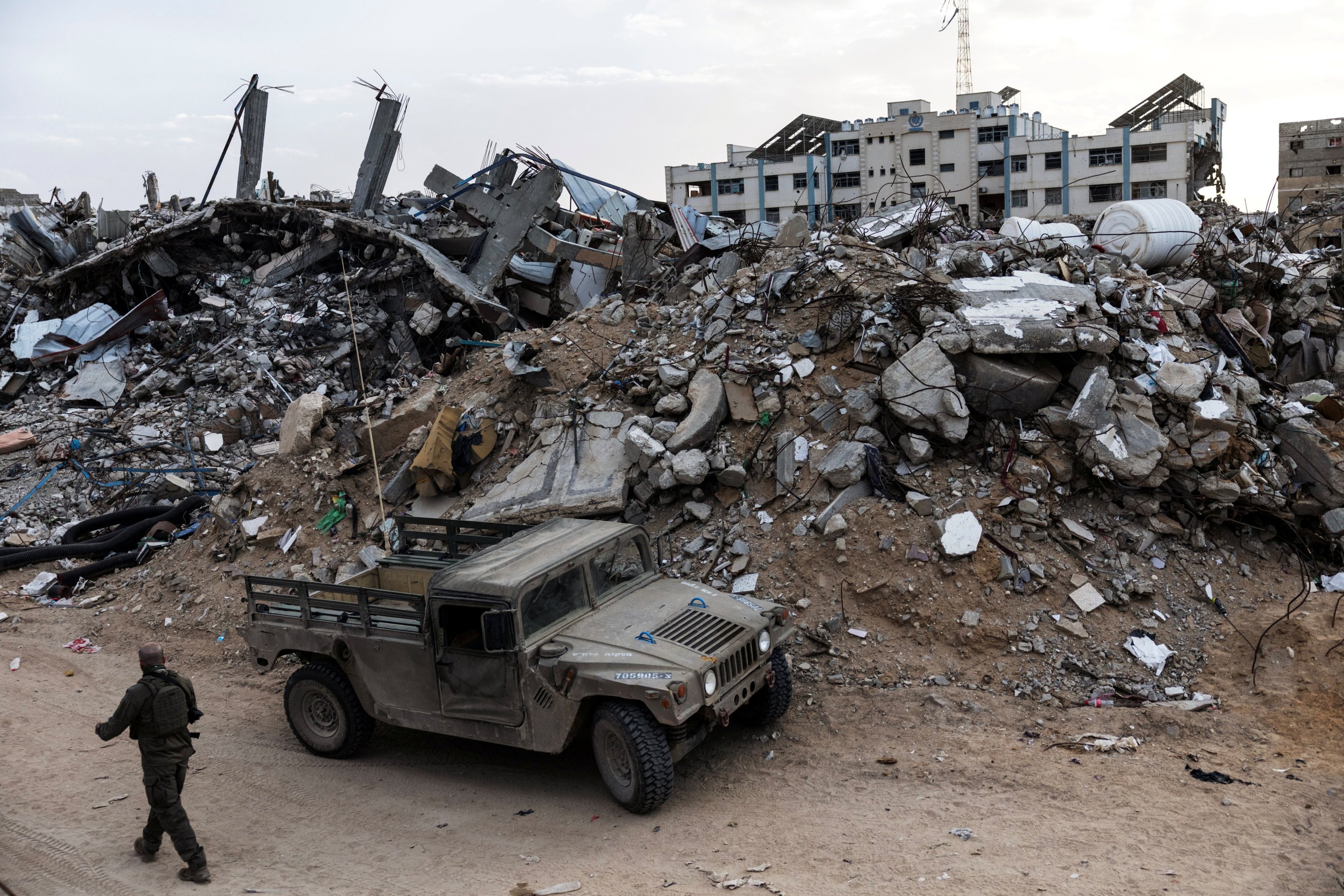
Israel will never withdraw all its troops from the Gaza Strip, Defense Minister Israel Katz said during a conference arranged by a pro-settler newspaper on Thursday, vowing to create a broad security zone around the Palestinian enclave and allow settlement building in the territory's north.
"In Gaza, Israel will never fully withdraw. There will be a significant security area inside the Gaza Strip," Katz said.
This would remain the case, even in the event of a transition to the second phase of U.S. President Donald Trump's peace plan and disarmament by Palestinian resistance group Hamas, he added.
The security zone would run within the Gaza Strip, Katz said. He added that in the northern part of the coastal strip, Israeli settlement cores could be created that he claims would protect the security zone.
Katz, a member of the Prime Minister Benjamin Netanyahu's right-wing Likud party, was once again contradicting elements of the Trump peace plan, which provides for a phased withdrawal of all Israeli troops from the Gaza Strip.
Following criticism of similar remarks made on Tuesday, Katz initially appeared to draw back. But on Thursday he told the conference: "Reverse is something that I only do when driving."
He said Israel would exercise "de facto sovereignty" in Gaza, similar to what he described as Israel's policy in the occupied West Bank.
Israel launched a brutal war on Gaza in October 2023, with U.S. backing, killing more than 71,000 Palestinians and wounding more than 171,000 others, most of them women and children.
A cease-fire based on a proposal advanced by Trump took effect on Oct. 10, but Israel has violated it daily, resulting in the death of 411 Palestinians.
Katz said it would be possible to establish Nahal outposts in northern Gaza "in an organized manner when the time comes."
Nahal outposts are youth-based settlement frameworks overseen by the Israeli army's Nahal Brigade that combine military service with settlement activity, according to Israeli media.
Since the start of the war in Gaza, Israel has intensified actions aimed at annexing the occupied West Bank, including home demolitions, forced displacement and settlement expansion, according to Palestinian authorities.
Annexation of the West Bank would effectively end prospects for a two-state solution to the Palestinian-Israeli conflict as envisioned in U.N. resolutions.
About 750,000 illegal Israeli settlers live in hundreds of settlements across the West Bank, including about 250,000 in occupied East Jerusalem. Settlers carry out near-daily attacks against Palestinians in efforts to force them from their land, Palestinian officials say.
Katz said his vision since the start of the Gaza war has included establishing Nahal military sites in northern Gaza, along with religious schools and other facilities.
On the West Bank, Katz said Israel is implementing a policy of "practical sovereignty," adding that current conditions do not allow for a formal declaration of annexation, including Palestinian displacement, troop deployment and settlement expansion.
Palestinian authorities have long urged the international community to pressure Israel to halt settlement activity in occupied territories, which the United Nations considers illegal.
On Tuesday, Katz told settler leaders that Nahal outposts would be established in northern Gaza on land where settlements evacuated in 2005 once stood. Those remarks contradicted Trump's plan calling for a full Israeli military withdrawal from Gaza.
Israeli media reported that Washington conveyed surprise and anger to Netanyahu's government over Katz's comments. At the premier's request, the defense minister later said the government was not seeking to establish settlements in Gaza, a statement widely seen as a retreat before he reiterated his position on Thursday.
Israeli media warned that Katz's remarks could complicate Netanyahu's planned visit to Florida, where he is expected to meet Trump on Dec. 29.
Israel rejects withdrawal or the establishment of an independent Palestinian state with East Jerusalem as its capital on borders that predate the 1967 war.