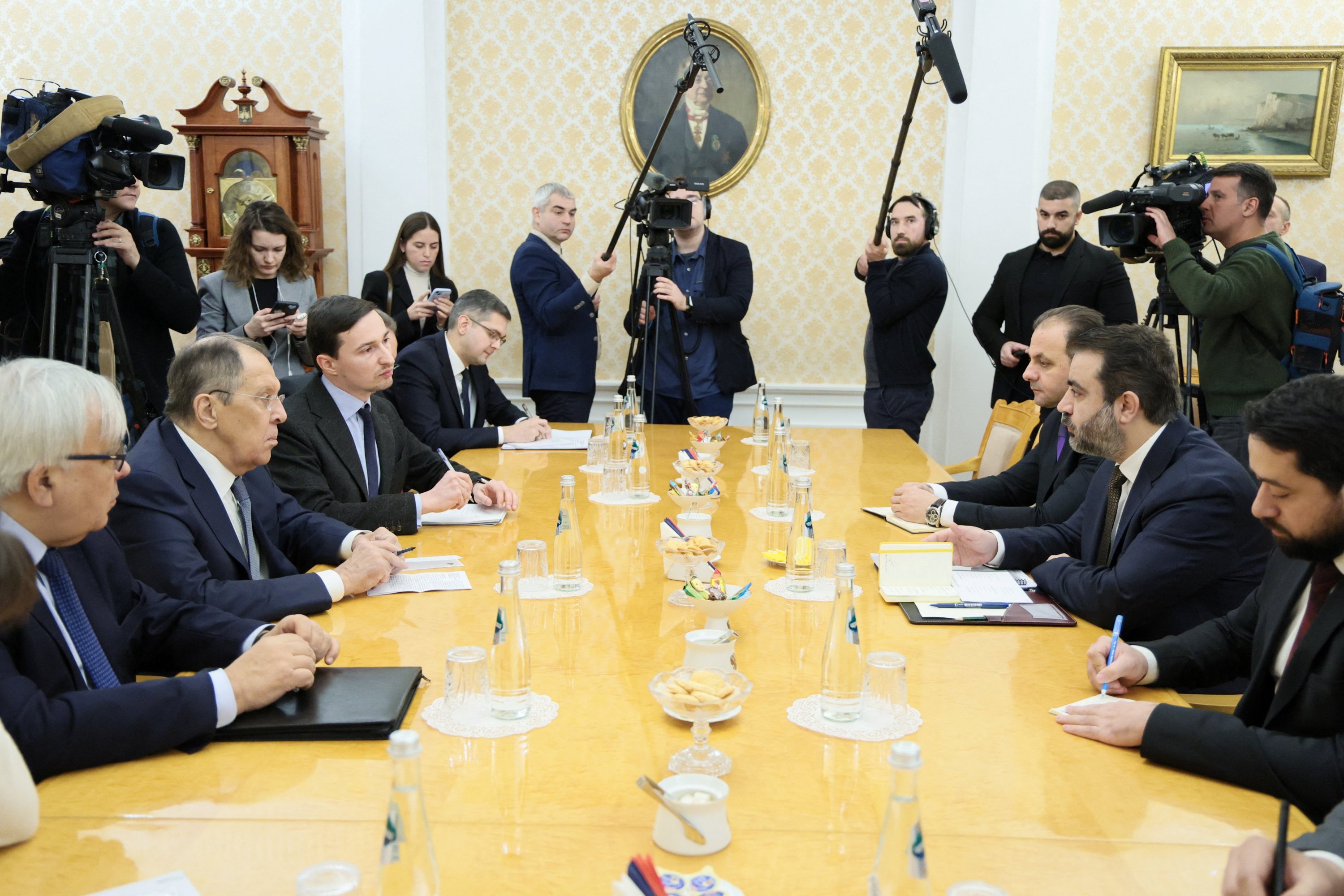
Syrian Foreign Minister Asaad al-Shaibani and Defense Minister Murhaf Abu Qasra met with Russian President Vladimir Putin in Moscow on Tuesday, according to Syria's official news agency SANA.
The meeting addressed a range of political, military and economic issues of mutual concern, with a particular focus on strategic cooperation in the military and defense industry, it added.
The talks also explored prospects for expanding economic and trade cooperation, including support for reconstruction projects, the development of infrastructure sectors, the encouragement of investments in Syria, boosting trade exchange and facilitating partnerships, steps expected to impact the Syrian economy and improve living conditions positively, reported SANA.
On the political front, the two parties discussed recent developments in regional and international conditions and emphasized the importance of political and diplomatic coordination between Damascus and Moscow within international forums.
Putin reaffirmed Russia's firm support for Syria, emphasizing the importance of preserving Syria's territorial integrity and full sovereignty and rejecting any projects aimed at dividing the country or undermining its independent national decision-making, the agency said.
He also reiterated Moscow's rejection of Israel's repeated violations of Syrian territory, describing them as a direct threat to regional stability and security, it added.
The visit comes less than two days after the visit of a high-level Turkish delegation to Damascus, headed by Foreign Minister Hakan Fidan, National Defense Minister Yaşar Güler and National Intelligence Organization (MIT) Director Ibrahim Kalın, where discussions were held regarding the issue of the integration of the U.S.-backed terrorist group YPG into the Syrian army.
Later Wednesday, al-Shaibani met with Russian Foreign Minister Sergey Lavrov where they emphasized that Russia-Syria ties are entering an advanced phase of development.
Speaking at the meeting, Shaibani emphasized that Russia-Syria ties are entering an advanced phase of development.
"The past year was significant for Syria, first of all, this year marked the end of the war that lasted 14 years, and the end of the previous regime. The most important success we have achieved over the past year is the lifting of sanctions against Syria," he said.
He underscored that the current focus of the transitional government revolves around reconstructing the nation following the conflict and fostering diplomatic balance in global affairs.
"Approximately a quarter of a million residential houses, and 4 million residential buildings have been destroyed in Syria," he said.
There also remain numerous displaced persons residing in tent settlements within northern and northeastern regions, many expressing eagerness to repatriate once suitable living conditions are established, he said.
Nearly 250,000 individuals remain unaccounted for, attributable to actions taken by the former authorities, he added.
Addressing these challenges forms the absolute priority agenda during the initial stages of Syria's transition period, according to Shaibani.
"We have also managed to stop the spread of drugs over the past year and are now trying to attract investments into the Syrian economy in order to create jobs, which is also one of the topics of our bilateral cooperation," he said.
Lavrov greeted Shaibani, who met President Vladimir Putin on Tuesday, stressing the significance of maintaining consistent dialogue between both nations.
"I know that yesterday you had a very good meeting with Russian President Vladimir Putin, during which you discussed bilateral issues, the situation in the region and practical tasks to ensure the key issue of sovereignty and territorial integrity of the Syrian Arab Republic," he said.
Lavrov invited Shaibani to use today's meeting to explore opportunities for enhancing cooperation across various fronts.