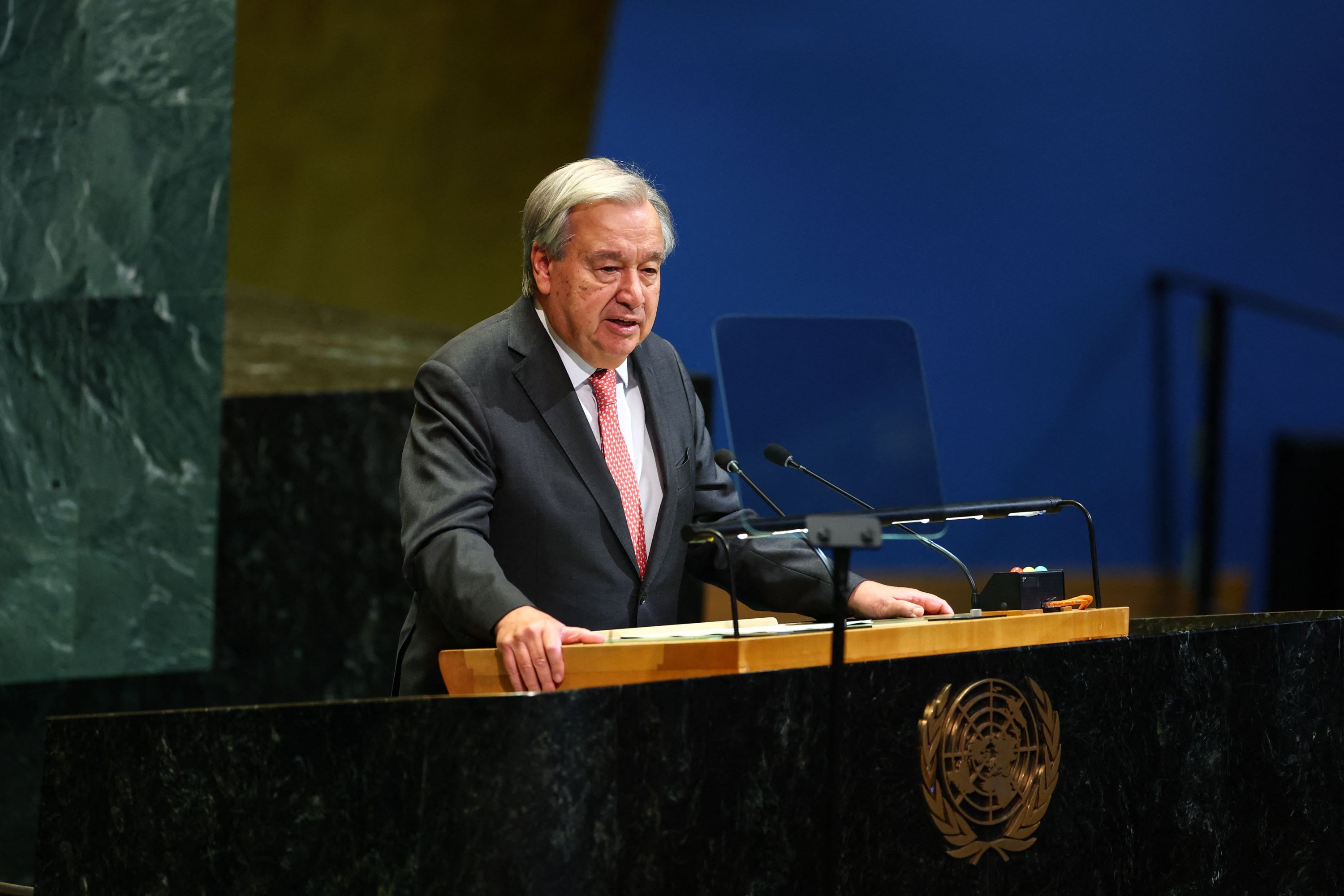
U.N. Secretary-General Antonio Guterres said Monday that Palestinian statehood “is a right, not a reward,” urging world leaders to revive efforts for a two-state solution despite Israel’s rejection of Palestinian sovereignty.
France recognized Palestinian statehood on Monday at the start of a high-profile meeting at the United Nations aimed at galvanizing support for a two-state solution to the Mideast conflict. More nations are expected to follow, in defiance of Israel and the United States.
French President Emmanuel Macron's announcement in the U.N. General Assembly hall received loud applause from the more than 140 leaders in attendance. The Palestinian delegation, including its U.N. ambassador, Riyad Mansour, could be seen standing and applauding as the declaration was made. Mahmoud Abbas, the Palestinian president, was seen applauding on a live-camera view after the U.S. government banned him from attending the U.N. gathering in person.
The United Kingdom, Canada, Australia and Portugal recognized the state of Palestine on Sunday, and the Palestinians expect a total of 10 countries to do so in the coming days. Around three-fourths of the 193-member United Nations recognize Palestine, but major Western nations had until recently declined to, saying one could only come about through negotiations with Israel.
Palestinians have welcomed the moves toward recognition, hoping they might someday lead to independence. "This is a beginning, or a glimmer of hope, for the Palestinian people,” Fawzi Nour al-Deen said Sunday as he held a bag on his head, joining thousands of people fleeing south from Gaza City. "We are a people who deserve to have a state.”
The creation of a Palestinian state alongside Israel in the West Bank, Gaza and east Jerusalem - territories occupied by Israel in the 1967 Mideast war - is widely seen internationally as the only way to resolve the conflict.
Israeli Prime Minister Benjamin Netanyahu's government opposed Palestinian statehood even before the war and now says such a move would reward Hamas. He has hinted Israel might take unilateral steps in response, including annexing parts of the West Bank, which would put a viable Palestinian state even further out of reach.
A U.N. official brushed off such threats, saying efforts to bring about a two-state solution should continue regardless of Israel's actions. "I think we have to be determined in achieving the goal that we want to achieve, and we cannot be distracted by threats and intimidation,” said U.N. spokesman Stephane Dujarric.
Netanyahu is under pressure from his far-right coalition to move ahead with annexation, but the United Arab Emirates - the driving force behind the 2020 Abraham Accords, in which the UAE and three other Arab states forged ties with Israel - has called it a "red line," without saying how it could affect the two countries' now close ties.
Netanyahu said he would decide on Israel's response to the Palestinian statehood push after meeting with President Donald Trump at the White House next week, their fourth meeting since Trump returned to office. The Israeli leader is set to address world leaders at the U.N. on Friday.
The Trump administration is also opposed to growing recognition of a Palestinian state and blames it for the derailment of cease-fire talks with Hamas. Trump's envoy, Steve Witkoff, walked away from the talks in July, and earlier this month an Israeli strike targeted Hamas negotiators in Qatar, a key mediator.