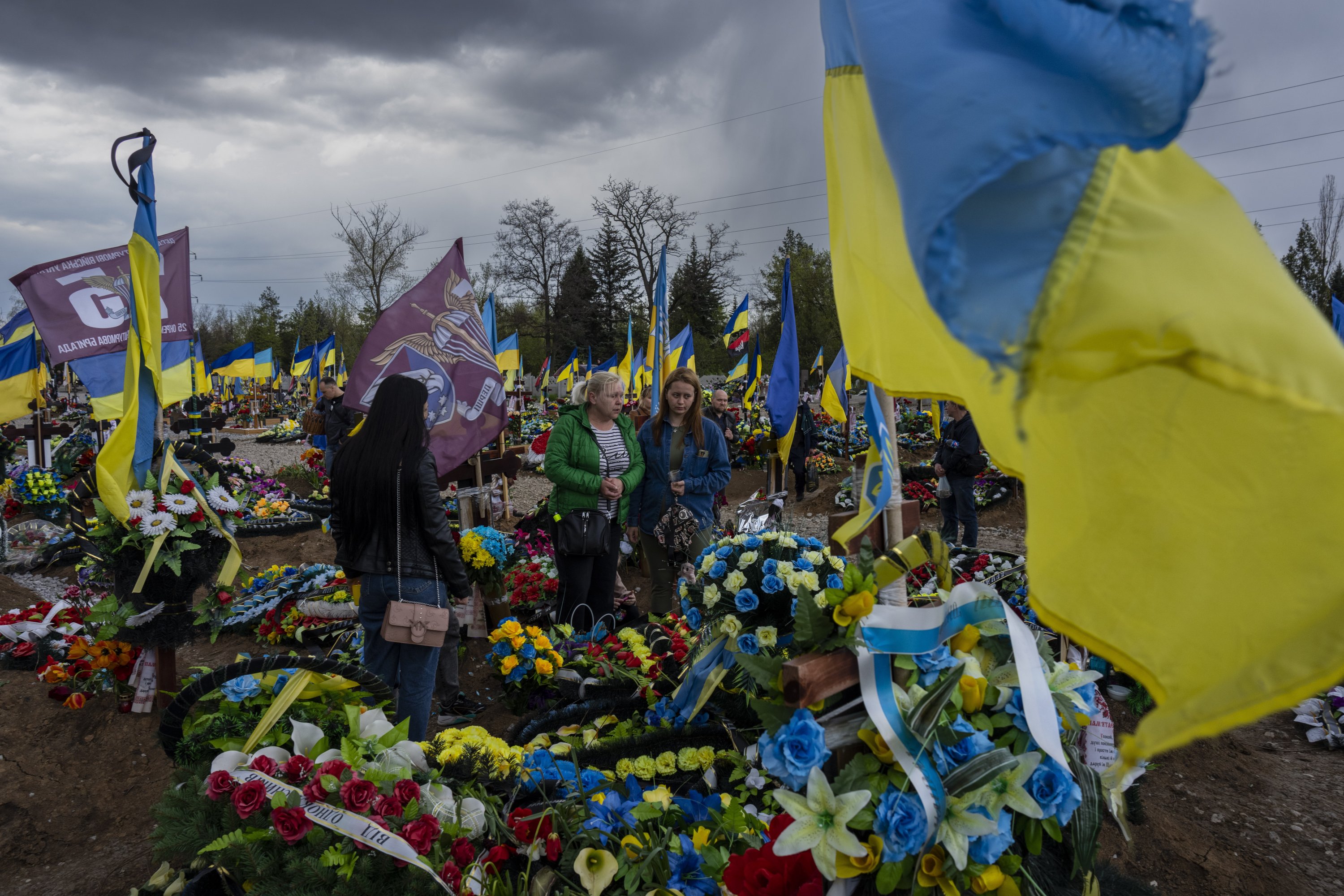
Russian aggression against Ukraine did not simply break the rule-based world order established after World War II. The invasion became another step in an attempt to get international relations back to the 19th century, to the times of the Vienna system, when Russia employed the right of conquest to become the leading "conductor" of the "Concert of Europe" and successfully played the "great game" in Central Asia.
The north-south dividing line passing through the northern Black Sea, the Caspian Sea and abutting the Altai, remains critical to the implementation of the Kremlin's plans even now. Strictly speaking, it has been a pillar of Russian imperial policy. However, for the nations that resumed their independent state-building after the Soviet Union dismantling, Russia lost its appeal as a regional center of gravity. Not least because it failed – did not try, actually – to offer its neighbors any integration project that would provide for an equal partnership and prevent Russia from gaining the position of the primary, or even the only beneficiary. The Commonwealth of Independent States (CIS), the Russian-led Collective Security Treaty Organization (CSTO), and the Eurasian Economic Union (EEU) – all these formats of multilateral cooperation in their current form are aimed at preserving this exclusivity.
However, for the Central Asian states, historically, multi-vectoring is a natural way of communicating with the outside world. Ukraine also aspired to be a multi-vector – until Russia's imperial swagger forced it to make a final choice.
Not only Ukrainians face Moscow's territorial claims as revenge for the lack of piety towards its ambitions. Both the former and the latter are known perfectly well to our friends in Kazakhstan. Both Ukrainians and Uzbeks experienced gas blackmail in dead of winter. Besides Kyiv, Bishkek is perfectly aware of the bad odds to get the Kremlin's proteges extradited and tried. In both Dushanbe and Ukrainian Crimea, they know what a powerful tool of pressure the Russian military base may be.
On top of that, I believe both a stud farmer in the Ashgabat area and the Bucha equestrian club owner agree on the kind of punishment that racehorse murderers deserve. Meanwhile, a joke about Moscow's habit of burying the logistics and energy transport projects created without Russia does not need to be explained to anyone living anywhere along the ancient Silk Road. And commonly understood is sarcasm toward "protecting the Russian-speaking population."
There is much more in common between Ukraine and the states of Central Asia than it seems. Of course, we are not talking about gastronomic sympathies for manti, shawarma, borscht and dumplings. Yurts of invincibility in Ukrainian cities are a reminder of the joint liberation struggle after the collapse of the Romanov empire, of joint pain from the Holodomor in the fertile steppes of the West and East, and of the desire to protect one's way of life. Ukrainians highly appreciate this help. Special thanks for voting on Ukrainian resolutions at the U.N. We realize that in certain circumstances even "abstaining" is a manifestation of courage, not to mention a systematic voice "pro."
I know that information about events in Ukraine often reaches the states in the region with huge distortions due to the overwhelming Russian presence in their information field. Sometimes it is not easy to understand what is happening. But there is a way out: Watch the Soviet "White Sun of the Desert" movie again. Ask yourself how the Red Army soldier Fyodor Sukhov was brought from Samara to Turkestan. What was he doing there? The answer is on the surface: He was doing perfectly the same thing as Alexander Sukhov from Tver, who was killed in Ukraine last year. He brought us "Russian peace" with weapons in his hands. Simply put, he was a conqueror, not a liberator.
What is happening in Ukraine is not a proxy conflict between Moscow and Washington, as presented by Russian propaganda. We are the people, not proxies. Everything is simple in this war: There is an aggressor and there is a victim of aggression. The victim has the right to defend himself in all ways available. In particular, seeking support abroad. But we would not need it if Russia were not obsessed with "greatness." In the modern world, greatness is measured by the level of medicine, the quality of education and cutting-edge technologies, and not by conquests. However, people from the past cannot comprehend this benchmark.
Russia has not been able to impose its will on us either in nine years of creeping aggression or in more than a year of the all-out invasion. Moreover, being unable to win a decisive victory on the battlefield and being subject to increasing sanctions pressure, Russia is getting weaker. It feels like the growing imperial overstretch. In fact, it has already irrevocably lost its place in the superpowers league.
It means that further degradation of the international security system is imminent. In particular, in Central Asia. Moscow consistently interferes with integration processes within the region to retain its decadeslong role of arbiter. This is nothing but a continuation of the imperial practice of drawing borders without taking ethnic maps into account.
Moscow has established close relations with the Afghan Taliban, despite the fact that Russia designates it as a terrorist organization. Today, many are inclined to consider such convergence as a stabilizing factor. But what will happen next? Given the long history of the Kremlin's use of radical movements, the question is easy to answer. Trying to build a "cheaper" empire, President Vladimir Putin-era Russia repeatedly resorts to the racketeering strategy: The Kremlin tends to create a problem, and then offers its (by default – non-alternative and very expensive) services to solve it.
Ukraine is fighting for the restoration of a world living by the rules. We strive to build an international relations system ensuring safety for all and not just the premier geopolitical league members. We aspire to a reliable peace where the right to determine one's future is guaranteed by effective security mechanisms, and the aggressor is certainly punished. A comprehensive sanctions policy against Russia and those who, for reasons of financial or political gain, help it circumvent restrictions is one of the elements of this system. Justice needs protection, and we thank all the countries, including those of Central Asia, that block the terror state's attempts to restore its military strength undermined in Ukraine.
Russia is finally discrediting itself as a mediator between East and West. Instead, Ukraine has every chance to be at global crossroads – both as a key element of Eurasian security and as a transit state. Given the scale of destruction caused by the Russian barbarians – as the world's largest construction site, we are open to offers.
Russians are so fond of German historian Karl Hampe's saying, "History knows no 'if,'" that they attribute the quote to Joseph Stalin with their usual contempt for intellectual property rights. But hardly anywhere else in the modern world this aphorism is tried to be refuted more than in Russia itself. During Putin's "reign," alternative history became both the most popular literary genre and a leading imperative in politics. The Kremlin's logic is not to restore the empire's long-lost glory, might and greatness, but to create the empire's image in modernity.
Ukraine's logic is that this aggressive chimera can only be opposed by truth, a real partnership and dialogue on equal terms, based on mutual respect of cultures and sovereign states. We offer an open platform to reform international relations, and we would appreciate the Central Asian countries joining the sponsors of a new, fairer and safer world order for the common good.
*Head of the Office of the President of Ukraine