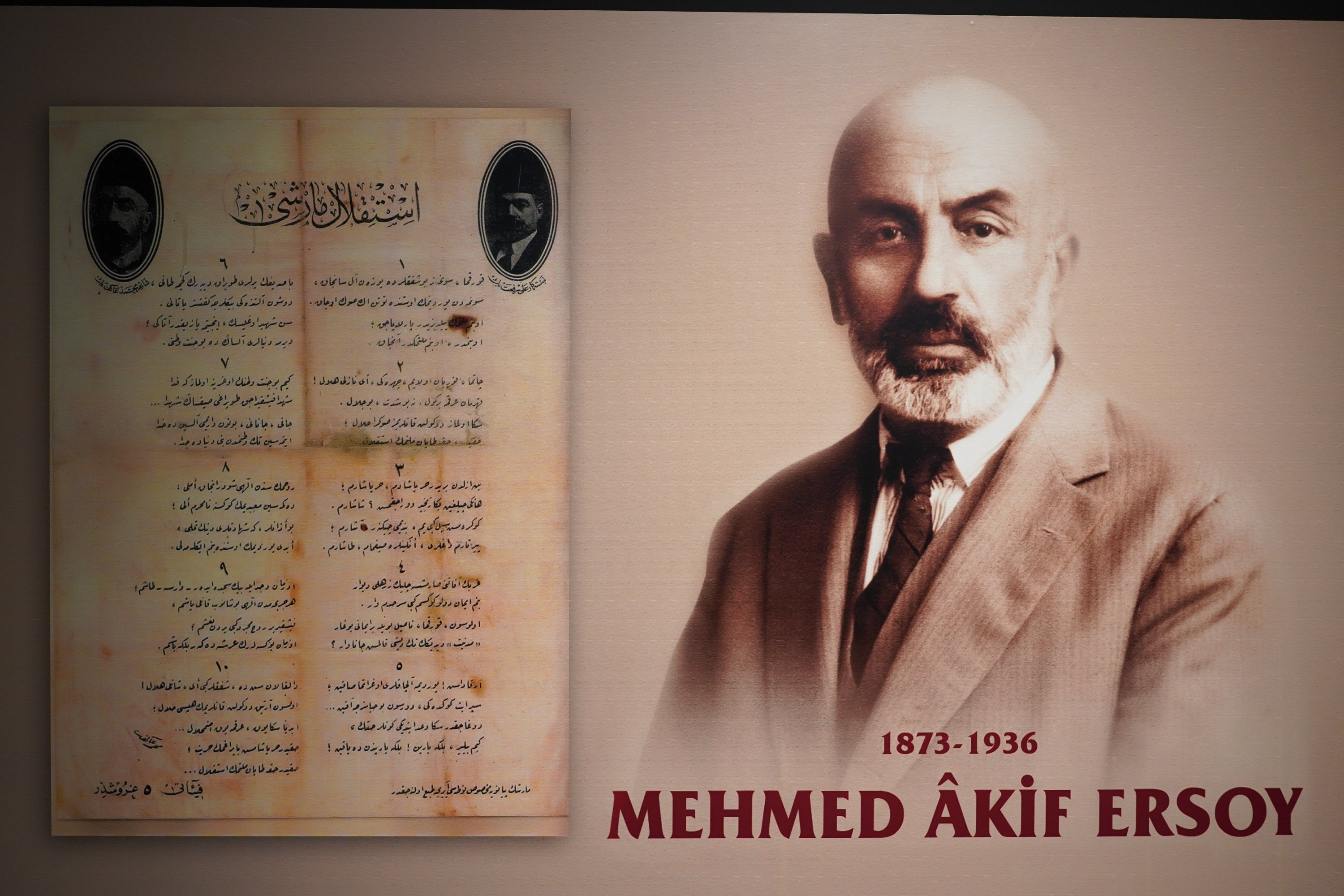
Mehmet Akif Ersoy, the poet, parliamentarian and intellectual who penned the "National Anthem," is being commemorated on the 105th anniversary of the anthem’s adoption, a symbol of the nation’s struggle for independence.
Born on Dec. 20, 1873, in Istanbul’s Fatih district, Ersoy was the son of a family that had migrated from the village of Suşitsa in Kosovo. He began his education at a local neighborhood school in Fatih, studying the Quran for two years, before enrolling in the Fatih Emir Buhari Mahalle Mektebi (Emir Buhari Neighborhood School, a primary school with religious and basic education) in 1879. In 1882, he continued his secondary education at the Fatih Merkez Rüştiyesi (Fatih Central Middle School, part of the Ottoman-era secondary school system).
Ersoy studied Arabic under Mehmet Tahir Efendi, a scholar at the Fatih Mosque madrassa and also attended Persian lessons there. He adopted the name “Akif,” the version of his father-given name “Ragif” preferred by his mother and friends. During his school years, he excelled in Turkish, Arabic, Persian and French.
Ersoy developed an interest in poetry while in middle school, beginning with Fuzuli’s "Leyla and Mecnun." After completing middle school, he enrolled in the prestigious Mülkiye Idadisi (a preparatory school for civil service and higher education) in 1885, where he took literature lessons from Muallim Naci Bey.
The death of his father from tuberculosis in 1888 and the destruction of the family home in the great Fatih fire the following year caused financial difficulties. To secure a profession and pursue boarding school studies, Ersoy left Mülkiye İdadisi and joined the newly established Ziraat ve Baytar Mektebi (Agriculture and Veterinary School), graduating first in the veterinary program in 1893.
Ersoy was also active in sports, participating in wrestling, swimming, long-distance walking, running and shot-put competitions.
Ersoy’s first published work appeared in 1893 in "Hazine-i Fünun," a ghazal. In 1898, he married Ismet Hanım, the daughter of Tophane-i Amire clerk Mehmet Emin Bey and had six children, one of whom died at 18 months.
He continued his literary work while teaching and became chief editor of "Sırat-ı Müstakim," a magazine first published on Aug. 27, 1908, by friends Eşref Edip and Ebül’ula Mardin.
Ersoy compiled his poems in the seven-volume work "Safahat." The first volume, written in 1911, explored Ottoman society during the constitutional era. The second volume, "At the Pulpit of Süleymaniye (1912)," focused on Ottoman intellectuals, while the third, "The Voices of the People (1913)," captured the perspectives of ordinary citizens. He followed these with "At the Pulpit of Fatih" (1914), "Memories" (1917) and "Asım" (1924), which reflects his views on World War I. The seventh and final volume, "Shadows," was completed in 1933.
Though pressured to translate the Quran into Turkish, Ersoy ultimately withdrew from the project, dissatisfied with the results. Out of respect for the nation, he did not include the National Anthem in Safahat.
During the Balkan Wars, World War I and the Turkish War of Independence, he worked to raise public awareness and gave sermons in Istanbul’s main mosques and across Anatolia, earning the title “Poet in the Mosque.”
Elected as a deputy for Burdur in the First Grand National Assembly, Ersoy moved to the Ankara Taceddin Dergahı in 1921. Initially hesitant to participate in the national anthem competition due to the TL 500 prize, he was persuaded by Minister of Education Hamdullah Suphi Bey and friend Hasan Basri Bey.
Ersoy’s anthem was published on Feb. 17, 1921, in Sırat-ı Müstakim and Hakimiyet-i Milliye. It was officially adopted as the national anthem on March 12, 1921. Ersoy donated the prize money to charity.
After the War of Independence, he lived in Egypt for an extended period, teaching Turkish. He returned to Istanbul for medical treatment on June 17, 1936. Weakened and ill, he stayed in an apartment on the fourth floor of the Mısır Apartments in Beyoğlu, owned by Abbas Halim Pasha, where he passed away on Dec. 27, 1936.
His grave, visited annually by thousands, is located at Edirnekapı Martyrs’ Cemetery.
In recognition of Ersoy’s life and contributions, the week of Dec. 20-27 was designated “Mehmet Akif Ersoy Memorial Week” following a 2019 joint regulation by the Ministries of Interior, Education and Culture and Tourism. The commemoration coincides with his birthday (Dec. 20) and the anniversary of his death (Dec. 27).