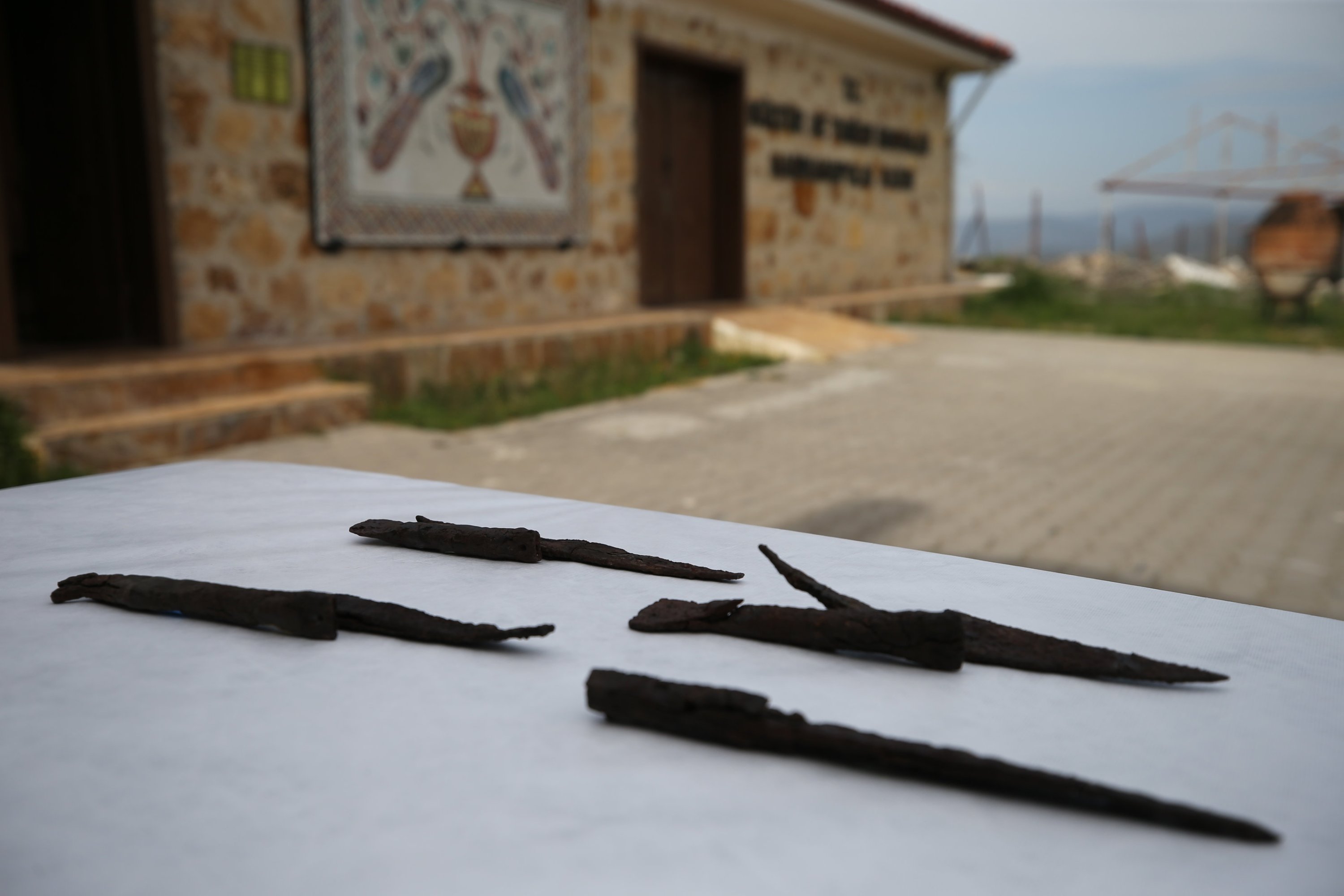
Knives believed to be 1,500 years old and a “kösüre stone” (a sharpening stone) have been unearthed in the ancient city of Hadrianopolis, located in the Eskipazar district of Karabük, northern Türkiye.
Excavation and restoration work is being carried out in the ancient city – used as a settlement during the Late Chalcolithic, Roman and Early Byzantine periods – under the leadership of professor Ersin Çelikbaş, a faculty member of the Department of Archaeology at Karabük University’s Faculty of Humanities and Social Sciences.
Çelikbaş told journalists that they discovered a set of knives in the kitchen section of a structure they call the “Hammam Building Complex” during excavation work at the site.
Noting that the knives vary in size, Çelikbaş said: “We can say they are very similar in type. Four knives were found, along with a sharpening stone. When the knives were first uncovered, they were in many fragments, around 250 pieces. We reconstructed these pieces in our laboratory and restored the knives to their original forms.”
Emphasizing the importance of the knives, Çelikbaş stated: “The fact that the knives were found in the same place indicates that the people living in the Hammam Building Complex were engaged in animal husbandry. Archaeological data had already shown that livestock activities were intensive in Hadrianopolis during antiquity, especially in the Late Roman and Early Byzantine periods. The discovery of these knives confirms that families involved in animal husbandry lived in the Hadrianopolis region in ancient times.”
Pointing out that the knives are rare examples from a typological perspective, Çelikbaş continued: “The fact that they were found as a set is also very important. We can say that they are significant archaeological finds both methodologically and in terms of providing important data about the social life here. In addition, a sharpening stone was found alongside the knives. This is also important for us because there is a quarry in the Eskipazar region, known from the Turkish-Islamic and especially the Ottoman period, that produces a stone called ‘kösüre stone.’ This stone was famously used during the Ottoman period for sharpening knives and cutting tools.”
Çelikbaş added that the discovery of the kösüre stone, together with the knives in the excavation area, proves that this type of stone was used by people much earlier than previously known: “We have determined through stratigraphic analysis that the knife set dates to the A.D. fifth-sixth centuries. Therefore, this also shows that animal husbandry activities in the Hadrianopolis region – and in present-day Eskipazar – have continued uninterrupted for approximately 1,500 years.”