Velocity and vulnerability are two terms that define our age. Geopolitical equilibria fracture and reform with alarming frequency; economic axes tilt; power is renegotiated not only between nations but between platforms, corporations and individuals. The world is not merely warming, it is being reshaped, recalibrated and re-scripted in real time. The global order, once described through relatively stable binaries and alliances, now feels porous, provisional and perpetually under revision.
And yet, our individual lives advance according to an almost stubbornly linear rhythm, as though insulated from the tremors reshaping the wider world. Exhibition calendars are drafted months, sometimes years, in advance; biennials and art fairs proceed with logistical precision; studios remain illuminated late into the night; production schedules are honored; collectors weigh acquisitions with measured deliberation; artists calculate risks that are at once aesthetic and financial; contracts are negotiated, signed, archived; canvases are stretched, primed, layered; crates are sealed and shipped across continents.
Under the immaculate lighting of international art fairs from Basel to Miami, from London to Istanbul to works are installed with curatorial exactitude, while outside those climate-controlled halls headlines flicker with geopolitical volatility, economic recalibration and ideological polarization. This paradox is hardly unprecedented; history is replete with moments when cultural production persisted amid uncertainty. Yet what distinguishes our present is the degree to which this simultaneity is rendered hyper-visible. Through digital media, we experience in real time the dissonance between continuity and rupture, between the measured cadence of artistic labor and the accelerated tempo of global disruption. The coexistence of chaos and continuity of crisis and choreography has thus become one of the defining tensions of our era, not as an abstract philosophical dilemma but as a lived, daily condition.
Art history, when examined with sober attention, reminds us that the most consequential aesthetic transformations rarely germinate in climates of stability or comfort; rather, they emerge from periods marked by profound social strain, ideological contestation, and structural upheaval. The Baroque, for instance, did not merely introduce theatricality and dynamism into painting and architecture; it unfolded in the charged atmosphere of the Counter-Reformation, as the Catholic Church mobilized visual spectacle to reassert spiritual authority in the wake of Protestant dissent. The chiaroscuro of Caravaggio, the ecstatic sculptures of Bernini and the soaring interiors of Borromini can be read not simply as stylistic innovations but as visual strategies responding to religious fracture and political consolidation.
Centuries later, modernism crystallized at the threshold of industrial acceleration, urban overcrowding and the disorienting expansion of mechanized life. The fractured planes of Cubism, the velocity celebrated by Futurism and the existential disquiet embedded in Expressionism mirrored a world reconfigured by factories, railways and mass warfare. The avant-garde movements of the early 20th century Dada, Surrealism, Constructivism arose directly from the psychic shock of World War I and the collapse of inherited certainties; they dismantled representation because representation itself seemed inadequate to capture the absurdity and trauma of mechanized conflict. Contemporary art, as it evolved in the late 20th and early 21st centuries, assumed form within an environment defined by globalization, media saturation, postcolonial critique and epistemic doubt. Installation, performance, relational practices and digital experimentation reflect not only technological innovation but also a growing awareness of interconnectedness and instability. In each of these historical junctures, aesthetic rupture did not occur despite crisis but through it transforming anxiety, fragmentation and uncertainty into new visual languages capable of articulating the complexities of their time.
In such periods, art is never merely instrumental or ornamental. It becomes an architecture of consciousness. A way of structuring chaos, the language for interpreting fragility, an attempt to transform vulnerability into form.
The essential question, then, is not whether art will respond to our era, it inevitably will. The more urgent question is how. When the world feels volatile, what aesthetic posture do we adopt? Panic? Populism? Spectacle? Or a refined, conscious, long-term perspective that resists the seduction of immediacy?
The art market, too, is implicated in this inquiry. The tension between rapid monetization and enduring value mirrors the broader contradictions of late capitalism. In a culture intoxicated by speed by viral visibility, by speculative surges, by the promise of instant relevance what does it mean to insist on permanence?
Perhaps the most radical gesture available to us today is not provocation for its own sake, nor the reflexive amplification of outrage, but the far more demanding discipline of discernment: the capacity to remain deliberately selective within an environment saturated by noise, to uphold standards of quality amid pervasive uncertainty, and to persist in producing work that is thoughtful, rigorous, and internally coherent without surrendering to the hysteria, acceleration, or performative urgency that so often masquerade as relevance in our time.
Periods of instability tend to generate two opposing impulses in art. One seeks immediacy: reactionary work that mirrors chaos, amplifies outrage, or capitalizes on collective anxiety. The other seeks structure: an attempt to slow perception, to carve out contemplative space, to insist on formal integrity precisely when external conditions appear unstable.
The former often receives rapid attention. It aligns with the emotional tempo of its moment. It circulates quickly across digital platforms and responds to headlines with near-journalistic urgency. There is nothing inherently illegitimate about such responsiveness; art has always engaged with politics, conflict and social unrest. Yet when reaction becomes the dominant aesthetic strategy, nuance risks being flattened into slogan.
The latter approach discipline, refinement, a sustained exploration of form can appear out of sync with its era. It does not shout. It does not necessarily trend. It asks for time, for patience, for cultivated attention. And yet, historically, it is often this slower current that shapes lasting legacies.
Consider the way abstraction emerged not as escapism but as a profound metaphysical inquiry. In the aftermath of devastation, artists such as Mark Rothko sought not to document ruins but to create spaces of spiritual intensity. His canvases, with their hovering fields of color, were not retreats from reality but confrontations with the abyss. They translated existential uncertainty into chromatic depth. Similarly, the architectural rigor of minimalism often misunderstood as cold or detached can be read as an ethical stance. In stripping away ornament, it foregrounds structure. In reducing form, it amplifies presence. It asks: what remains when excess is removed? What endures when spectacle fades?
In our current context which dominated by algorithmic attention economies the commitment to formal rigor becomes an act of resistance. To labor over composition, to refine texture, to pursue coherence in a fragmented environment is not antiquated. It is radical.
Artists today navigate a landscape in which visibility is often conflated with value. Metrics views, likes, shares create the illusion of objective significance. Yet history has consistently demonstrated that what circulates most rapidly is not always what endures longest. The discipline of form, the patient cultivation of a visual language, demands a different temporality. It operates on a horizon beyond the quarterly report or the art fair cycle. This does not imply disengagement from contemporary issues. On the contrary, the most resonant works often metabolize the anxieties of their time at a deeper structural level. They do not merely illustrate instability; they embody it, interrogate it, reconfigure it.
To structure chaos is not to deny it. It is to transform it into something intelligible.
The contemporary art market reflects and intensifies the contradictions of our era. On one hand, it remains one of the few global arenas where symbolic capital and financial capital intersect so visibly. On the other, it has become increasingly financialized, subject to speculative logics that echo broader economic patterns.
Art fairs proliferate across continents, each promising access to the “next” breakthrough. Auction results are analyzed like stock performances. Emerging artists are sometimes propelled into dizzying price escalations, only to face equally abrupt corrections. The rhetoric of discovery often masks a cycle of acceleration and abandonment.
This environment produces pressure. For artists, the temptation to align production with market appetite can be subtle yet pervasive. Styles that sell are repeated. Narratives that attract institutional validation are amplified. Risk is recalibrated, not always toward innovation, but toward strategic positioning.
Yet there remains a fundamental distinction between liquidity and legacy. A work can command a high price without possessing depth. Conversely, works that initially perplex or resist categorization may acquire significance over time.
The tension between rapid gain and enduring value is not confined to art; it characterizes contemporary capitalism more broadly. Short-term returns are prioritized over long-term sustainability. Attention is monetized. Trends are manufactured. In such a climate, to insist on durability to create work that aspires to transcend its immediate context is to swim against the current.
Collectors, too, face a choice. To collect as investors chasing appreciation curves, or to collect as custodians of meaning. The former approach treats art as asset class; the latter as cultural memory. These positions are not mutually exclusive, but the balance between them reveals underlying priorities.
Institutions likewise navigate this terrain. Museums, increasingly dependent on private funding, must reconcile scholarly missions with donor expectations. Curatorial programs oscillate between blockbuster exhibitions and critical inquiry. The spectacle economy exerts influence even within spaces dedicated to preservation and research. And yet, despite these pressures, art has repeatedly demonstrated an uncanny resilience. Movements that initially emerged at the margins have reshaped the center. Artists who refused to conform have redefined the canon. The market, for all its volatility, cannot fully dictate aesthetic evolution.
The question, therefore, is not whether the market exists, but how artists position themselves in relation to it. Is the work conceived as product first and proposition second? Or does the proposition remain primary, even if it complicates immediate profitability?
In moments of global uncertainty, this distinction becomes sharper. Economic turbulence can either intensify speculation or prompt reflection. It can incentivize caution or provoke deeper commitments to substance.
The art world stands at such a crossroads. The speed of capital competes with the patience of craft. The spectacle of visibility contends with the quiet authority of depth.
Beyond market dynamics lies a more intimate inquiry: what does it mean to maintain an aesthetic ethic amid instability?
To create is always to make a claim about value. To devote months, sometimes years, to a body of work is to assert that attention itself is meaningful. In an era saturated with distraction, this assertion carries weight.
Noise has become ambient. News cycles compress crises into consumable fragments. Social media collapses distinctions between the trivial and the catastrophic. The result is a continuous hum of urgency. Within such a climate, discernment becomes endangered.
To remain selective, to choose what to engage with, what to internalize, what to translate into form is not elitism. It is discipline. It is a refusal to allow external volatility to dictate internal coherence.
Quality, too, requires defense. Not as nostalgia for some imagined golden age, but as commitment to standards that transcend trend. Technical mastery, conceptual clarity and intellectual rigor are not impediments to relevance; they are its foundation.
There is, perhaps, a temptation in fragile times to equate rawness with authenticity. To assume that immediacy guarantees truth. Yet authenticity is not synonymous with impulsivity. It can be cultivated, reflective, deliberate.
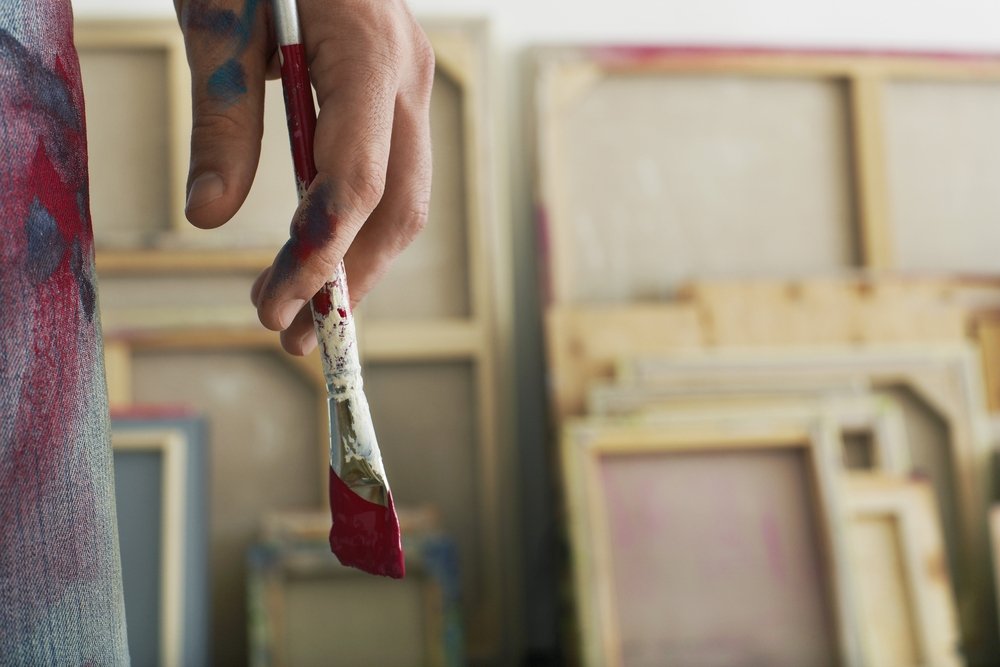
The artist’s studio, in this sense, becomes a site of counter-temporality. A space where time stretches rather than accelerates. Where gestures are reconsidered. Where failure is not immediately publicized but absorbed into process. In continuing to work despite uncertainty, despite fluctuating markets, despite geopolitical tremors, the artist enacts a quiet defiance.
To produce is to affirm continuity.
This affirmation does not ignore suffering or instability. It acknowledges them while refusing paralysis. It recognizes fragility without capitulating to despair.
Perhaps this is the deeper radicalism of our moment: not the grandiose gesture, but the sustained one. Not the viral provocation, but the long conversation between material and mind. Not the frantic multiplication of images, but the careful construction of meaning.
Panic is contagious. Populism is seductive. Spectacle is profitable. But refinement conscious, long-term, ethically grounded refinement demands courage. History will not remember every trend, every spike, every viral sensation. It will remember the works that articulated their era with depth and integrity. It will remember those who structured chaos into form.
The world is being reshaped, power is being renegotiated, certainties are dissolving.
And still, the studio light remains on.