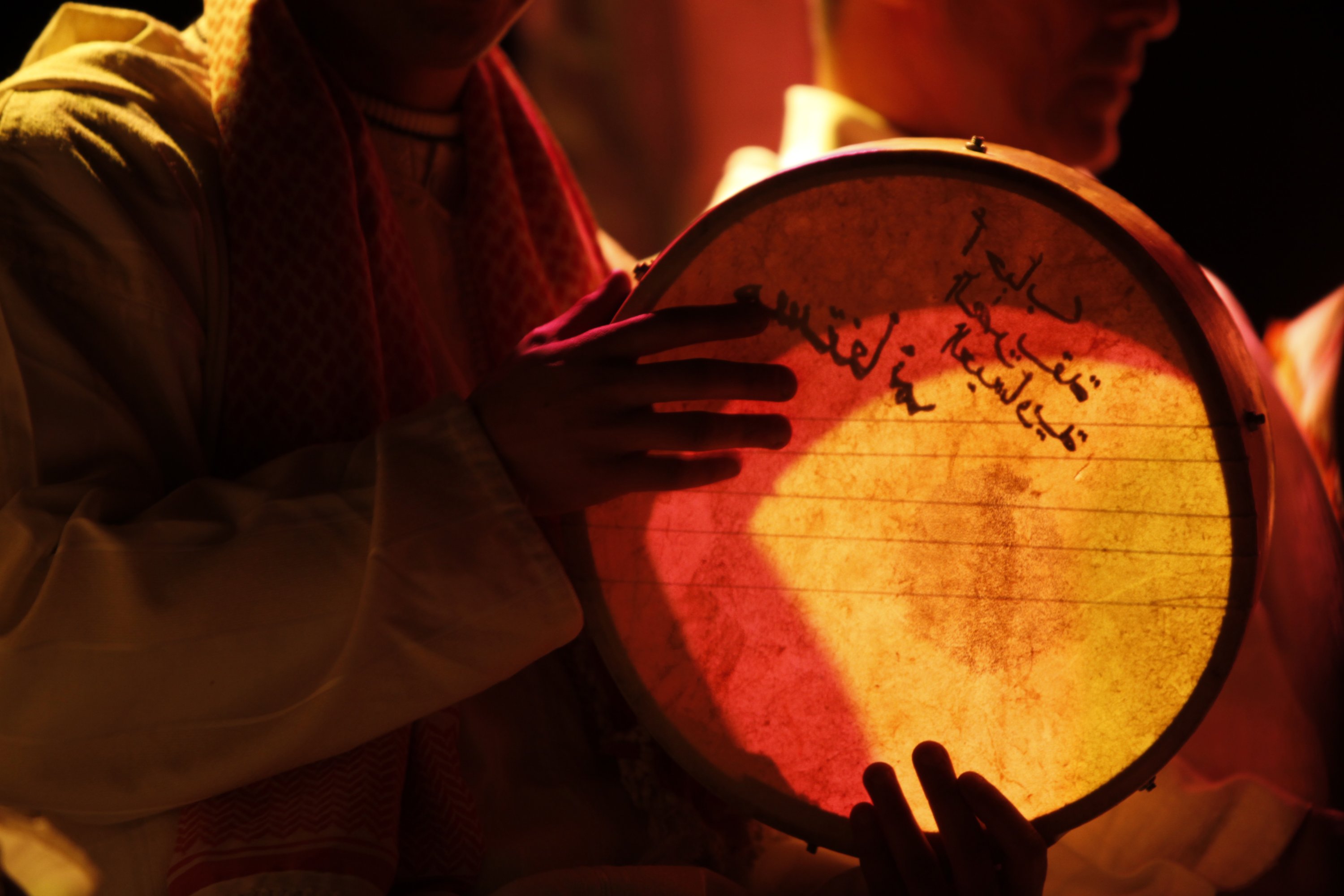
Music has accompanied humanity in every aspect of life since the dawn of time, its history as old as humanity itself. Early humans experienced music’s joy through instruments made from wood, bone and animal skins. Over centuries, diverse cultures around the world created a variety of instruments and melodies, enriching the musical landscape. While this general narrative is widely accepted, Sufis believe music predates human history. According to them, music existed since the primordial covenant ("Elest Bezmi") – a spiritual moment described in the Quran when God gathered all human souls before their earthly lives and made them testify to His oneness. This event symbolizes the original, eternal connection between the human soul and the Divine.
This understanding led Sufis to differentiate between ordinary sounds of creation and the divine. Early Sufis preferred the term "sema" rather than "musiki" (music) to distinguish divine music emanating from the sacred call from mere worldly melodies that satisfy selfish desires. The term sema refers both to rhythmic melodies produced by instruments or the human voice and to sounds that evoke the divine presence. For Sufis, music doesn’t necessarily require instruments; even the breath itself is a musical tone.
Breath holds as much importance as sound and sema in Sufi thought. Understanding how Sufis view human breath helps us grasp their relationship with music more deeply. Breath is a continuous tone inherent to human life, with heartbeat and pulse rhythms aligned with it. Sufis believe that while breathing, humans utter the sound “Hû.” The roots of divine names like “Ilah” and “Allah” contain the letter “he” and breathing naturally produces sounds such as “he,” “ha” and “hi.” Thus, “Hû” circulates with the breath; the breath itself sighs “Hû.” The mystic poet Niyazi-i Mısri said, “Without breath, not even a single letter can come alive in this world.” Similarly, the poet and activist Amiri Baraka noted, “Religion must have music because the soul does not descend without a song. The soul is our breath. Without breath, there is no life. Pulse, flow, rhythm – all repeat within us.”
In Turkish, the word teneffüs (breath) also means to shine or radiate. “Everything contained in breath is like the light at the end of darkness,” a metaphor that captures its spiritual significance. According to Ibn Sina, breath harmonizes with light but not with darkness, being the only substance that brings human chemistry closer to celestial beings. Symbolically, the rhythm of breath reflects the two parts of the Islamic declaration of faith: “Lâ ilâhe” (there is no deity) points to the origin of everything else, while “illâ’llâh” (except God) indicates a return to ultimate unity. Breath emanates from the divine name "Ar-Rahman" and is the principle of existence.
Throughout life, we hear the rhythm of our heart and the sound of our breath. Breath’s tone makes it audible and enables us to hear words. Sound is perceived through vibrations created by breath; tone is a quality of sound. We best perceive breath’s tone when singing, breathing quietly, or during spiritual chanting ("dhikr"). Vocal coaches emphasize mastering breath control as the foundation of singing, which sharpens our perception of tone. John Cage, an avant-garde composer, said, “Humans can never truly hear silence because they always hear the tone of their own breath until death.” Sufi Hasan Lütfi Şuşud added, “I have never seen a more delicate instrument than breath.”
Sufis believe that in eternity, only the “One” existed – the absolute being. This Creator commands creation with the word “Kun” (Be) and what is willed comes into existence. The divine command “Kun” is pronounced through the letters kaf and nun, whose sounds cause our existence. The foundation of all existence is thus these letters and sounds. All creatures, whether potentially or actually alive, contain sounds or letters that form the basis of existence. The source of all sounds is the divine sound at creation. According to Hurufi philosophy, even the noise of objects striking each other is inseparable from God’s word.
Islamic mysticism’s roots lie in the Quran, which states that everything was created by the command “Kun.” Similarly, the Bible begins with “In the beginning was the Word” and the Gospel of John confirms this. The Quran also teaches that the world’s end will come with the trumpet sound of the angel Israfil. Thus, creation’s beginning and end are tied to divine sounds.
The entry and exit of a Muslim in this world are accompanied by music: at birth, the call to prayer ("adhan") is whispered and the name spoken; at death, prayers, the proclamation of God’s greatness ("takbir") and Quranic recitations – forms of music – are performed.
Despite the positive divine meanings Sufis attribute to music, many Islamic scholars like Ibn Taymiyyah considered music forbidden because it provokes pleasure and distracts reason. Yet, Sufis believed in music’s power to heal and bring peace, viewing it as a key tool for reaching God. Despite opposition, the Sufi connection to music persisted. Sufi lodges ("tekkes") became centers for musical education and practice, especially the Mevlevi lodges, which played a crucial role in religious and Sufi music development.
Before the 15th century, there are no known religious compositions explicitly attributed to Ottoman-Turkish music traditions. Some researchers identify Beste-i Kadim compositions, such as "Dügâh" and "Pençgâh" – forms of classical Ottoman music – as Mevlevi ritual pieces, though their composers remain uncertain. These pieces have been played in lodges for centuries.
Mevlana Jalaluddin Rumi’s emphasis on music greatly influenced its development within Mevlevilik. He said, “Music is the language of God.” Sufi orders aimed to transform disciples into perfected humans, using music – regarded as sacred knowledge – as a key means. Mevlevi sheikh Ismail Ankaravi noted that music performed for God’s pleasure helps believers draw closer to Him.
Cüneyd-i Bağdâdi, one of the first to connect the primordial Elest Bezmi covenant and music, explained that those who listen to music in ecstasy testify to God. He said that a person at rest begins to move upon hearing sema music because the divine address from the primordial covenant settles in the soul and hearing sema awakens this memory.
Despite some restrictive religious interpretations, poetry, dance and music have become integral to Sufi spiritual practice, turning the experience of divine love into a holistic aesthetic. Traditions such as Alevi, Bektashi and Mevlevi maintain rituals ("semah" and sema) that create profound inner beauty transcending centuries. Beyond these, many other Sufi orders have rich musical repertoires in their ceremonies. This rich musical tradition continues to play a vital role in Sufi spiritual expression today.