I have written before on that dreadful phenomenon by which formerly obscure places gain worldwide fame due to the horrors of war. Well, now we have another such name to add to that ever-lengthening list. It is Minab. That small city on the southern Iranian coast, which was apparently little known in Iran itself just a month ago, is now and forever will be indelibly connected with the appalling loss in a double strike of 170 people, the majority being schoolgirls aged between 7 and 12. To simply look at the photographs of the victims and know that they were never even given the chance to grow up is simply heartrending. Of course, a formal apology for this by the U.S. president would not be able to assuage the grief of those mourning the children and other victims or account for what happened, but his clear desire to evade any responsibility for this or any other negative result of a war that he unnecessarily launched at the behest of Israel in the first place is indicative of the way he and his administration and supporters view the conflict.
It demonstrates that from the perspective of Washington, this horrendous incident is of little consequence, and this in turn reflects the fact that the welfare of the Iranian people, for whom the war was purportedly launched, is dehumanized, those who have been killed in the conflict on the Iranian side being little more than statistical detail.
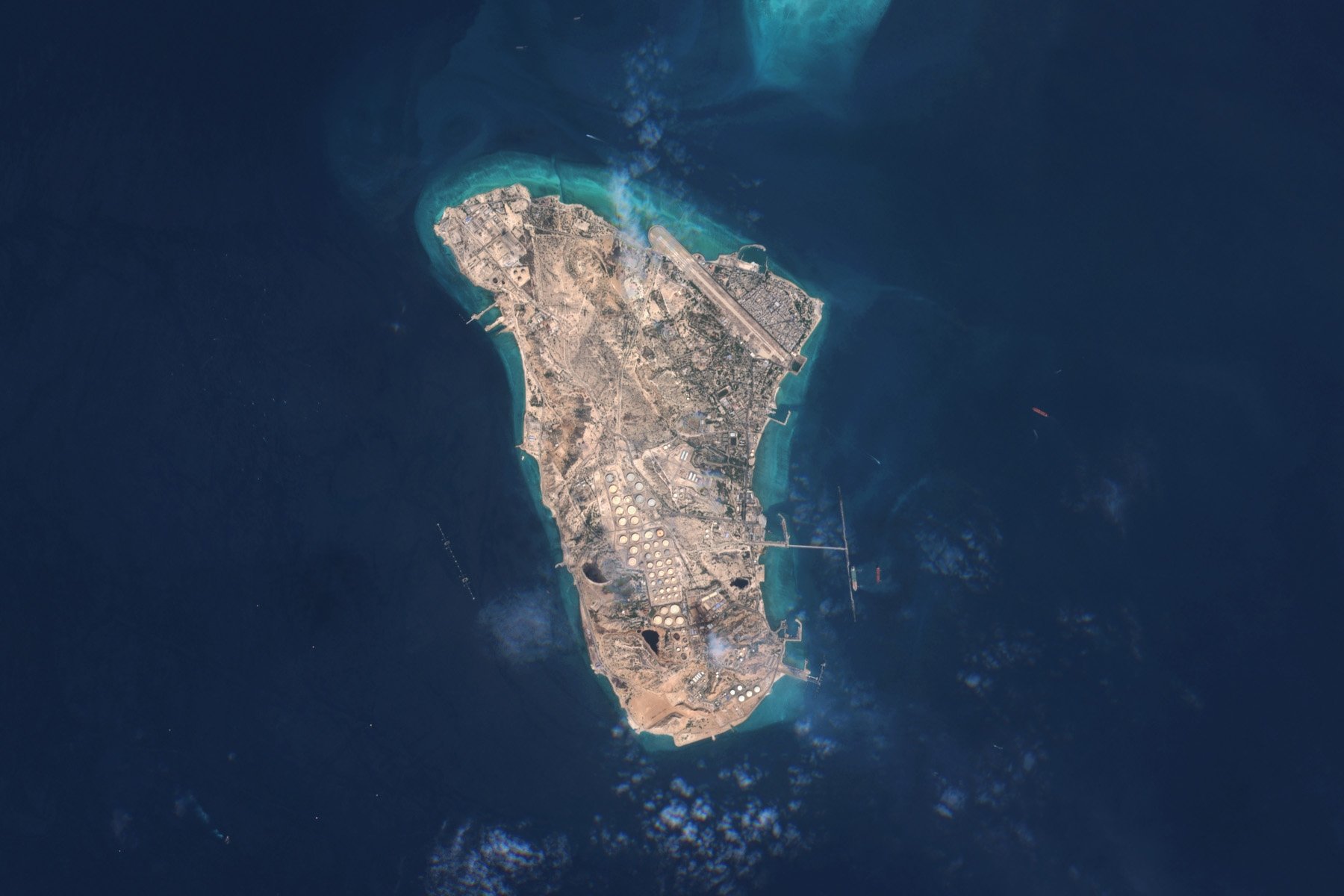
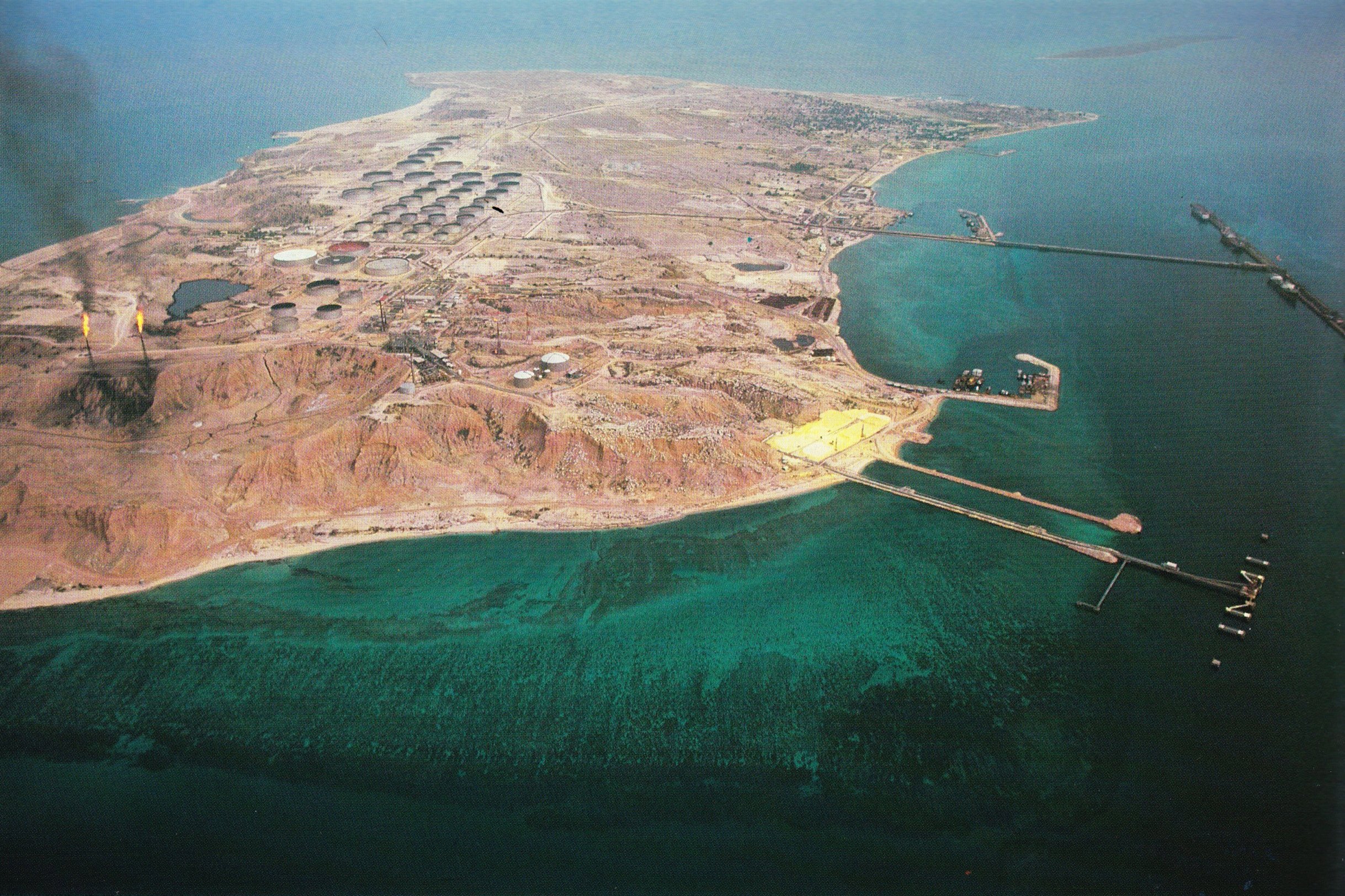
Another place that is also now getting worldwide attention is the tiny island of Kharg, a place heavily bombed by the U.S. and of which the U.S. president claims “every military target was totally obliterated.” So far, no atrocity has been reported from there, but with the rhetoric and the cavalier approach of this administration being one in which restraint and concern for what is under the bombs are regarded as “woke” and “stupid rules of engagement” and a new bombing of the island could be carried out “just for fun,” then, if such a report one day surfaces, it will unfortunately not be a surprise.
Unlike what I imagine is the vast majority of those following the news these days, I had actually heard of Kharg Island prior to its being thrown into the international spotlight by this war. I own a copy of "The Island of Kharg," a slender book written by the Iranologist R. Ghirshman back in 1960. I am, of course, not able to corroborate whether the claim of the U.S. president that the U.S. bombing only struck military targets, but from the book I am aware of the important cultural heritage of this island, and I wish to draw upon it to show what is at least at risk of damage or destruction there in this war.
In doing so, I may seem open to the accusation that I am more concerned with cultural damage, and maybe only potential cultural damage at that, than with the human suffering that has been caused by this war. It would not be true, though. As far as the human suffering of this war is concerned, it has touched me deeply. However, I am not in a position where I can add any extra firsthand information on the human angle of this conflict, and thus, were I to focus on it, I could only simply repeat what others have reported. Secondly, I feel that separating the damage to human life from that inflicted on a culture creates a false dichotomy.
The cultural heritage within which a people live is an integral part of their lives and traditions. People who are helplessly forced to watch the destruction of their cultural heritage are effectively rendered stateless refugees while still on their own soil. As for myself, not being able to humanize the impact of this conflict through firsthand accounts, I hope with this piece to allow the reader to “see” the island for what it is, rather than it simply appearing to be nothing more than a square in a strategic game. I want to metaphorically “humanize” part of Iran’s rich cultural heritage that has been put at risk by this war to indicate more of the potential cost of the conflict. I hope that being in possession of a book that is out of print and which surely few people own will allow me to do this. That means, of course, that I will be relying heavily on Ghirshman’s writing in this piece.
As for Ghirshman himself, he had intimate knowledge of Kharg Island. Roman Ghirshman (1895-1979), a Ukrainian Jew who became a French citizen, worked as an archaeologist in Iran for the bulk of his adult life. Part of this included the excavation of a Nestorian Christian monastery on Kharg Island in 1959-60. He was also asked then to survey the island as it was about to be dramatically transformed into what Ghirshman calls “one of the greatest world centres for the export of oil.” The political system in Iran at that time was that of the monarchy but that was overthrown in the revolution of 1979, establishing the Islamic Republic of today, though the importance of the island itself for Iran’s oil exports remained unchanged. That is why it has become a target in this current war.
Back in 1960, though, economic opportunity was balanced with a desire to preserve Iranian history. Care was therefore taken in the transformation of the island into a major oil base that, as Ghirshman notes, “the engineers did no irreparable damage,” and the survey also assisted them to “avoid disturbing all early remains that were of any importance.” In addition, the engineers themselves became aware that they were part of a continuity – that, as Ghirshman puts it, “the geographical and climatic advantages of Kharg have been familiar through all ages to sailors in the Persian Gulf, whose ships, several thousand years ago, had already adopted the island as a regular port of call.”
More than anyone, Ghirshman, with his deep historical knowledge, understood the importance of Kharg Island, “the only island in the northern part of the Persian Gulf.” Thus, even though he describes it as a “remote patch of earth” and “no more than a rock,” he is also aware that the fortunes of the Island of Kharg provide a striking confirmation of the importance of the part played in history by geographical situation. This has always been a dominant factor in human affairs, on some occasions lending assistance to man’s undertaking and on others undermining them.
He would not, of course, know that just a few decades later, the island that he had come to know and feel so deeply for would be threatened with such intensive destruction due to the significance of “its geographical situation” once again being to the fore.
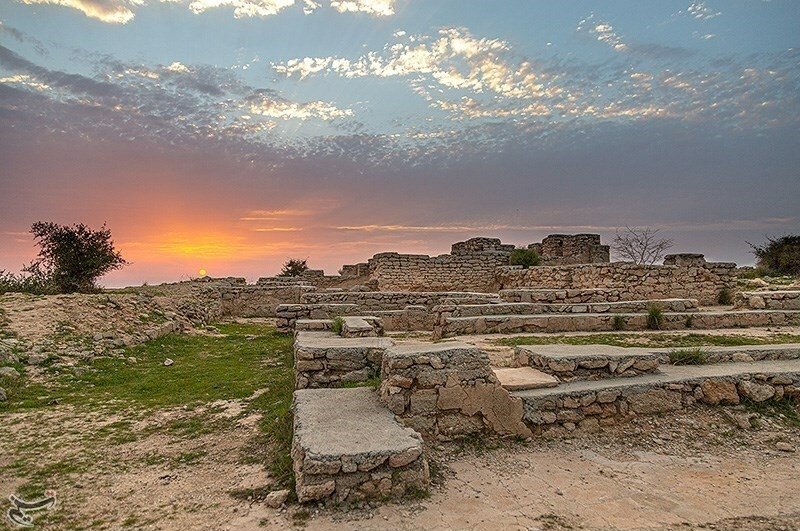
Ghirshman reveals that despite its size, Kharg is rich in archaeological remains reflecting its importance throughout the centuries. For instance, the island is home to megalithic tombs dating back to 1000 B.C. A human presence was possible on the island due to the presence of water there. What Ghirshman calls “a large basin in the mountainside” was fed by a spring and, according to Ghirshman, was capable of holding almost 40 million liters of water. This allowed the island’s inhabitants to meet one of the most basic human needs, and as such, animated their spiritual focus as well. Ghirshman notes, “In all ages men have established their holy places close to water – in this instance beside both a spring and a lake – for water is a sacred element, the source of life, generation and fertility.” There, the Greeks constructed a temple to Poseidon. That became ruined, though, and over the top of what remained, a Zoroastrian Temple was erected, Ghirshman using the evidence of a coin to date its construction back to the A.D. fourth century.
Ghirshman reveals that with the coming of Islam to the island, the Zoroastrian temple was converted into a mosque. This mosque has an architectural element that is relatively unusual in the Islamic world; its roof is sharply conical with a delicate honeycomb design. Ghirshman is keen to see continuity in change, and thus he notes that, “Thus three religions, spanning a thousand years, successively established their place of worship at this same site on the rock.” This has given a special spiritual importance to this particular site in that it “from the earliest times had been considered holy and which continued to be so regarded, despite the alterations of creeds and the changing racial character of the island’s population.”
Having noted the existence of “A Greek Temple, a Zoroastrian Fire Temple, a Church with a Nestorian Monastery, an early Mosque,” the tiny island is, for Ghirshman, marked by its “cosmopolitanism” in its “richness and diversity.” For Ghirshman, this predates the appearance of the monotheistic Semitic faiths there, as he speculates that there, “Persians, Greeks, Palmyrans, Arabs and probably Hindus, encounter(ed one another) and commingled.”
It is somehow symbolic that an island whose cultural treasures denote cosmopolitanism has, albeit for different reasons, become a particular target for the current president of the United States, for whom cosmopolitanism is so distasteful.
In place of the humanistic celebration of the differences of human culture, this administration, in its war, has instead drawn upon an exclusivist Christian messianic idea, but this is ironic for the bombs that strike the island threaten a site that shows the presence of Christianity in the Persian Gulf in the A.D. first millennium, the island then being home to Nestorian Christians.
The western side of the island is the harshest. As Ghirshman notes, “Here the naked rock, barren and forbidding, rises to a plateau, cut across by wadis. Nothing grows there.” Yet it is where the Nestorian monks settled. Ghirshman surmises that they did so in the spirit of separating from other human contact and “directing their lives wholly towards some inner centre.” In this forbidding part of the island, “The Nestorian monks, by tremendous efforts and long and painful labours, built a monastery with a noble church attached to it.” Having himself excavated this church, Ghirshman surmises that the human remains that he uncovered there were “perhaps those of Christian martyrs transferred from the mainland in order to be deposited in the church,” which, if true, would have added spiritual significance to the site.
Despite its austere settings, the monastery was not left undecorated. Stucco work adorned much of the inner and outer walls, and, “The most usual motif was one composed of a series of circular medallions on which were put geometrical or botanical designs.” Also, “honeysuckle ornamentation, in pure Sassanid style, graced the upper part of the walls.” Most significantly, the Nestorian cross is depicted, “the distinctive form of this is here recognizable for the first time.”
Ghirshman exclaims that, “An examination of the remaining traces left by the monks arouses our astonishment at the ingenuity, patience and perseverance which must have gone into the workings that they constructed.” He is not referring here simply to the religious building of the monks but also to how they managed to sustain their mortal lives on this inhospitable side of the island. To achieve this, the water that fell on the eastern side of the elevation was “entrapped in holes” and then “conveyed through long subterranean channels” that are “known as qanats or qariz” that the monks laboriously hewed. This, in addition to wells also dug by the monks, also allowed for a very basic level of agriculture.
Ghirshman’s style is a mix of an eye for accuracy in detailing the historic culture of the island with a barely hidden enthusiasm for it, which is augmented by the delicate sketches that sit alongside the more clinical photographs. His work is really a celebration of the deep history of Iran and the ingenuity and constructiveness of humankind. As such, it stands in stark contrast to the reason Kharg Island is currently in the news.
In writing this piece, I am not making the claim that any of these historic sites have been damaged in the heavy U.S. bombardment of the island or, especially, that they may have been deliberately targeted. It is hardly likely that someone like me would be made privy to target lists or damage assessments.
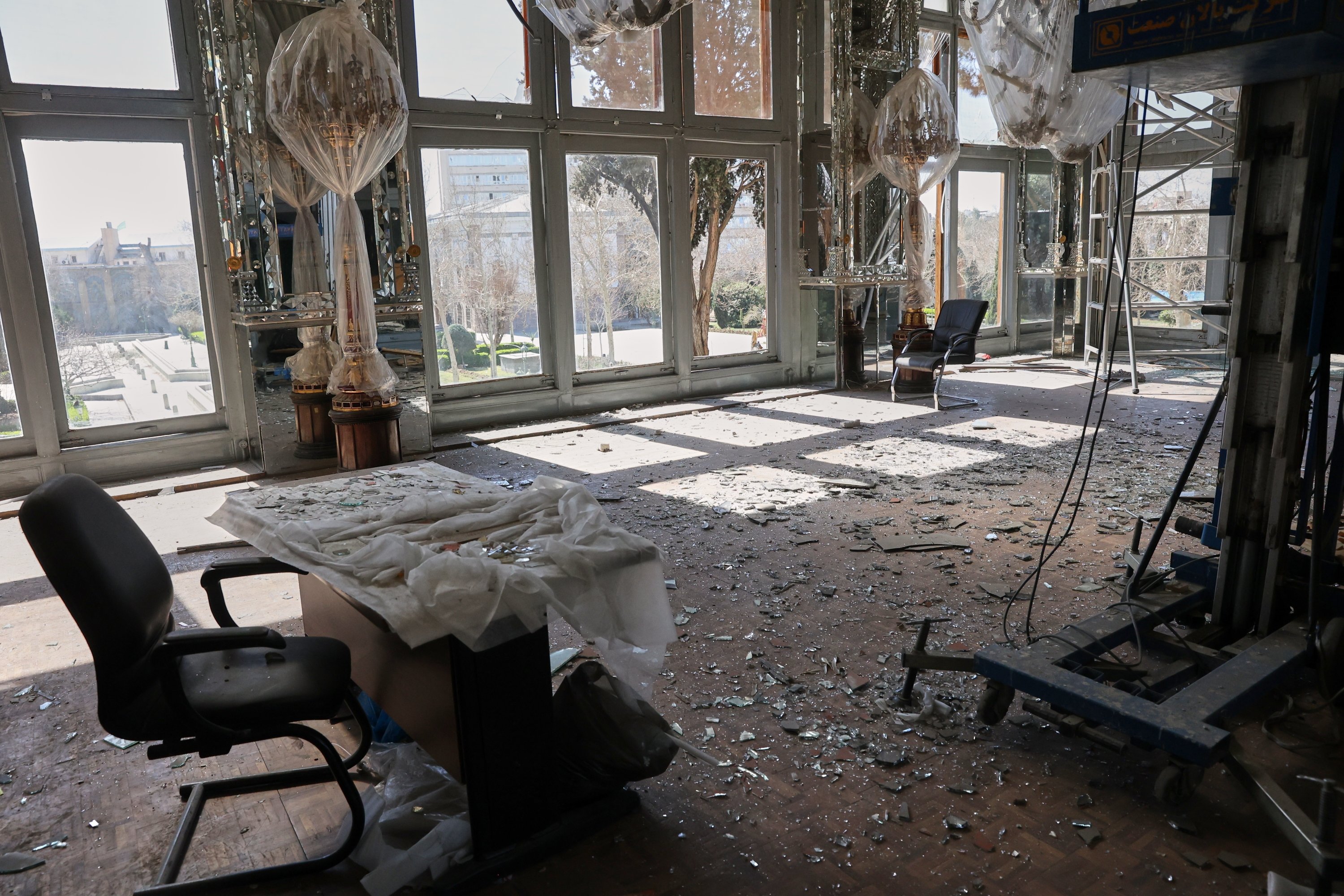
Yet, there is good reason to be concerned. It has been reported that the UNESCO heritage sites of the Golestan Palace in Tehran and the Meidan Emam in Esfahan have been damaged in bombing campaigns so far. Indeed, Kharg Island is not a UNESCO site. That does not mean, as I hope this piece has proved, that it, or other historic sites in Iran that are not on the UNESCO list, do not deserve consideration, though. In Türkiye, for instance, while key cultural treasures are on the UNESCO list, I know myself that it is far from comprehensive, with many uniquely beautiful and significant sites not included on it. This is not to fault UNESCO, which has compiled a list of worldwide scope that still has to be manageable, and is thus necessarily limited. Yet, this certainly should not suggest that there is any carte blanche for unlisted sites to be treated without consideration.
Both the rhetoric and the conduct of the war so far do not suggest that much thought is given to Iran’s rich heritage. An administration that, through its propaganda videos, can be thought to literally regard what they are conducting as a video game and who callously uses such sickening phrases as “we’re punching them while they’re down, which is exactly how it should be” is unlikely to. Moreover, the president at its head, who is ultimately responsible for all that it does, cannot be thought to have a care for the memory of the past, as he seems unable to even remember what he has said in previous speeches. Yet, in launching an unprovoked war against a country with as deep a history as that of Iran, that administration is accountable for any damage to the cultural sites of that great country, just as with the loss of innocent life. The best way to end the threat to the further loss of either would, of course, be to bring this horrific and unnecessary war to a speedy end.