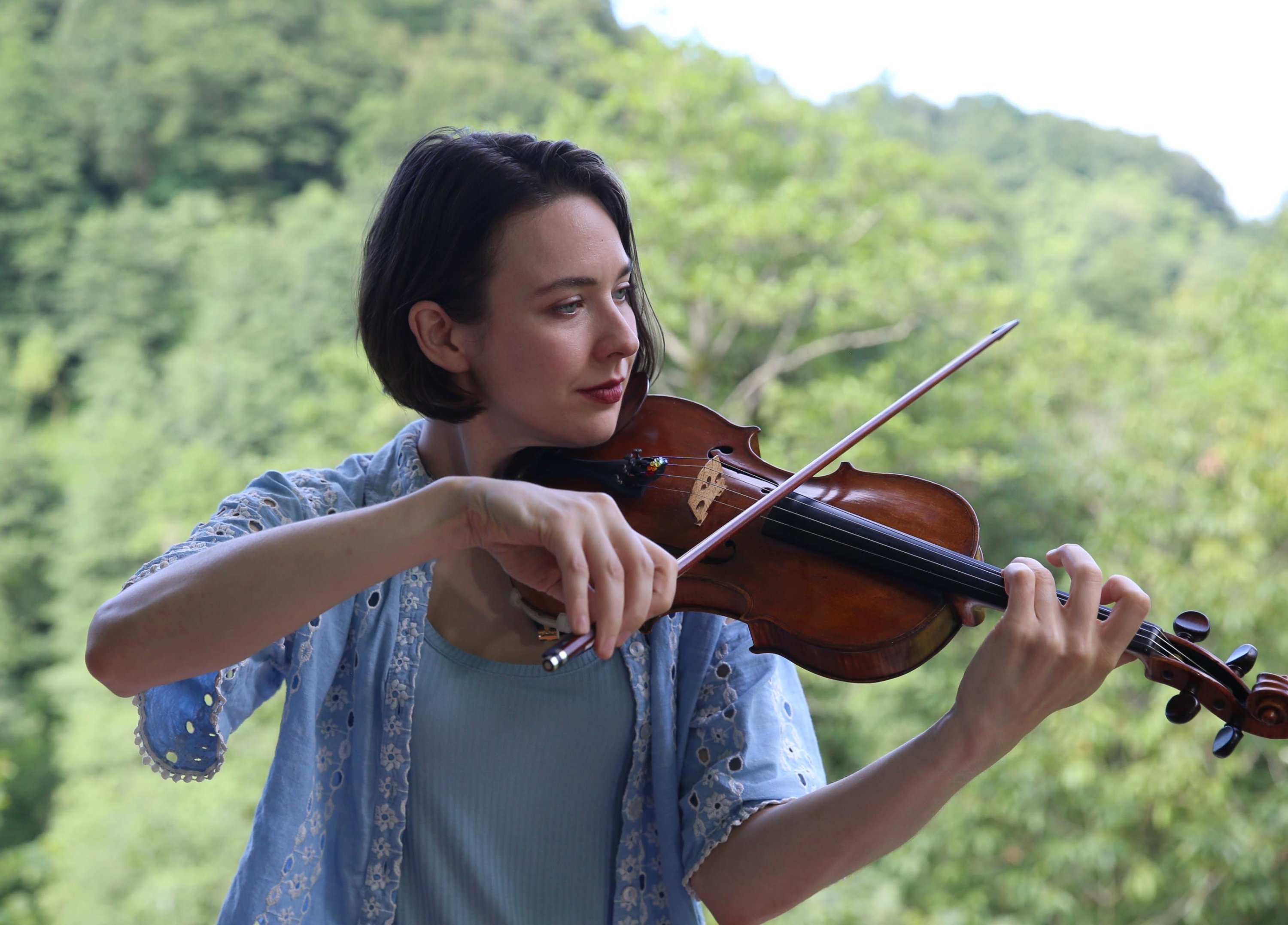
American violinist and ethnomusicologist Audrey Wozniak came to Türkiye in 2015 to explore its musical traditions. More than a decade later, the country has become central to her work as a performer, researcher and educator.
Born in Hawaii and later raised in Texas, Wozniak began studying music at age 6. She became interested in the violin after watching violinist Itzhak Perlman on the children’s television program “Sesame Street.”
Wozniak grew up studying works by Western composers including Beethoven, Bach and Mozart. A year of study in Japan during high school broadened her interest in other cultures, leading her to study Chinese and explore traditional music from Azerbaijan, the Uyghur community, China and Indonesia.
She later met Iranian kamancheh player Kayhan Kalhor, who suggested she visit Istanbul. Wozniak came to Türkiye in 2015 and was introduced to ethnomusicology, the study of music in its cultural and social contexts.
She went on to earn a doctorate in ethnomusicology from Harvard University. She now divides her time among the United Kingdom, Istanbul and Rize, using concerts, research and television programs to explore connections between Turkish music and other traditions.
One of the traditions that most influenced Wozniak when she first arrived in Türkiye was “meşk,” a traditional method of learning and transmitting music through close interaction between teacher and student.
Wozniak recalled visiting a teacher’s office, where musicians would drink tea and talk before taking out their instruments and playing together.
The experience showed her a different approach to learning music from the one she had known in Western classical music.
At the time, Wozniak did not speak Turkish, and she initially found some elements of Turkish music unfamiliar.
“The intervals in microtonal music sounded very strange to me, even out of tune,” she said. “But the difference in the music also fascinated me because, although my own instrument, the violin, has been present in Turkish music for more than 250 years, it is played here in a completely different way.”
Wozniak continued traveling to Türkiye while pursuing a master’s degree in communications and politics in London. After completing her doctorate, she decided in 2024 to remain in Türkiye.
“As a violinist, any musical culture in which the violin is present attracts my attention,” she said.
She has been particularly interested in the kemenche used in Black Sea music, saying its complex rhythms, ornaments and techniques present a challenge for a string player.
“I am trying to learn by imitating what I hear,” she said.
Wozniak said she has also been influenced by the musical traditions of Kırşehir and Elazığ, which she described as having deep historical roots.
Wozniak said her understanding of Turkish music expanded as she encountered forms including “uzun hava,” “kırık hava,” and “bozlak.”
She performed Neşet Ertaş’s “Neredesin Sen” during a concert organized by the Turkish Music Society in Zurich. The event coincided with the aftermath of the 2023 earthquakes centered in Kahramanmaraş and was turned into a solidarity concert rather than being canceled.
Wozniak said she initially knew little about Ertaş but later came to appreciate his influence.
“I realized that he was a master musician who was extremely important not only for Türkiye but for the world as well,” she said.
She said performing Turkish music gives her a connection with audiences that goes beyond the music itself.
“You play a piece and everyone begins singing along with the lyrics,” she said. “When I become part of that, it is a very meaningful feeling. I feel that I am bringing something back to life – a shared emotion.”
Wozniak said she tries to introduce Turkish music to wider audiences through performances that combine Turkish and Western traditions.
“I may not be Türkiye’s number one violinist, but I believe I have a different perspective and can bring that perspective into my work,” she said.
“Music is truly a part of life in Türkiye. When people come together, music accompanies them.”
Wozniak has traveled extensively across Türkiye as the host of “Türkiye'yi Dinliyorum,” a program produced for TRT Music. She said she learned regional musical traditions directly from local musicians during the program.
Her work has also taken her to Rize, where she said she has found a connection between music, ecology and the region’s landscape.
“I feel as if I am living inside a mythology here,” Wozniak said. “Türkiye’s surroundings, ecology and historical locations are incredibly impressive.”
Wozniak now describes her life as a triangle connecting Cambridge, Istanbul and Rize.
“Cambridge means work, Istanbul means work and research and Rize means enjoyment, ecology and peace,” she said.
“I feel very comfortable in Türkiye. I am very happy to be here, and I feel safe.”