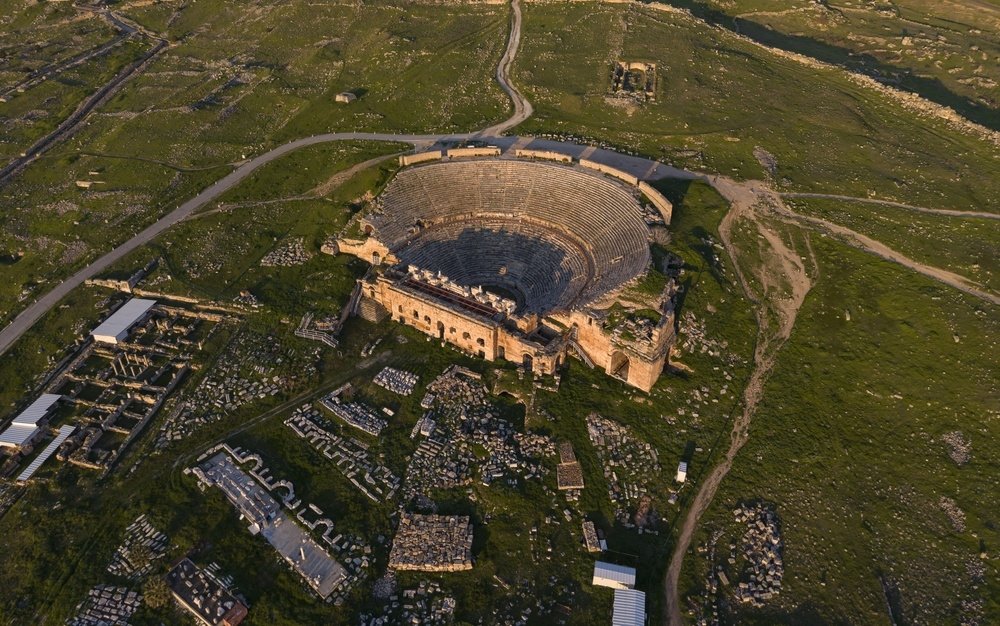
Culture and Tourism Minister Mehmet Nuri Ersoy met with Italian Culture Minister Alessandro Giuli in Türkiye's Pamukkale to discuss cultural heritage projects, highlighting joint archaeological research, restoration work and exhibitions.
Speaking at the opening of the 17th Archaeology Symposium on Italian Missions in Türkiye in the ancient city of Hierapolis, Ersoy said an exhibition on Göbeklitepe at Rome’s Colosseum had attracted nearly 6 million visitors. He also announced talks on scientific and cultural exchanges between Ephesus and Pompeii, while a joint project at the ancient city of Elaiussa Sebaste is targeted for 2027.
The meeting brought together Giuli, Italian Ambassador to Türkiye Giuseppe Manzo, Denizli Governor Yavuz Selim Köşger and representatives of relevant institutions.
Ersoy said the gathering highlighted the importance of long-running international research in Anatolia and Türkiye’s evolving approach to archaeology.
The ancient city, which brought together different communities, beliefs and cultures in antiquity, now hosts Turkish and Italian researchers pursuing shared scientific goals, he said.
Italian excavations in Hierapolis began 70 years ago. Researchers from Pamukkale University are now contributing under the Culture and Tourism Ministry’s Heritage for the Future project, which Ersoy described as an example of the collaborative model Türkiye seeks to develop in archaeology.
Ersoy stressed that archaeology involves more than uncovering ancient structures and artifacts. It also encompasses conservation, restoration, site planning, visitor management, museum work, scientific publications and public engagement.
“Just as important as uncovering an archaeological site is preserving it, interpreting it and ensuring its sustainable future,” Ersoy said.
He added that Türkiye had significantly expanded the scale and pace of its archaeological work in recent years, strengthening research led by Turkish scholars while establishing more comprehensive institutional frameworks for foreign archaeological teams working in the country.
Italy is one of Türkiye’s longest-standing partners in archaeological research, Ersoy said. Italian scholars lead excavations at six sites: Arslantepe, Hierapolis, Uşaklı Höyük, Karkamış, Kınık Höyük and Yumuktepe.
Researchers from Turkish universities actively participate in many of these projects, while Italian scholars also join excavations led by Turkish teams, he added.
Ersoy said international archaeological partnerships strengthened Türkiye’s scientific capacity, encouraged the exchange of knowledge and experience, and fostered a shared approach to heritage preservation.
Ersoy said Denizli was an appropriate host for the symposium because it is among Türkiye’s leading provinces for archaeological and cultural heritage research.
Scientific studies are underway at sites spanning different historical periods, including Aşağıseyit and Beycesultan mounds, Ekşi Höyük, Kale-i Tavas, Laodikeia, Hierapolis, Tripolis, Kolossai and Attouda.
Documentation of Seljuk and Ottoman cultural assets is also continuing under the National Inventory Project for Turkish-Islamic Period Gravestones and Inscriptions.
Pamukkale-Hierapolis is listed as a UNESCO World Heritage Site, while Laodikeia is on UNESCO’s Tentative List, Ersoy noted, describing the designations as international indicators of Denizli’s cultural heritage potential.
He said excavation and conservation work was progressing simultaneously at several sites. Projects include visitor reception facilities and landscaping at Hierapolis, restoration at Laodikeia, and planned conservation and visitor management improvements at Tripolis.
The initiatives aim to make archaeological sites living cultural spaces accessible to the wider public, he added.
Ersoy said the Göbeklitepe exhibition at Rome’s Colosseum, titled “Göbeklitepe: The Mystery of a Sacred Place,” had attracted nearly 6 million visitors, demonstrating the public reach of cultural heritage exhibitions.
It was followed by “Troy and Rome: Myths, Legends and Stories of the Ancient Mediterranean,” which examined the historical and mythological connections between the two ancient cities.
Featuring 221 artifacts selected from museums across Türkiye, the exhibition presented thousands of years of cultural ties between Anatolia and Italy, Ersoy said.
Türkiye and Italy have launched discussions on scientific and cultural exchanges between the ancient city of Ephesus and the Archaeological Park of Pompeii, Ersoy said.
The two sides also aim to launch a joint project at Elaiussa Sebaste, an ancient city in Mersin, in 2027, with Italy’s Central Institute for Archaeology under the Ministry of Culture.
In Cappadocia, Turkish and Italian specialists are working together to preserve cultural assets, particularly wall paintings, he added.
Ersoy said combating the illicit trafficking of cultural property was another shared priority.
The return to Türkiye of cultural assets seized in Italy in recent years demonstrated tangible progress in protecting cultural heritage, he said.
“Scientists come together at excavation sites; specialists work side by side in laboratories, museums organize joint exhibitions, young researchers join new scientific networks, and our cultural assets are protected through a shared sense of responsibility,” Ersoy said.
Ersoy said Türkiye aimed to provide stronger scientific resources for archaeological research, ensure the continuity of excavation and conservation projects, and increase the international presence of Turkish scholars.
The country also seeks to establish lasting partnerships with foreign research teams working in Türkiye, he added.
He thanked Giuli and other Italian officials and institutions, researchers, universities and ministry staff for their contributions. He also acknowledged artists from both countries whose work has strengthened cultural ties.
Ersoy expressed hope that the meeting in Hierapolis would lead to further progress and that the 17th Symposium of Italian Archaeological Missions would pave the way for new research initiatives.