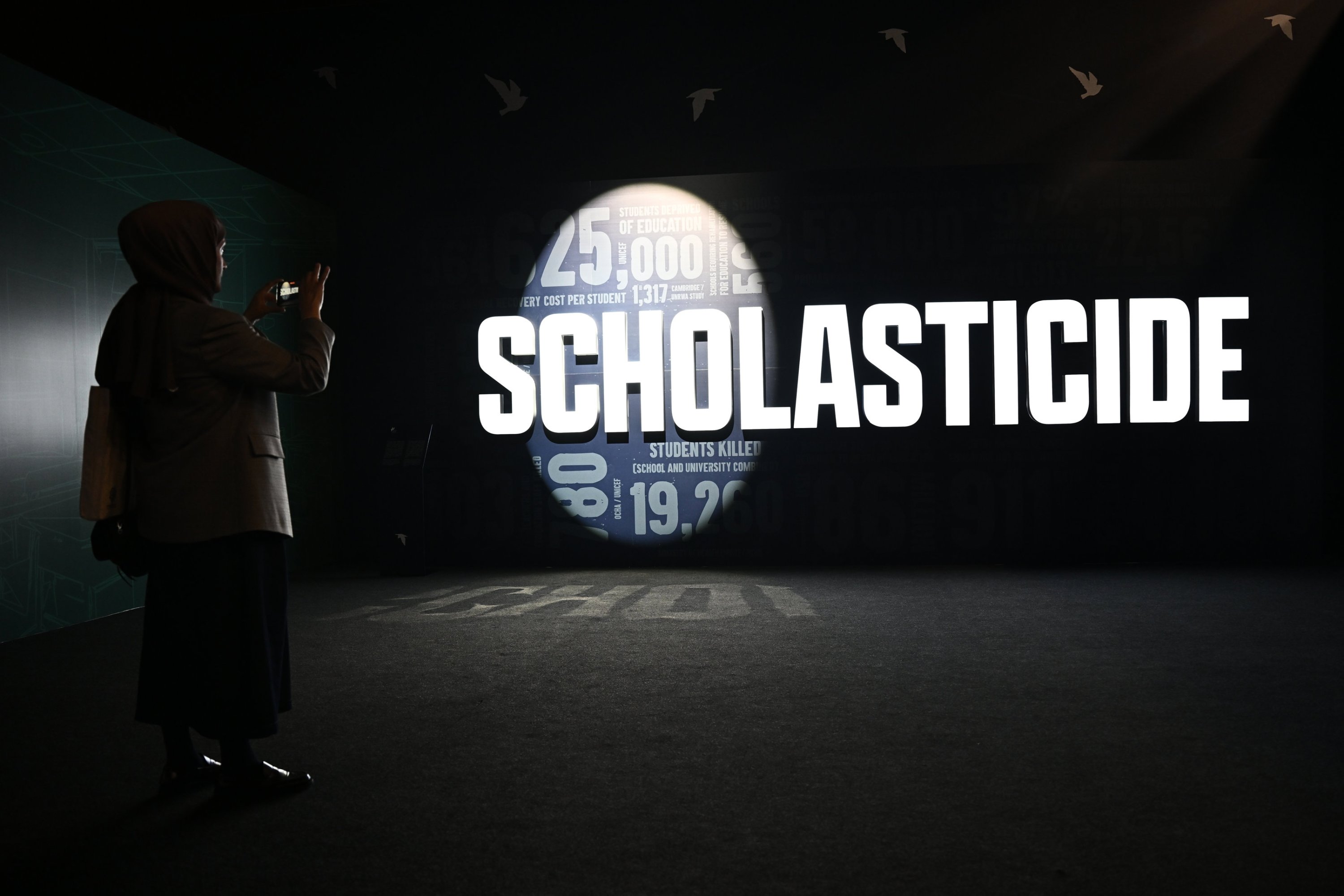
There are moments, rare yet unforgettable, when a diplomatic forum ceases to be merely a space of dialogue and becomes instead a space of confrontation, not between states, but between language and reality, between what is said and what is felt. The Antalya Diplomacy Forum 5th edition has offered precisely such a moment, not only through its panels, speeches and strategic discussions, but through something far quieter and far more unsettling: an exhibition centered on scholasticide; the systematic destruction of schools, universities and educational life.
One does not expect to encounter grief so directly in the polished corridors of diplomacy. And yet, there it was: images of bombed classrooms, shattered desks, empty chairs that once held children, walls that once echoed with learning, now reduced to debris.
It is one thing to speak of conflict in abstract geopolitical terms; it is another to stand before the visual evidence of what that conflict does to the most fragile and foundational structure of any society, its education system. The exhibition did not shout. It did not accuse in overt slogans. It did something far more powerful: it made the absence and the absents visible. And in that absence, the concept of scholasticide became impossible to ignore.

Scholasticide is not simply the destruction of buildings, it is the destruction of continuity. When a school is bombed, what disappears is not only a structure but a timeline or the pupils who are full of life and hope for their countries; it is lessons interrupted, questions never asked, inventions never to be invented, paintings never to be painted, dreams never to come true...
When schools are bombed, it is teachers silenced, futures suspended. A classroom is not just a room; it is a promise for the country and the world. And when that promise is systematically broken, what is being attacked is not only the present population, but the future intellectual capacity of a society.
In recent conflicts, we have witnessed the repeated targeting of educational institutions, schools, universities, libraries, often reduced to collateral damage in official narratives. Yet when the pattern becomes too consistent, too widespread, too deliberate, it begins to reveal itself not as accident, but as method.
To speak of scholasticide without confronting its most immediate and harrowing manifestations would be an evasion of responsibility. The deliberate targeting of educational spaces, most recently exemplified in Israel’s bombing of a school amid the first days of escalating tensions, signals not merely collateral damage, but an assault on the very possibility of a future. When children and young people are killed while sitting at their desks, in spaces meant for learning, imagination and intellectual becoming, violence crosses an irreversible threshold: it ceases to be a tragic byproduct of war and becomes a calculated annihilation of continuity. This is not without precedent.
From the destruction of universities in Sarajevo during the Bosnian War, to the burning of schools in Afghanistan, to the repeated devastation of classrooms in Gaza, where entire generations have been denied stable access to education, the pattern is unmistakable. Humanity may, in principle, condemn civilian deaths; yet there exists a deeper moral abyss when the victims are students, when the setting is a classroom and when the perpetrator is a state actor cloaked in the language of legitimacy. To bomb a school is not only to kill; it is intentionally to erase memory in advance, to interrupt the formation of thought and to declare that knowledge itself is expendable. In this sense, scholasticide stands as one of the most insidious and unforgivable forms of violence of our time, an act that reveals not strength, but the profound ethical collapse of those who commit it. Because those who commit that war crime well know that to destroy education is to destabilize a society at its root. Because a nation without functioning schools does not simply fall behind, it becomes vulnerable. Vulnerable to manipulation, to dependency, to the erosion of its own narrative. Education is not a luxury infrastructure; it is the spine of sovereignty.
And yet, how often do we hear this discussed at the center of diplomatic negotiations?
The Antalya Diplomacy Forum 5th edition, held this year under the theme of navigating uncertainty, gathered leaders, policymakers and thinkers from around the world. Panels addressed war, security, alliances, regional tensions, and future risks. The language was precise, measured and necessary. But walking from those panels into the scholasticide exhibition created a rupture. Because diplomacy, for all its sophistication, often speaks in abstractions, stability, escalation, deterrence, resolution. These are essential concepts, yet they risk becoming distant from lived experience. They rarely capture what it means for a child to lose access to education, or for a teacher to continue teaching in ruins, or for a generation to grow up without the intellectual tools to interpret their own reality or systematically to be the target of bombings and to die.
This is where diplomacy reveals its limitation: it can negotiate cease-fires, but it struggles to articulate loss. And perhaps more importantly, it struggles to prioritize what should never be negotiable.
The destruction of schools should not be a secondary concern. It should not be a footnote in humanitarian discussions. It should stand at the center of diplomatic urgency. Because when education collapses, peace, even if achieved, rests on hollow ground.
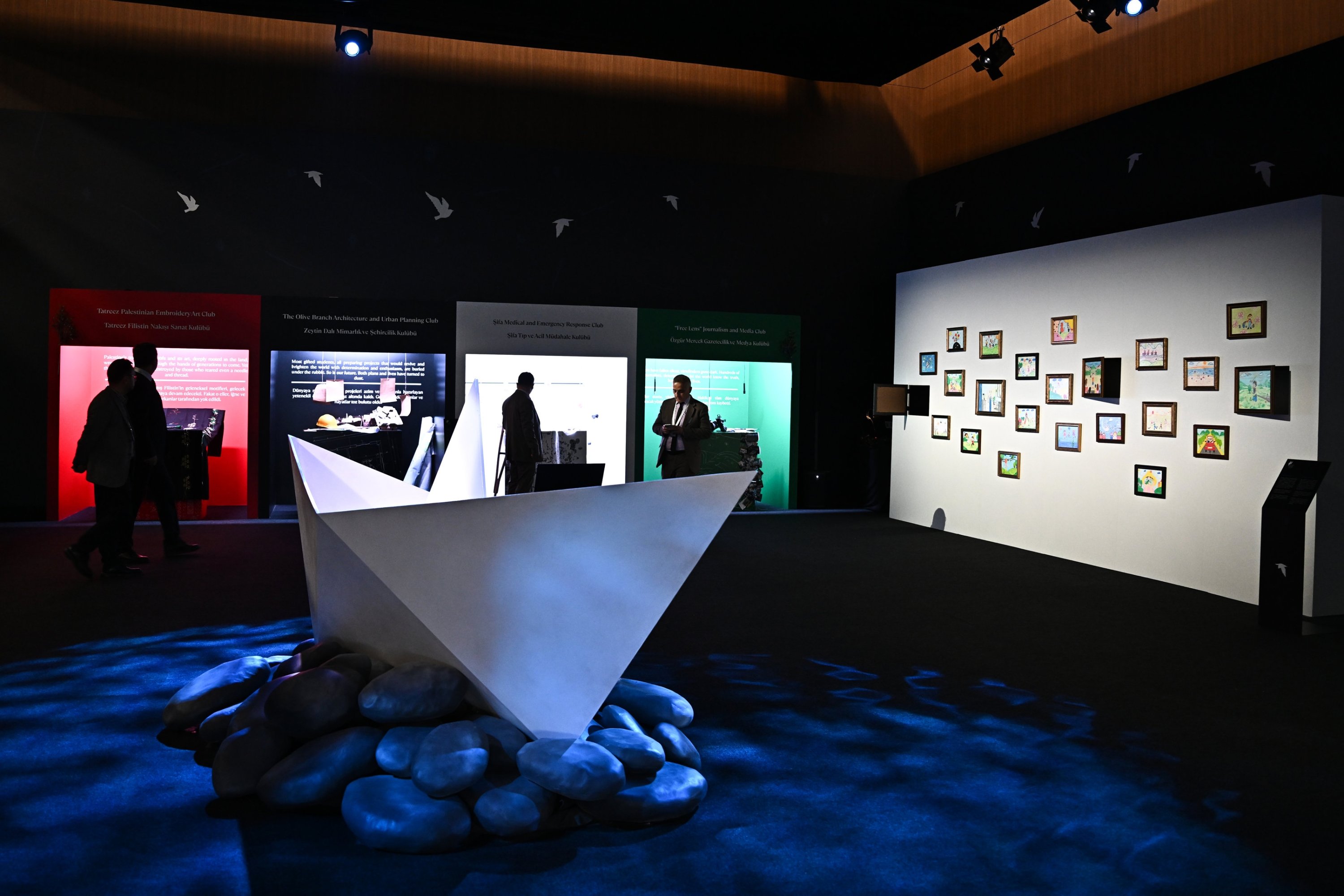
What the exhibition at the Antalya Diplomacy Forum achieved was something no panel could fully replicate: it translated a concept into an experience. Art does what diplomacy often cannot.
It bypasses strategic language and speaks directly to human perception. It does not ask for agreement; it demands recognition. It creates a space where denial becomes more difficult, where distance collapses, where the viewer is no longer an observer but a witness. Standing in that exhibition, one did not need data or reports to understand scholasticide but felt it through images, paintings done by children, video art and installations. Thus, the emptiness of a classroom becomes louder than any statistics; the image of a destroyed school carries more weight than a policy brief; the silence of absent children becomes a form of accusation no diplomat can easily deflect. This is why art is not peripheral to diplomacy; it is essential to it. Because diplomacy operates in the realm of interests, while art operates in the realm of conscience. And without conscience, diplomacy risks becoming merely technical.
To speak of art as necessary is often misunderstood as a romantic claim. It is not. Art is necessary because it allows societies to process reality. It provides a language for grief, for hope, for memory, for resistance. Without art, suffering becomes mute. Without art, history becomes easier to distort. Without art, the human experience becomes flatter, more easily reduced to numbers and narratives imposed from above. For individuals, art is a means of survival at the level of meaning, for nations, it is a means of survival at the level of identity.
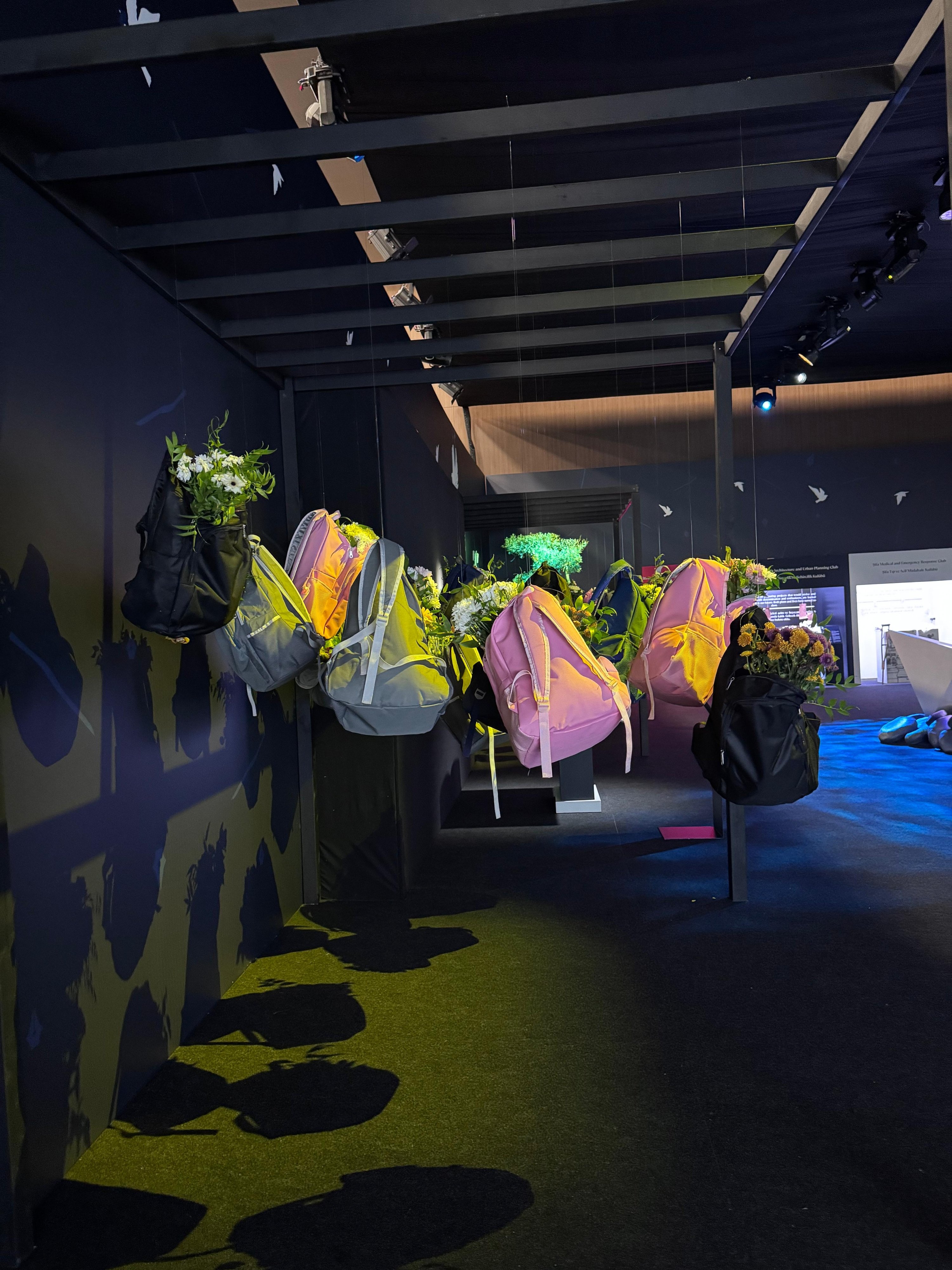
This is why scholasticide and cultural destruction are so often intertwined. The targeting of education is rarely isolated, it exists within a broader attempt to fragment memory, weaken identity, and disrupt continuity. Every artwork that documents, reflects, or reimagines such destruction becomes part of an alternative archive, one that refuses erasure. But the presence of the scholasticide exhibition suggests something more. It suggests that diplomacy is beginning, however slowly, to open itself to other forms of knowledge. That it recognizes, even if implicitly, that political dialogue alone is insufficient to grasp the full complexity of contemporary conflicts. The question now is whether this recognition will deepen.
Will art remain a side element, or will it become integrated into the core of diplomatic thinking?
Will the destruction of education remain a secondary issue, or will it be treated as a central threat to global stability?
In this regard, the Antalya Diplomacy Forum deserves recognition for refusing silence for bringing scholasticide into visibility not only as a political issue, but as a human and moral rupture articulated through artistic expression.
To render such violence visible through art is to resist erasure; it is to insist that memory remains active, that conscience is not anesthetized by the repetition of tragedy. Yet visibility alone is not enough. If the international community is to retain even a fragment of its ethical credibility, scholasticide must be explicitly defined, codified and prosecuted as one of the gravest war crimes under international law. For what crime could be more severe than the intentional destruction of a generation in the very spaces meant to cultivate its future? What greater violation exists than extinguishing life at the very moment it is being shaped toward knowledge, imagination and possibility? To elevate scholasticide to the highest level of legal and moral condemnation is not merely a juridical necessity, it is a civilizational imperative. Without such recognition, we risk normalizing the unthinkable; with it, we affirm that humanity still possesses the capacity to draw a line that must never again be crossed.
As I left the exhibition and returned to the structured world of panels and speeches, one thought remained persistent: diplomacy speaks loudly of the future, and art, standing quietly in between, reminds us of what is at stake.
And the Antalya Diplomacy Forum has the potential to become more than a meeting point of power; it can become a meeting point of awareness, where policy and perception, strategy and sensitivity, intellect and imagination converge in the most humane version as it can be.