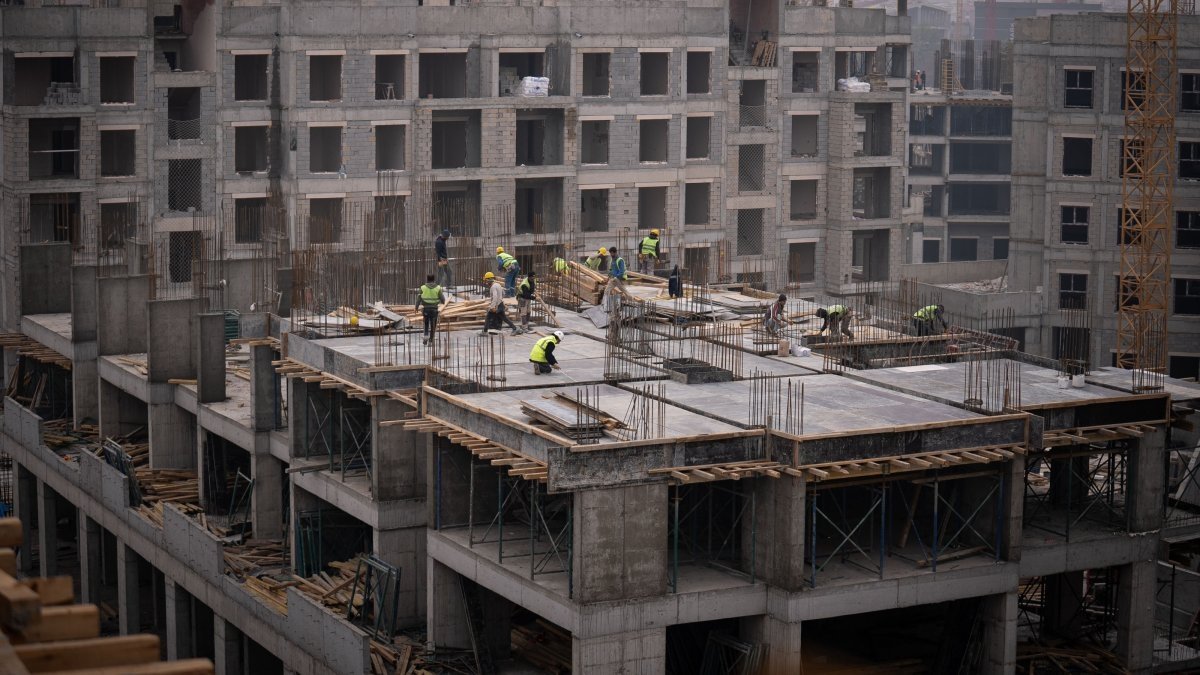
The construction sector made the largest contribution to Türkiye's economic growth in 2025 thanks to housing production, urban transformation projects and infrastructure investments, sector representatives said, adding that they expect this momentum to continue this year.
The Turkish economy grew by 3.6% last year, according to official data, being supported by the economic program implemented and maintaining expansion momentum despite tighter monetary conditions.
Like this, Türkiye ranked among the three fastest-growing economies among member countries of the Organisation for Economic Co‑operation and Development (OECD).
When the activities forming gross domestic product (GDP) are examined, the activity in the construction sector grew by 10.8% in 2025 compared with the previous year. It was the sector with the highest growth last year.
Sector representatives suggested the data once again reveals the increasing momentum in construction, noting that the surge in housing production, urban transformation and infrastructure investments has also made a significant contribution to the national economy.
Neşecan Çekici, head of the Real Estate Investors Association of Türkiye (GYODER), recalled in a statement that construction was among the sectors contributing most to economic growth.
"This development clearly shows that the sector has once again become one of the main drivers of growth," she told Anadolu Agency (AA), according to remarks published on Sunday.
"Construction has a multiplier effect that activates a very broad ecosystem simultaneously, including cement, iron and steel, ceramics, glass, paint, furniture, logistics, architecture and engineering, finance, insurance and real estate services," Çekici continued.
"For this reason, the acceleration in construction spreads across many areas of the economy, from industry to services, and from employment to tax revenues," she suggested.
Çekici also noted that the number of salaried employees in the construction sector rose from 1.8 million to 2 million over the past year.
At the same time, she pointed out that reconstruction efforts in earthquake-hit regions, urban transformation projects and infrastructure investments have helped keep production capacity and supply chains active through public-private cooperation.
"However, for sustainability, not only increased production but also access to financing, cost stability and predictable licensing and planning processes must be strengthened simultaneously," she said.
Furthermore, Çekici said the sector’s contribution to growth is expected to continue this year as well, although the continuation of momentum will depend on financial conditions. She added that in 2026, housing projects that are high-quality, located in the right areas and aligned with real demand will stand out.
She also pointed to several factors that would determine the sector’s trajectory this year, citing them as including improved access to credit and financing, easing volatility in input costs and labor costs, and ensuring that urban transformation expands with a focus on "quality and resilience."
Ziya Yılmaz, chairperson of the board of the Housing Developers and Investors Association (KONUTDER), similarly said that the construction sector’s 10.8% growth last year once again demonstrated its multiplier effect and strategic importance.
He emphasized that the comprehensive reconstruction process in earthquake-affected regions is being carried out on a scale that could set a global example.
Yılmaz also said that the construction sector does not only mean housing production but that it directly affects around 250 sub-sectors, making it one of the sectors with the broadest impact on employment, production and tax revenues.
"Our sector continues to make a strong contribution to the economy through both reconstruction in earthquake-affected areas and production activity across the country. However, in order for this contribution to turn into a sustainable locomotive effect, improving access to financing and supporting production continuity are of great importance," he furthered.
Yılmaz added that whether last year’s momentum can be sustained in 2026 will depend not only on domestic demand dynamics but also on global economic developments and geopolitical developments in the surrounding region.
He said Türkiye retains its potential thanks to its strong production capacity and dynamic housing demand.
Noting that the increase in building permits last year needs to translate into accelerated production, he said land and financing policies should be addressed together.
Engin Keçeli, chairperson of the Association of Construction Contractors and Real Estate Developers (INDER), said they were proud that the construction sector made the largest contribution to growth in 2025.
"This year will be much better. We never wish for instability in our region, but the whole world has seen that Türkiye is the safest haven in this region," he said.
"The value of our country is being recognized again. For this reason, we believe 2026 will be better than 2025," he added.
Pointing out that infrastructure investments in Türkiye have always continued, he went on to stay they have managed to recently overcome the slowdown experienced in housing production in previous years.
"The increase in new building permits this year indicates that housing production will continue. Because demand is high, we are obliged to increase supply. This will automatically bring growth," he said.
Mustafa Ekiz, head of the Real Estate and Construction Platform, said that for Türkiye’s economic growth to continue this year, sectors outside construction must also come into play.
He noted that this would improve the quality of economic growth while supporting employment and productivity.
Ekiz said that in the short-term, housing production and public and private sector investments could support growth, but in the long-term the country needs to accelerate transformation in sustainability, technology, exports and high value-added production.