The European Union remains hopeful of reaching a trade agreement with the United States despite President Donald Trump's intensified threat of 30% tariffs, the bloc's trade chief said Monday, amid growing pressure on Brussels to adopt a firmer stance.
European Trade Commissioner Maros Sefcovic's remarks came as EU ministers agreed on Monday to prioritise negotiations with the United States to avoid the levies that the trade chief said would wreck transatlantic trade.
Trump threw months of painstaking talks into disarray on Saturday by announcing he would hammer the bloc with the sweeping tariffs if no agreement is reached by Aug. 1.
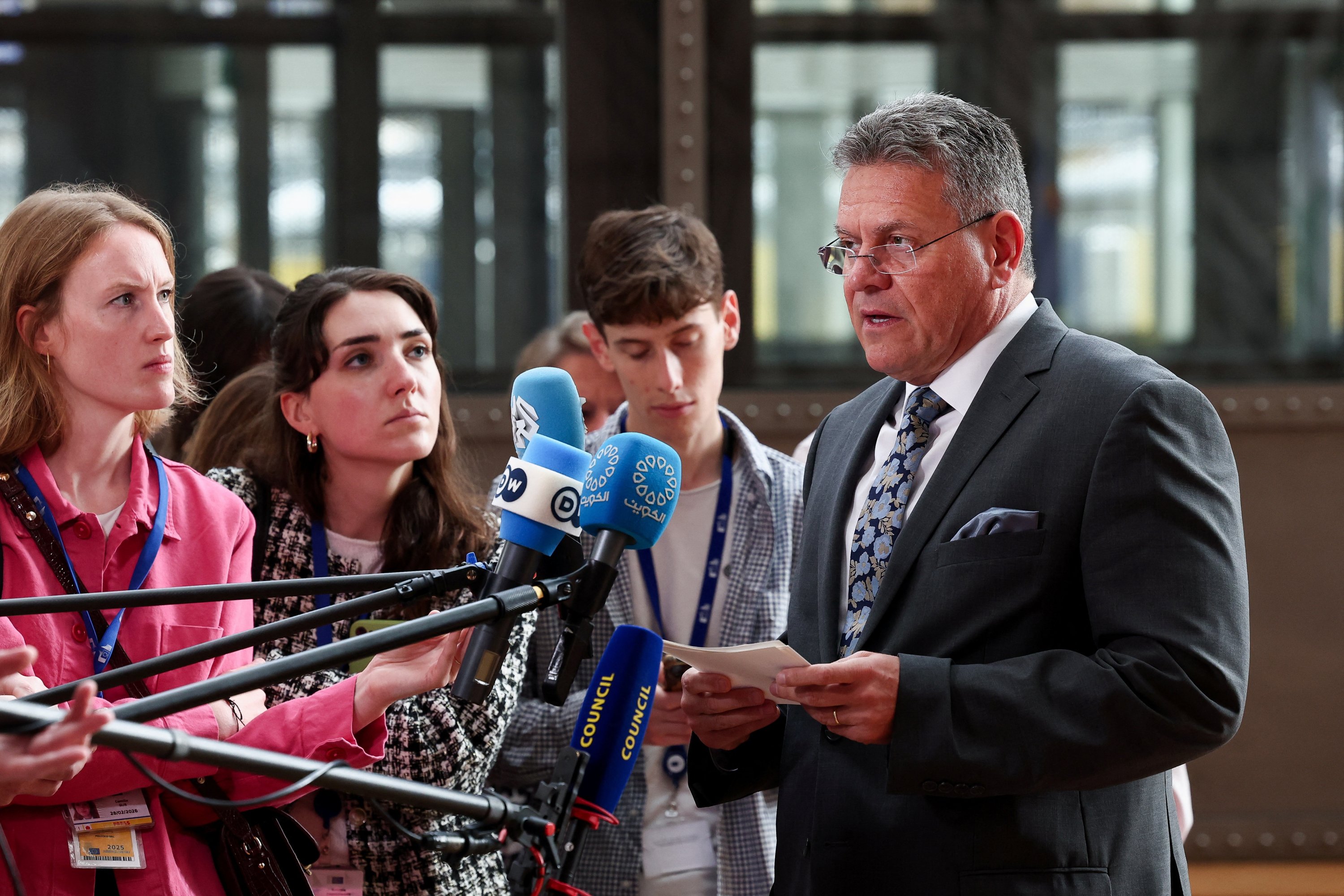
Heading into Brussels talks with EU trade ministers, Sefcovic said despite Trump's latest threat, he "felt" Washington was ready to continue negotiating – and he planned to speak with his U.S. counterparts later in the day.
Sefcovic, who is leading talks on behalf of the EU's 27 states, said reaching a deal remained the priority – while acknowledging calls from countries including key power France for the bloc to flex its muscles in negotiations.
"The current uncertainty caused by unjustified tariffs cannot persist indefinitely," Sefcovic told reporters, adding the EU was preparing for "all outcomes," including "well-considered, proportionate countermeasures."
A 30% tariff rate would make it almost impossible to continue trading as before, with enormous consequences for supply chains and negative impacts on both sides of the Atlantic.
"And therefore I think we have to do, and I will definitely do, everything I can to prevent this super-negative scenario," Sefcovic told reporters before the meeting on Monday.
European Commission chief Ursula von der Leyen on Sunday delayed a package of retaliatory measures over U.S. tariffs on steel and aluminium – a day before they were set to kick in – as a sign of goodwill.
But diplomats said an additional package of reprisal measures would be presented to trade ministers Monday that could be rolled out if Trump imposes the 30% tariffs.
The EU threatened in May to target a much bigger swathe of U.S. goods, including cars and planes, if talks fail. Diplomats said the finalized list was expected to be worth 72 billion euros ($84.2 billion).
France's Trade Minister Laurent Saint-Martin said retaliation plans should be drawn up with "no taboos," adding the weekend's setback called for a rethink of the bloc's tactics.
"If you hold anything back, you are not strengthening your hand in negotiations," he said at the Brussels talks. "Obviously, the situation since Saturday requires us to change our strategy."
Denmark's Foreign Minister Lars Lokke Rasmussen, whose country currently holds the EU presidency, said Brussels needed to show its strength.
"We don't want any kind of trade war with the U.S. ... we don't want to escalate things," he said.
"We want a deal, but there's an old saying: 'if you want peace, you have to prepare for war,'" he said ahead of the talks.
EU nations – some of which export far more to the United States than others – have sought to stay on the same page over how strong a line to take with Washington in order to get a deal.
French President Emmanuel Macron on Saturday urged von der Leyen's commission to "resolutely defend European interests" and said the EU should step up preparation for countermeasures.
German Chancellor Friedrich Merz agreed and said he had spoken to Macron, Trump and von der Leyen in the past few days and would "engage intensively" to try to find a solution.
Brussels had readied duties on U.S. goods worth around 21 billion euros in response to the levies Trump slapped on metal imports earlier this year.
But it held off on those measures to give space to find a broader trade agreement – and has now suspended them again until early August.
Since returning to the presidency in January, Trump has unleashed sweeping stop-start tariffs on allies and competitors alike, roiling financial markets and raising fears of a global economic downturn.
But his administration faces pressure to secure deals with trading partners after promising a flurry of agreements.
So far, U.S. officials have only unveiled two pacts, with Britain and Vietnam, alongside temporarily lower tit-for-tat duties with China.
The EU, alongside dozens of other economies, had been set to see its U.S. tariff level increase from a baseline of 10% last Wednesday, but Trump pushed back the deadline to Aug. 1.
The EU tariff is markedly steeper than the 20% levy Trump unveiled in April – but paused initially until mid-July.
Thomas Byrne, the minister for Ireland, whose pharmaceutical industry puts it on the front line of Trump's trade war along with industrial powerhouse Germany, called for Europe to "work our hardest" for a deal before Aug. 1.
"That gives us certainty, it protects investments, it protects jobs," he said.