One of Türkiye's leading business bodies said on Monday that a European industry without Türkiye would be "unthinkable," as the EU weighs a "Made in Europe" strategy that could prioritize regionally produced goods.
The initiative is expected to set minimum domestic content requirements for strategic products such as cars and batteries, as the bloc seeks to curb reliance on China. Details of the proposed rules are expected to be announced soon.
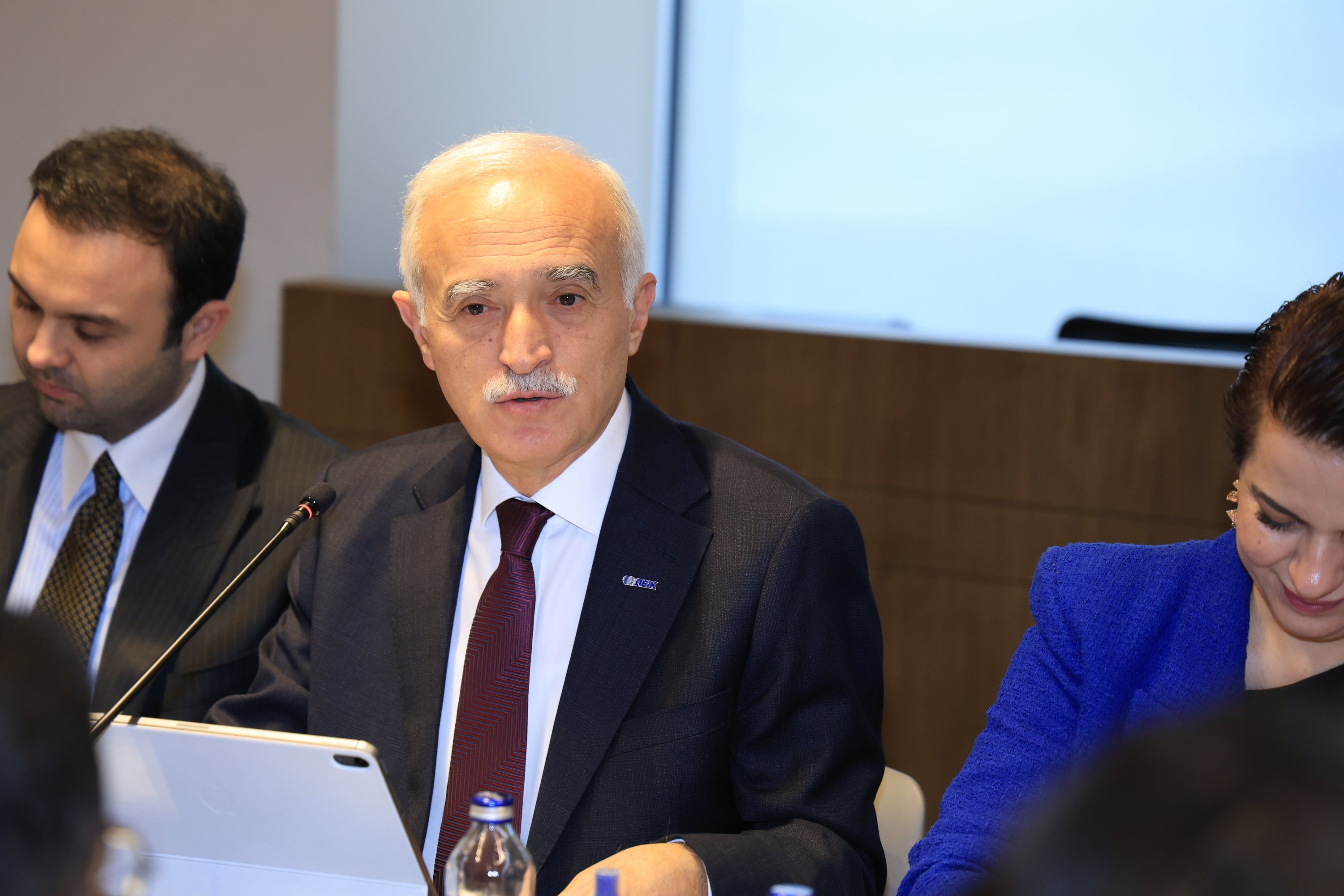
Nail Olpak, the head of the Foreign Economic Relations Board (DEIK), said the strategy has emerged as a new priority area for Türkiye. The uncertainty appears to add to long-standing frustration over the impasse regarding the update of the EU-Türkiye Customs Union.
Olpak said the most important lobbying effort in Europe in the coming period would focus on ensuring Türkiye is not disadvantaged by the initiative, which he says is widely seen as aimed at protecting European industry from Asia-Pacific competition.
"Europe strengthening its own industry is understandable," Olpak told reporters in Istanbul. "But we cannot accept a scenario in which Türkiye, which has been integrated with European industry for 30 years and has strong production capabilities, is excluded because of this approach."
Türkiye has long voiced frustration over the lack of progress in modernizing the customs union, which Olpak said would remain DEIK's main agenda item.
The deal was struck in 1995, before the European Commission formally proposed revamping the pact in 2016. But the Council of the EU never gave it a mandate to start negotiations amid a host of disagreements.
Turkish officials and businesses have long argued that the current agreement is outdated and no longer reflects global trade realities or the depth of today's economic relationship.
The pact was the first substantial customs union between the EU and a non-member country, covering industrial goods and processed agricultural products. A modernized agreement would expand the scope to services, agriculture in full and public procurement.
Olpak also flagged concerns over the EU's plan to abolish the 150-euro ($177.7) duty-free threshold for e-commerce imports and introduce additional customs duties.
"Our other focus is to ensure Türkiye, as a customs union member, is exempted from this practice," he said. Such an exemption would give Türkiye a competitive edge against China due to its logistical proximity to Europe, he noted.
Olpak also criticized the EU's free trade deal with the South American bloc Mercosur, noting that although Türkiye hasn't been part of the negotiations, such agreements become binding under the customs union framework.
Commenting on U.S. President Donald Trump's threat to impose a 25% tariff on countries that do business with Iran, Olpak said the issue had not yet affected trade.
On Syria, he said the country offered major potential for Turkish businesses, but warned that expectations for immediate reconstruction were unrealistic.
"Reconstruction in Syria is not something that can be done immediately," he said. "We are talking about amounts measured in the hundreds of billions of dollars. Questions such as who will finance this, which institutions or international organizations will be involved, all need time."
He said daily trade with Syria was likely to continue rising, but large-scale reconstruction projects would require improved security conditions and a longer timeframe.
Olpak said proposals for free-zone-style production hubs near the Syrian border were being seriously discussed, citing potential cost advantages and labor considerations.
"This could be important for us when we talk about production and labor costs," he said. "There is also the reality of Syrian refugees. These are issues on the table."
Such zones could involve dual-access systems on both sides of the border and would need to allow easy movement of labor and goods, Olpak said, adding that security and political dimensions would be key.
While textiles are often mentioned first, Olpak said the opportunity extended beyond a single sector.
"Textiles come to mind immediately, but it should not be limited to that," he said. "It would be more accurate to think in terms of medium-sized, workshop-scale manufacturing operations, which can be established and mobilized more quickly."
Following a challenging year for the economy and trade, Olpak said the business community expects financial conditions to improve moderately in 2026.
But he cautioned that global uncertainty driven by geopolitical tensions and protectionism remains the biggest risk.
Companies are looking for some easing in financial conditions in the near term and greater predictability over the longer run, he said.
"The anti-inflation program continues. From the perspective of our industrialists and exporters, competition and financing issues were truly at the forefront in 2025, and not everything went according to market expectations," he noted.
Olpak said the government's reference to 2026 as a "reform year" was one of the most encouraging signals for the business community.
"One of the positive aspects we see for 2026 is the use of the term 'Year of Reform.' This will bring a more positive approach in terms of the business world's expectations," he added.
In terms of financial conditions, both interest rates and the volume of access to credit, "we think there will be a slightly better picture compared to 2025."
Olpak stated that the increase in uncertainties and the decrease in predictability are what disturb the business world the most.
He said heightened geopolitical risks and declining predictability in global trade have prompted DEIK to pursue a "paradigm shift" in commercial diplomacy.
Olpak said they will develop "special strategies" by focusing primarily on 33 countries identified for the coming period.