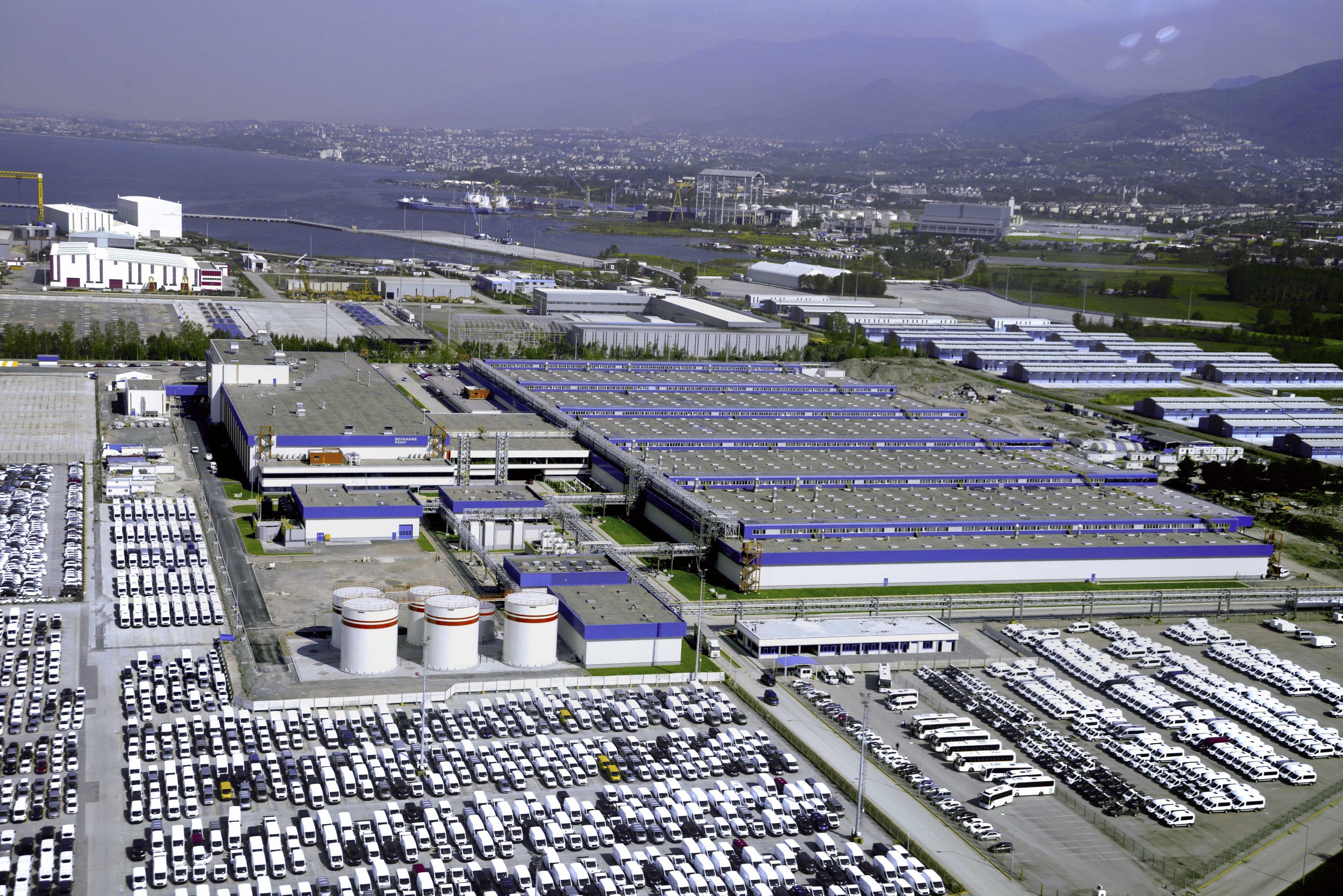
Ford of Europe President Jim Baumbick on Monday urged the European Union to ensure that the planned "Made in Europe" industrial policy remains open to partners such as Türkiye and the U.K., warning that excluding them would weaken production inside the bloc itself.
Baumbick's comments came after more than 1,100 CEOs and business leaders co-signed a newspaper article published across Europe late on Sunday backing the "Made in Europe" strategy, which would prioritize locally manufactured products.
The European Commission is expected to propose the so-called Industrial Accelerator Act later this month as part of efforts to bolster European industry against cheaper imports, particularly from China. The initiative has divided EU member states and industries.
The newspaper article was co-signed by CEOs from a broad range of industries, including steelmakers ArcelorMittal and Tata Steel, drugmakers Novo Nordisk and Sanofi, tiremakers Continental, Michelin and Pirelli, airline group Air France KLM and French utility Engie.
"Canadian Prime Minister Mark Carney is right: those who are not sitting at the table now will end up on the menu... Steel is inextricably linked to this," said Marie Jaroni, CEO of Europe's No. 2 steelmaker Thyssenkrupp Steel Europe, another signatory.
Car makers were absent from the list, however, since, owing to their sprawling global supply chains, they are concerned about how narrow the "Made in Europe" definition will be.
"Ford supports strengthening Europe's industrial base, but the planned 'Made in Europe' rules must remain open to trusted partners like the U.K. and Türkiye," Ford's Baumbick said in a comment to Reuters.
"Our European factories depend on deeply integrated supply chains in the U.K. and Türkiye and excluding them would weaken production inside the EU itself."
Türkiye is one of the largest automotive producers in Europe and is home to manufacturing facilities of many of the world's top auto suppliers.
Nearly 70% of Türkiye's automotive exports go to Europe and the country produces the vast majority of the continent's light commercial vehicles. Türkiye itself imports roughly 8% of Europe's total vehicle exports, making it the continent's fourth-largest market.
Business leaders in Türkiye have also expressed caution over uncertainty regarding Europe's new plan.
Nail Olpak, the head of the Foreign Economic Relations Board (DEIK), last week said a European industry without Türkiye would be "unthinkable."
"Europe strengthening its own industry is understandable," Olpak told reporters. "But we cannot accept a scenario in which Türkiye, which has been integrated with European industry for 30 years and has strong production capabilities, is excluded because of this approach."
In the co-signed article, EU industry chief Stephane Sejourne argued that Europe must protect its strategic sectors.
"Without an ambitious, effective and pragmatic industrial policy, the European economy is doomed to be just a playground for its competitors," he wrote. "We must establish, once and for all, a genuine European preference in our most strategic sectors," the French member of the Commission said.
Stefan Hartung, CEO of major car parts supplier Bosch, cautioned that the new rules should "address level-playing field issues" rather than "compensate for competitive disadvantages."
Governments, including France, are championing the idea of "Made in Europe" regulations. But others, including Sweden and the Czech Republic, warn that "buy local" requirements could deter investment, raise prices in government tenders, and hurt the EU's competitiveness globally.
"The Chinese have 'Made in China,' the Americans have 'Buy American,' and most other economic powers have similar schemes that give preference to their own strategic assets. So why not us?" Sejourne wrote.
"Whenever European public money is used, it must contribute to European production and quality jobs."
Local content is also taking center stage in negotiations for the European Commission's next 2028-2034 budget.
But Mercedes-Benz CEO Ola Kaellenius told reporters that local content requirements risked driving up inflation and shrinking the market.
"You have to be incredibly, incredibly careful here to use a scalpel," he said.