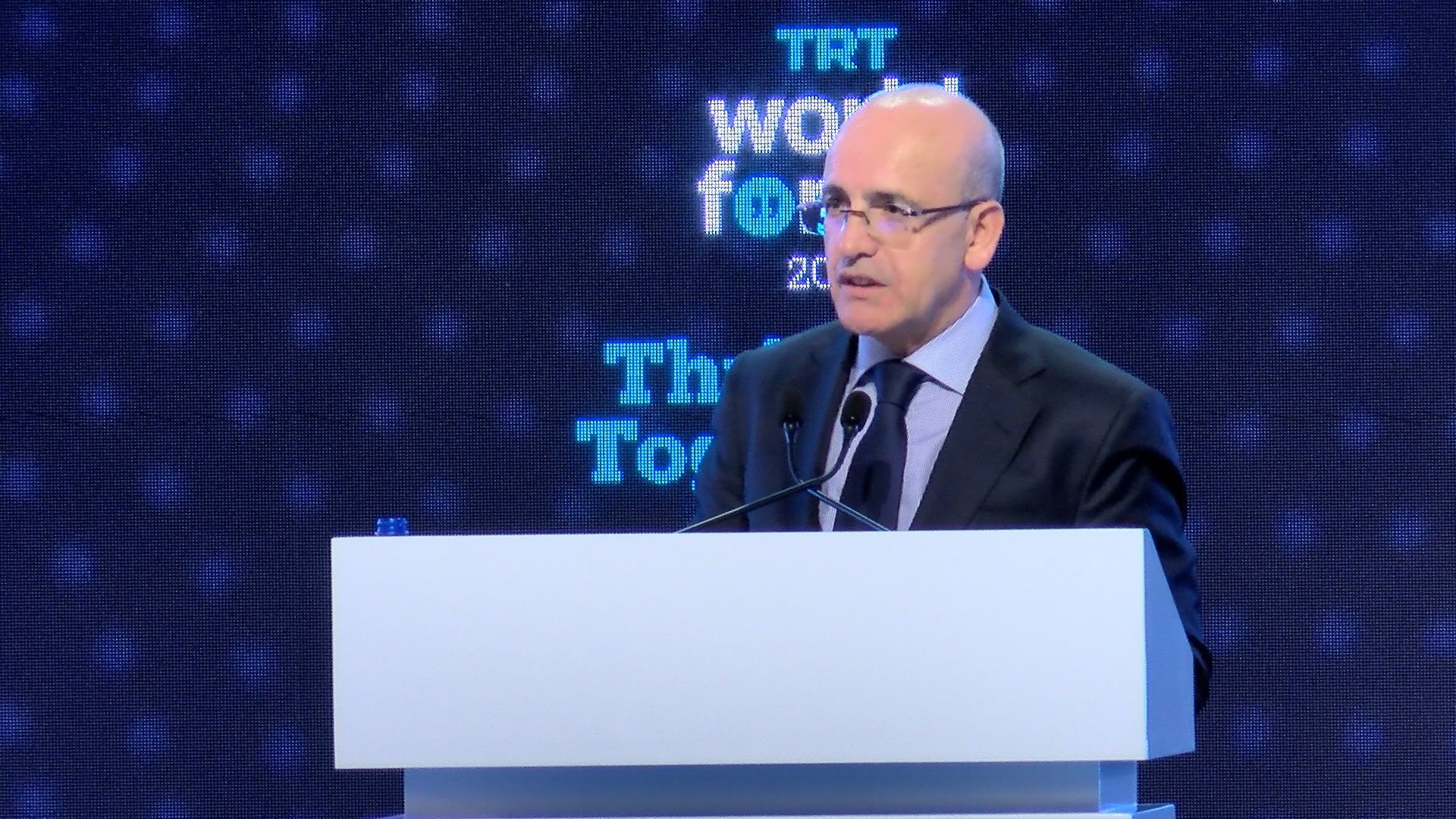
Authorities have begun to see the outcomes of the economic steps taken, Treasury and Finance Minister Mehmet Şimşek said Sunday, pointing to the improvement in the outlook, increasing investor confidence and the rise in gross reserves, which have reached the highest level of all time, according to official data from last week.
"Investor confidence has increased with the policies we have implemented, risk premium has decreased, our reserves have strengthened, and exchange rate volatility has decreased. The hemorrhage in the Turkish lira has stopped," Şimşek told Sabah daily.
Detailing the scope of outcomes due to policies implemented, the minister provided information on other indicators of the improving economic outlook, apart from strengthening reserves such as a dropping risk premium, which has plummeted significantly since May.
"The credit default swap (CDS) showing our country's risk premium was above 700 basis points in May," he said.
"As of Dec. 7, it has decreased to 336 basis points. While Türkiye's risk premium declined by more than 300 basis points between May and December, the average risk premium of developing countries has fallen by 55 basis points," he explained.
President Recep Tayyip Erdoğan appointed the new economic administration following the May elections, naming respected veteran Şimşek the new finance and treasury minister and Hafize Gaye Erkan as the new central bank governor, the first woman to hold the post.
Furthermore, the minister pointed out what he said was decreasing exchange rate volatility on a monthly basis when compared to May.
"Exchange rate volatility has decreased, and the hemorrhage in the Turkish lira has stopped. The implied exchange rate volatility of one-month options was 57% in May, and as of Dec. 7, it has dropped to 9%. During this period, the average volatility of developing countries was 11%," he noted.
The minister also said that rebalancing in the growth has commenced, and they were moving "toward a more balanced composition."
In addition, he also evaluated the current account gap, providing detailed information on the contribution of the domestic demand to growth, which he said had shown signs of decreasing when compared between the second and third quarters.
"If we compare the second quarter with the third quarter of the year, the contribution of domestic demand to growth decreased from 10.2 points to 8.5 points. The negative contribution of net foreign demand also decreased from 6.3 points to 2.6 points," he said.
"The current account deficit is decreasing. The annualized current account deficit showed an improvement of $8.6 billion in September compared to May, reaching $51.7 billion," he noted.
Türkiye's economy expanded by a more-than-expected 5.9% in the third quarter, driven by household spending, official data showed earlier this month, but activity is expected to slow after aggressive monetary tightening meant to cool domestic demand and rein in inflation.
Gross domestic product (GDP) grew 0.3% from the previous quarter on a seasonally and calendar-adjusted basis, data from the Turkish Statistical Institute (TurkStat) showed.
The minister also mentioned the rating outlook, which he said was "improving," referring to the upgrades by rating agencies Standard & Poor's and Fitch Ratings.
"S&P raised our rating outlook first to stable and then to positive. Fitch upgraded it from negative to stable," he said.
In his interview with Sabah, Şimşek also evaluated the so-called KKM scheme, which authorities began to roll back earlier in August to urge conversions from KKM to standard lira accounts.
"There are withdrawals from FX-protected KKM accounts," he said.
"With the normalization of monetary policy, Turkish lira returns have begun to increase. The volume of deposits under the scheme stood at TL 3.3 trillion on Aug. 25. As of Dec. 1, this amount decreased to TL 2.7 trillion," he explained.
"Our gross reserves are also increasing. Gross reserves have increased by $41.7 billion since the end of May, reaching $140.1 billion, the highest level of all time," he maintained.
According to a separate report obtained by the Anadolu Agency (AA) Sunday, the minister is expected to embark on a new round of investor meetings along with Central Bank of Republic of Türkiye (CBRT) Governor Erkan in Spain's capital Madrid on Dec. 14-15.
There, the minister is expected to meet with senior executives of more than 80 Spain-based global companies with a total turnover exceeding 600 billion euros ($646 billion).
The report said he would also meet with more than 30 banks and fund managers managing $2 trillion in assets, while the meetings are also set to address the issues regarding the cooperation of Turkish-Spanish companies in third countries.
The new economic administration had a series of meetings with top executives and global financial bodies since June, while the central bank last month announced it would hold its first investor day meeting in New York on Jan. 11, 2024.