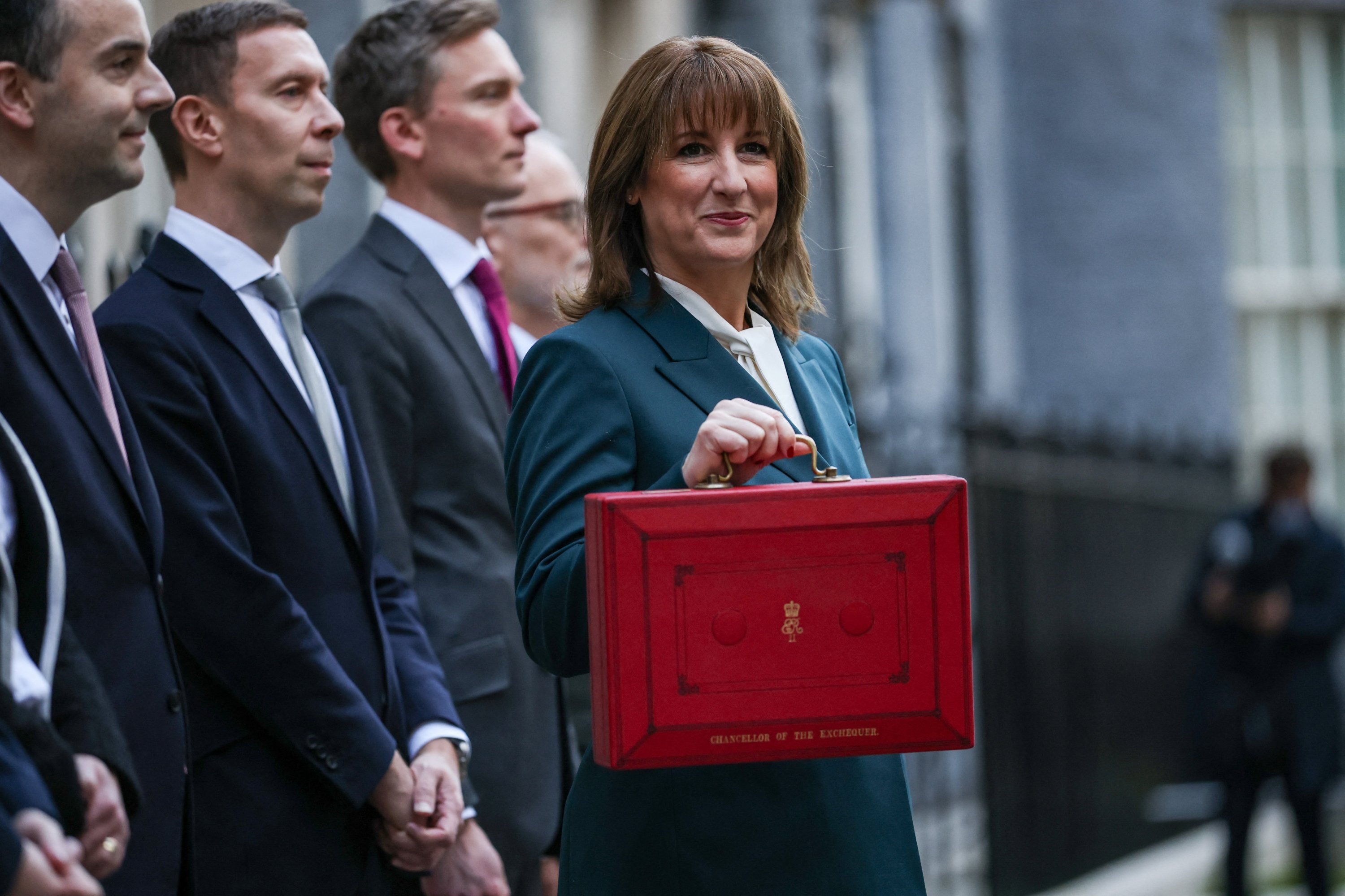
British Treasury chief Rachel Reeves delivered a budget on Wednesday that will take more tax from workers, people saving for a pension and from investors to give herself more room for meeting her borrowing targets.
But the chaos that has engulfed the Labour government during weeks of mixed messaging and political infighting continued up to the final moment. The entire contents of the budget were accidentally leaked shortly before Reeves delivered the budget statement.
The error sparked anger and mockery in the House of Commons, and a frenzy on trading room floors. A senior economist in London at a top broker said he was in "a state of shock" when reading the headlines, which pushed the pound and U.K. government bond prices higher.
The Office for Budget Responsibility (OBR) cut its forecasts for growth in the British economy over the coming years.
But in a figure closely watched by investors assessing Britain's borrowing risks, the OBR said the government will now have more than double its previous buffer for meeting its fiscal targets even as it raises spending on welfare.
This result was in large part due to more than 26 billion pounds ($34.4 billion) of fresh tax rises, which came just over a year after Reeves ordered 40 billion pounds of tax hikes – the biggest since the 1990s. She had promised last year's rises would be a one-off.
The government was elected in a landslide victory in July 2024 on a promise not to raise taxes on income for working people, and Reeves acknowledged some of the budget's tax hikes broke the spirit of that pledge and would face criticism.
"No doubt, we will face opposition again. But I have yet to see a credible, or fairer alternative plan for working people," Reeves said to cheers from Labour Party lawmakers.
"I am asking everyone to make a contribution, but I can keep that contribution as low as possible because I will make further reforms to our tax system today to make it fairer and to ensure the wealthiest contribute the most."
British government bond yields – which are sensitive to concerns about higher borrowing – were lower at 1340 GMT than they were before the OBR report was published in error ahead of Reeves' annual tax and spending speech to parliament.
The fall in borrowing costs suggested investors were largely comfortable with the budget plan.
The value of sterling rose against the U.S. dollar and the euro.
The unprecedented early release revealed the key announcements from the budget on taxes, economic growth and individual policy changes. The OBR apologized quickly for the "technical error" and said it had initiated an investigation "into how this happened."
One Labour lawmaker said Reeves had found out about the mistake as she walked into parliament for the prime minister's weekly question-and-answer session, which preceded the budget.
During Prime Minister's Questions, she scribbled notes with one of her Treasury ministers, Torsten Bell. "This is deeply disappointing and a serious error on their (the OBR's) part," Reeves said.
Kemi Badenoch, the leader of the opposition Conservative Party, said the error made Britain look like a "shambolic, laughing stock" and said Reeves should consider resigning.
"If she doesn't resign for breaking her promises (on the economy), she should sure as hell should go for this," she said.
As Reeves started to deliver her budget, she was taunted by opposition lawmakers, with one shouting: "We've already read it. Surprise us".
She had promised to take "fair and necessary choices" to improve the country and speed up economic growth, but she recognized the unhappiness among voters.
Although Britain's next national election is not due until 2029, the authority of Reeves and Prime Minister Keir Starmer has been questioned within the center-left Labour Party.
The OBR said the headroom – the amount of extra spending or tax cuts possible for the government while staying within its budget rules – now stood at almost 22 billion pounds in five years' time.
In March, the OBR had forecast headroom of 9.9 billion pounds, a historically low level which was eaten up by a downgrade of the country's economic outlook, higher-than-expected borrowing costs and a U-turn on welfare reform.
The OBR said in its budget assessment that tax rises planned by Reeves would raise an annual 26.1 billion pounds by 2029-30, chief among them a longer freeze on the thresholds at which people start to pay income tax and a higher rate of income tax.
The three-year extension of the freeze on income tax thresholds – which was first introduced by the previous Conservative government – would raise an extra 8 billion pounds in the 2029/30 financial year, the OBR said.
Reeves said in her first budget last year that she was returning stability to the public finances after the shocks delivered by Brexit, the coronavirus pandemic and the "mini-budget" crisis of former Conservative Prime Minister Liz Truss.
The generosity of pension incentives was scaled back with social security charges on salary-sacrificed pension contributions, raising almost 5 billion pounds.
Increasing tax rates on dividends, property and savings income by 2 percentage points would raise 2.1 billion pounds, the OBR said.
An annual tax on homes worth more than 2 million pounds was expected to raise 400 million pounds in 2029/30.
Public spending was due to grow every year as a result of the measures in the budget – reaching an extra 11 billion pounds in 2029/30 – primarily to pay for a government U-turn in July on welfare cuts and lift a two-child welfare limit for families.
The OBR cut its forecasts for economic growth, saying gross domestic product was forecast to grow by 1.5% on average over the five-year forecast period, 0.3 percentage points slower than it expected in March due to lower productivity growth.
Reeves vowed she would do better: "We beat the forecasts this year and we will beat them again," she told parliament.