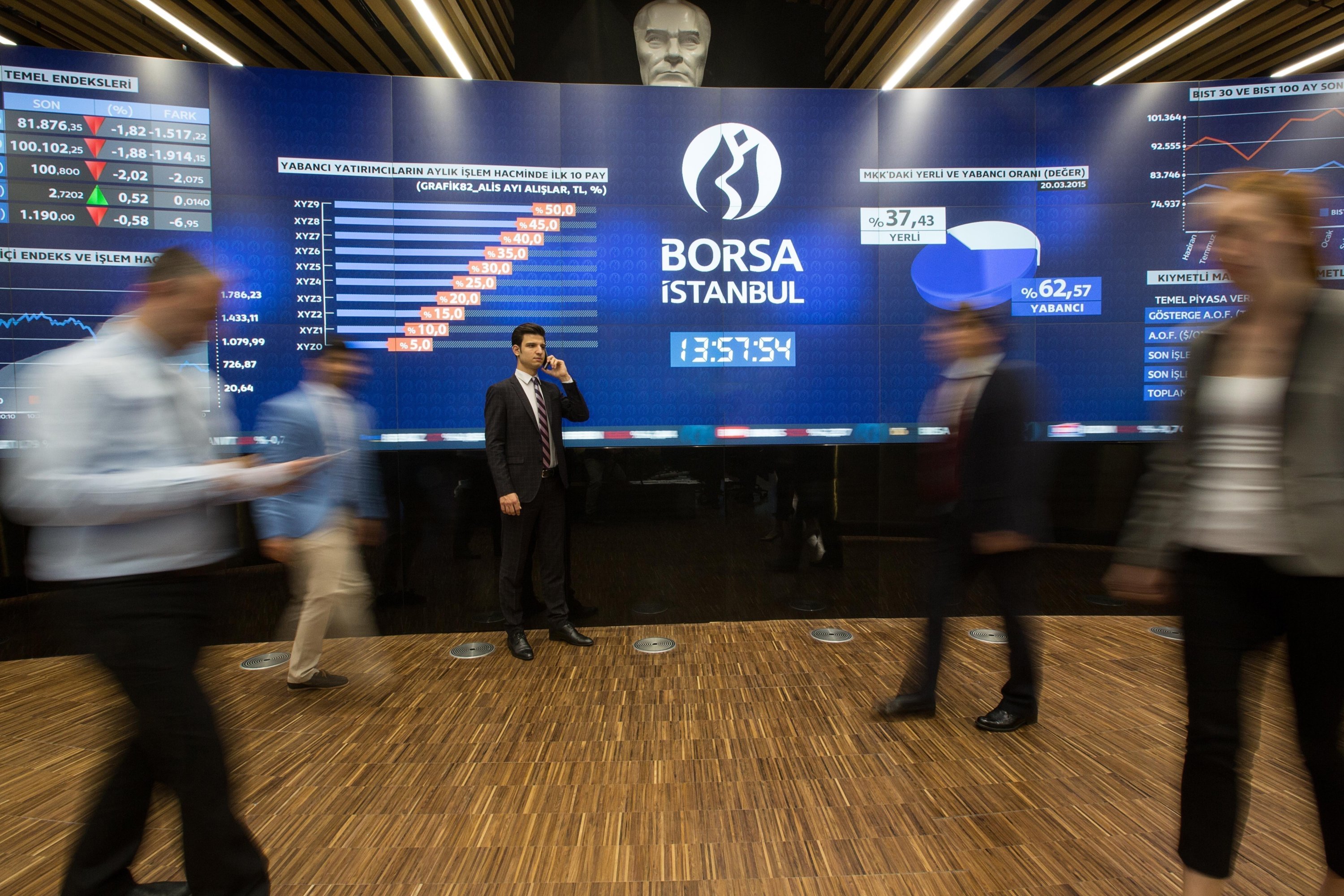
Turkish benchmark stock index, BIST 100, hit a new record high for the first time in about four months on Monday, supported by positive signals from domestic macroeconomic data and the decline in Türkiye's borrowing costs.
Starting the year at 11,296.52 points, the BIST 100 index broke a new record in the first trading week of the year. The rise in the BIST 100 index, led by the financial leasing and factoring index, exceeded 1.3%. After the market opened on Monday, the BIST 100 index reached a record high of 11,675.73 points.
The previous record was set on Aug. 26, 2025, at 11,605.30 points.
Later during the day, the index edged up further to 11.678,73 points at 3.30 p.m. local time (12:30 GMT).
On Friday, the BIST 100 rose by 2.1% to close at 11,498.38 points, with a daily transaction volume of TL 115.9 billion ($2.61 billion).
Global markets are trending positively amid strong expectations for interest rate cuts by the U.S. Federal Reserve (Fed), easing concerns about "overvaluation" in technology and AI companies, and a decline in oil prices, which are expected to support the ongoing global fight against inflation.
While these developments have had positive effects on domestic markets, steps taken by Türkiye's economic administration and the impact of the monetary policy conducted by the Central Bank of the Republic of Türkiye (CBRT) were reflected in macroeconomic indicators.
In Türkiye, inflation in December came in at 0.89% month-over-month, below expectations. On an annual basis, inflation dropped to 30.89%, the lowest level in 49 months.
Additionally, as the CBRT gradually continues its rate-cutting cycle, the steady rise in total reserves helps mitigate possible exchange rate risks. As of Dec. 26, the CBRT's total reserves had risen to $193.87 billion.
On top of that, easing regional tensions and Türkiye's strong geopolitical stance have increased foreign investor interest in Turkish lira assets, while also leading to a decrease in the country's borrowing costs.
Türkiye's 5-year credit default swap (CDS) fell to 204.5 basis points, its lowest level since May 2018.
Meanwhile, the country also posted a current account surplus of $457 million in October. This marked the fourth consecutive month of surplus, with the cumulative surplus for July, August, September, and October reaching $8.65 billion.
Seda Yalçınkaya Özer, manager of the research department at Integral Yatırım, told Anadolu Agency (AA) that the stock market hit a new record in Turkish lira terms on Monday. "Supported by last week’s optimism, the lower-than-expected December CPI data boosted the index today," she said, referring to the consumer price index (CPI) reading.
However, Yalçınkaya noted that in USD terms, the stock market is still 28% below its record high, adding that "when evaluating returns, the basis on which we look is critical."
"For the index to test a new peak in USD terms at current exchange rates, it would need to rise to around 14,800. If domestic and global risks remain balanced, we may see a convergence toward these levels during the year," she noted.
Ismet Demirkol, founder of Pariterium Consulting, said: "The fact that inflation came in at 0.89% in December strengthened expectations that the central bank will continue its rate cuts, which supported the rise in the stock market."
He also suggested that the downward trend in CDS contributed to the upward movement in the stock market.