Drinking tea in Türkiye is one of the most potent symbols of social life. The steam rising from the tulip-shaped glass carries the silent ritual of conversation, waiting and shared reflection. Tea houses, found on almost every corner and at every hour, serve as the spatial memory of this ritual. From the wooden benches of village squares to the backstreet cafes of Istanbul, from the coastal teahouses of the Black Sea to the mud-roofed tea stalls of Central Anatolia, there exists a wide variety. For this reason, tea in Türkiye is not merely a beverage; it is a shared table where memories quietly take root.
The roots of teahouses go back to the coffeehouses and reading rooms ("kıraathane") of the Ottoman era. From the 16th century onward, the coffeehouses that began to appear in the narrow streets of Istanbul were not just places where coffee was consumed; they were also spaces of communication, literary conversation and social gathering. The word “kıraathane” means “reading house.” In these places, newspapers, books and pamphlets were read aloud and the public followed the agenda from there. In this way, coffeehouses not only nourished oral culture but also served as a bridge, bringing written culture to different segments of society.
With the proclamation of the Republic, coffeehouses gradually gave way to teahouses. From the mid-20th century onward, as tea cultivation spread along the Black Sea coast, tea replaced coffee. Thanks to its affordability, ease of preparation and compatibility with the culture of sharing, tea quickly became central to people’s daily lives. This transformation was not merely a change in beverage preference; it also marked the birth of a new social space – the teahouse – within Türkiye’s modernization process.
Teahouses inherited part of the function once held by reading rooms, while at the same time creating a different sphere of sociability. Public readings of books and newspapers gave way to radio programs, television series and current conversations. Yet, the essence of the space – the culture of being together and sharing words – was preserved and carried into the present day.
In Türkiye, teahouses are places where not only daily life but also politics are closely followed. During local election periods, the conversation tables set up in these coffeehouses turn into small “neighborhood assemblies.” Here, campaign promises are debated, new projects discussed and even mayoral candidates’ plans are put on the table; the community’s demands and grievances are voiced and crises are resolved. In this sense, teahouses become informal spaces of consensus, where even neighborhood disputes or family tensions are eased by the simple act of sharing a glass of tea.
Over a single cup of tea, every topic finds its way onto the table – from economic crises to foreign policy, from local services to football. In this respect, teahouses are among the most vivid manifestations of the public sphere at the grassroots level. At this point, Jürgen Habermas’s notion of the “public sphere” comes to mind; yet Türkiye’s teahouses differ from Western coffeehouses in that they are built more on horizontal relationships. Here, an invisible bridge is formed between power and the people.
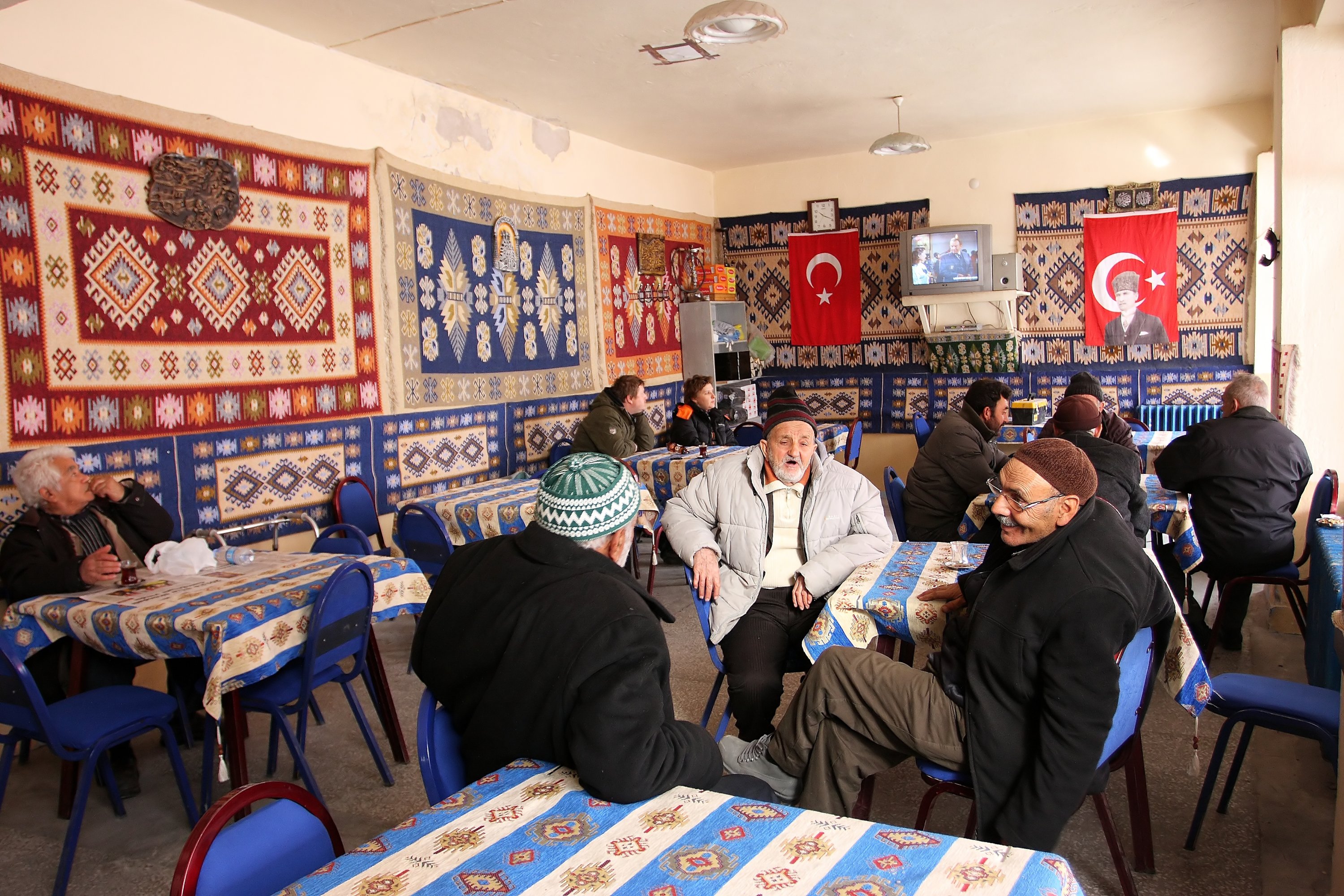
In difficult times, whether during economic hardships, social tensions or disasters such as earthquakes and floods, teahouses become spaces of unity, shared sorrow and solidarity, where people gather around small tables to share troubles and seek solutions. Here, they share their problems, search for solutions, console one another and sometimes remain silent together, carrying the same anxieties, worries and hopes.
At the same time, teahouses are also stages of joy. They are where national matches are watched with excitement, championships celebrated collectively, and the sweet commotion of a neighbor opening a new shop or a young man leaving for military service is shared. The warmth of tea lightens the weight of grief and multiplies happiness. In this way, teahouses in Türkiye endure as unique places where a community’s sorrows and joys are united around the same table.
The question “Shall we have tea?” in Türkiye is far more than a simple offer of a drink; it is often an outstretched hand, a gesture of comfort from one who notices the sadness on a friend’s face. A companion who has withdrawn into silence may open up over the steam rising from a tulip-shaped glass, as the warmth of tea unlocks the door to conversation. In this sense, drinking tea becomes a practice of compassion, a small yet profound gesture that rebuilds solidarity in the flow of everyday life.
From celebrating the joy of a new job with friends to reuniting with someone long unseen, many gatherings find their pretext in tea. Sometimes it accompanies success, and other times it makes an ordinary day meaningful. Thus, the invitation “Shall we have tea?” becomes a form of sharing that strengthens relationships, deepens conversation and slows down time so that its taste can be fully savored.
The influence of tea on society has naturally found its reflection in Turkish literature. For Ahmet Hamdi Tanpınar, tea is a symbol that conveys the rhythm of time and slows it down through conversation. Orhan Pamuk recalls Istanbul’s melancholy and fading memory through the image of tea in a tulip-shaped glass, evoked in everyday scenes. Sait Faik Abasıyanık portrays tea as a detail that reveals humanity and sharing in the world of fishermen, workers and ordinary people. In Cemal Süreya’s work, tea becomes a metaphor where love and affection meet daily life; it is a feeling shared in a tulip-shaped glass. For Turgut Uyar, tea is the companion of solitude and the complement of friendly conversations. In Necip Fazıl Kısakürek’s writings, tea appears as an accompaniment in the background of thought and contemplation. Latife Tekin depicts tea as a symbol of solidarity and hospitality in lives shaped by the migration from village to city, while for Murathan Mungan, tea is the warm emblem of belonging and hospitality in the households of the Southeast.
In European cities, “cafe culture” has long been seen as a mirror of urban identity and public life. In Paris, cafes became gathering places for writers, while in Vienna, they hosted political debates. In Türkiye, however, teahouses assumed a similar function through the warmth of tea. Around these small wooden tables, it is not only tea that is consumed but also ideas that are steeped, friendships that are nurtured and the social agenda that is constantly reshaped. A glass of tea may spark an acquaintance between strangers or soften political discussions, turning them from the cold rhetoric of officialdom into genuine dialogue. In this sense, teahouses embody a different kind of intimacy compared to Western cafe culture: they rest not on individuality, but on a culture of community and shared experience.
Yet, teahouses are more than political or cultural forums – they are places where the rhythm of everyday life slows down. Morning tea before breakfast, or afternoon breaks at the workplace, show that tea in Türkiye is not merely about quenching thirst but about embodying togetherness and sharing. Waiting for it to steep is, in itself, a quiet exercise in patience and listening. The slow brewing of tea becomes a subtle resistance to the hurried pace of modern life, while the steam rising from a tulip-shaped glass dissolves loneliness and unites differences at a common table. In this way, even a single glass of tea in an Anatolian teahouse can turn into an unforgettable memory of hospitality for a visitor and a shared pause in time for those who gather around it.