Daily Sabah logo

Politics
Diplomacy Legislation War On Terror EU Affairs Elections News Analysis
TÜRKİYE
Istanbul Education Investigations Minorities Expat Corner Diaspora
World
Mid-East Europe Americas Asia Pacific Africa Syrian Crisis Islamophobia
Business
Automotive Economy Energy Finance Tourism Tech Defense Transportation News Analysis
Lifestyle
Health Environment Travel Food Fashion Science Religion History Feature Expat Corner
Arts
Cinema Music Events Portrait Reviews Performing Arts
Sports
Football Basketball Motorsports Tennis
Opinion
Columns Op-Ed Reader's Corner Editorial
PHOTO GALLERY
JOBS ABOUT US RSS PRIVACY CONTACT US
© Turkuvaz Haberleşme ve Yayıncılık 2026

Daily Sabah - Latest & Breaking News from Turkey | Istanbul

  • Politics
    • Diplomacy
    • Legislation
    • War On Terror
    • EU Affairs
    • Elections
    • News Analysis
  • TÜRKİYE
    • Istanbul
    • Education
    • Investigations
    • Minorities
    • Expat Corner
    • Diaspora
  • World
    • Mid-East
    • Europe
    • Americas
    • Asia Pacific
    • Africa
    • Syrian Crisis
    • Islamophobia
  • Business
    • Automotive
    • Economy
    • Energy
    • Finance
    • Tourism
    • Tech
    • Defense
    • Transportation
    • News Analysis
  • Lifestyle
    • Health
    • Environment
    • Travel
    • Food
    • Fashion
    • Science
    • Religion
    • History
    • Feature
    • Expat Corner
  • Arts
    • Cinema
    • Music
    • Events
    • Portrait
    • Reviews
    • Performing Arts
  • Sports
    • Football
    • Basketball
    • Motorsports
    • Tennis
  • Gallery
  • Opinion
    • Columns
    • Op-Ed
    • Reader's Corner
    • Editorial
  • TV
  • Life
  • Health
  • Environment
  • Travel
  • Food
  • Fashion
  • Science
  • Religion
  • History
  • Feature
  • Expat Corner

Jupiter still largest planet, but not as huge as we thought

by Reuters

WASHINGTON Feb 05, 2026 - 12:44 pm GMT+3
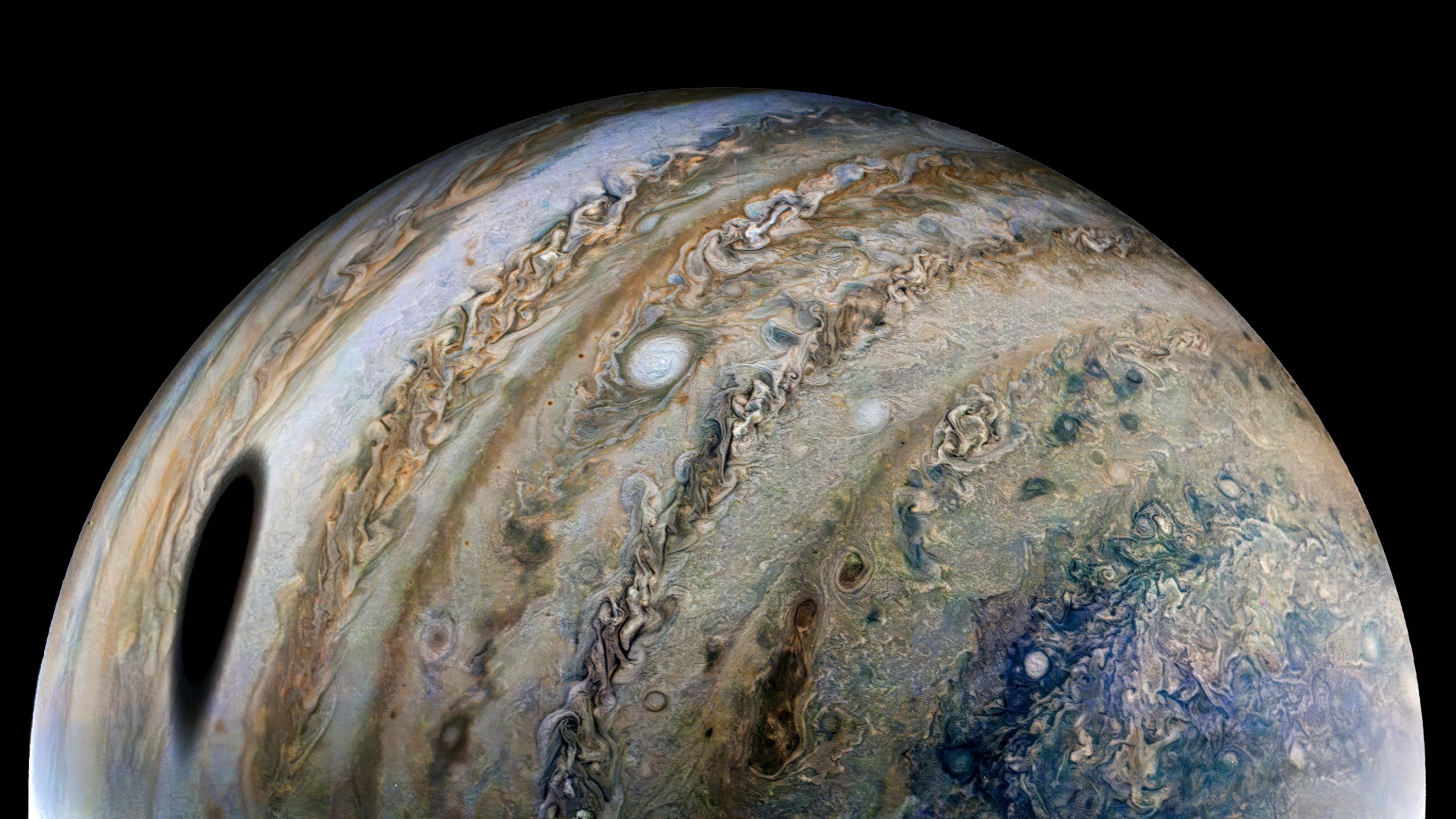
An enhanced-color image, using raw data from the JunoCam instrument aboard NASA's Juno spacecraft, shows the planet Jupiter, with a shadow of its moon Ganymede on the left, released by NASA on April 21, 2022. (Reuters Photo)
by Reuters Feb 05, 2026 12:44 pm

Jupiter, without a doubt, is ⁠the biggest planet in our solar system. But it turns out that it is not quite as large – by ever so small an amount – as scientists had previously ​thought.

Using new data obtained by NASA's robotic Juno ‍spacecraft, scientists have obtained the most precise measurements to date of Jupiter's size and shape. This is important information to gain a fuller understanding of this gas giant, including studying its complex interior structure.

The Juno ‌observations showed that Jupiter has an equatorial diameter of 88,841 miles (142,976 kilometers), which ‍is about 5 miles smaller than previous measurements had indicated. The observations also showed that Jupiter's diameter from north pole to south pole is 83,067 miles, about 15 miles smaller than previously estimated.

The planet, like our own, is not a perfect sphere, but rather a bit flattened – and, based on the new data, slightly more so than previously known. Jupiter is about 7% larger at the equator than at the poles. For comparison, Earth's equator is only 0.33% larger than its diameter at the poles.

The previous measurements of Jupiter were based on data gathered by NASA's Voyager and Pioneer robotic spacecraft in the late 1970s. Juno, launched in 2011, has been orbiting Jupiter since 2016, transmitting raw data back to Earth. NASA extended the Juno mission in 2021, giving scientists the opportunity to carry out ⁠the type of observations needed in order to fine-tune the measurements of its size and shape, including traveling behind Jupiter from Earth's point of view.

"When Juno passed behind Jupiter from Earth's perspective, its radio signal traveled through the planet's atmosphere before reaching Earth," said planetary scientist Eli Galanti of the Weizmann Institute of Science in Israel, lead author of the study published this week in the journal Nature Astronomy.

"Measuring how the signal changed due to Jupiter's atmospheric composition, density and temperature allowed us to probe the atmosphere and determine the planet's size and shape with high precision. Interestingly, this geometrical configuration did not occur during Juno's prime mission, so these experiments were not originally ‌planned," Galanti said.

Earth, which is the third from the sun among the solar system's eight planets, is a relatively small rocky world.

Jupiter, fifth from the sun, is so immense that all the other planets could fit inside it, including more than 1,300 Earths. Jupiter is ​composed primarily of hydrogen and helium, with traces of other gases. Strong winds are seen as stripes, and a few storms ‍dominate Jupiter's colorful outward appearance.

Juno has been collecting data about Jupiter's atmosphere, interior structure, internal magnetic field and magnetosphere, the region around the planet created by its internal magnetism.

Precise new measurements of Jupiter are ‍helpful to scientists ​because its radius – ‍a measure that is half its diameter – is a fundamental reference used in ⁠models of the planet's interior and its atmospheric structure.

"Jupiter is the largest ‍planet in the solar system and contains most of its planetary mass, so understanding its composition and internal structure is central to understanding how the solar system formed and evolved. Jupiter likely formed early and strongly influenced the distribution of material, the growth of other planets and the delivery of volatiles to the inner solar system, including Earth," Galanti said.

Volatiles are substances like water, ⁠carbon dioxide and ammonia that evaporate ‌easily. The delivery of these to the inner solar system, where the four rocky planets reside, was essential because volatiles, Galanti said, "supplied Earth with water and key ingredients for its atmosphere and for life."


  • shortlink copied
  • Last Update: Feb 05, 2026 1:55 pm
    KEYWORDS
    nasa jupiter
    The Daily Sabah Newsletter
    Keep up to date with what’s happening in Turkey, it’s region and the world.
    You can unsubscribe at any time. By signing up you are agreeing to our Terms of Use and Privacy Policy. This site is protected by reCAPTCHA and the Google Privacy Policy and Terms of Service apply.
    No Image
    In photos: Bosnian Muslim miners break fast underground
    PHOTOGALLERY
    • POLITICS
    • Diplomacy
    • Legislation
    • War On Terror
    • EU Affairs
    • News Analysis
    • TÜRKİYE
    • Istanbul
    • Education
    • Investigations
    • Minorities
    • Diaspora
    • World
    • Mid-East
    • Europe
    • Americas
    • Asia Pacific
    • Africa
    • Syrian Crisis
    • İslamophobia
    • Business
    • Automotive
    • Economy
    • Energy
    • Finance
    • Tourism
    • Tech
    • Defense
    • Transportation
    • News Analysis
    • Lifestyle
    • Health
    • Environment
    • Travel
    • Food
    • Fashion
    • Science
    • Religion
    • History
    • Feature
    • Expat Corner
    • Arts
    • Cinema
    • Music
    • Events
    • Portrait
    • Performing Arts
    • Reviews
    • Sports
    • Football
    • Basketball
    • Motorsports
    • Tennis
    • Opinion
    • Columns
    • Op-Ed
    • Reader's Corner
    • Editorial
    • Photo gallery
    • DS TV
    • Jobs
    • privacy
    • about us
    • contact us
    • RSS
    © Turkuvaz Haberleşme ve Yayıncılık 2021