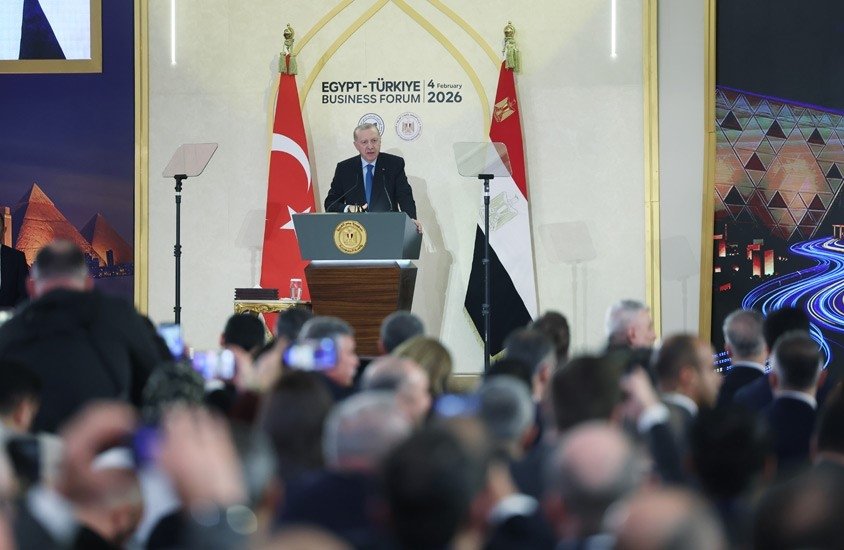
President Recep Tayyip Erdoğan paid visits over the past two days to Saudi Arabia and then to Egypt. Although these visits had been planned well in advance, they took place in a context in which uncertainty persists as to whether the Iran-U.S. tensions will evolve into war or into a negotiated settlement.
Erdoğan had previously visited Qatar, Kuwait and Oman in the last week of October. In the coming days, he is also expected to visit the remaining countries of the region, foremost among them the United Arab Emirates (UAE).
The future of bilateral relations undoubtedly occupies an important place on the agenda of these visits. However, it is necessary to recognize that each visit carries dimensions that go beyond bilateral ties.
The security architecture and geopolitical environment of the Middle East are being reshaped. In just the past 20 years, the region has witnessed every kind of crisis, conflict and war, drawing in all states, rendering relations fragile, collapsing state structures and weakening societal resilience. In the region, leaders, decision-makers, opinion-shapers and the public at large have experienced and observed firsthand the causes and consequences of these processes.
They know which kinds of steps deepen crises and which approaches foster normalization. They are aware of how global powers have used proxy actors within the region, whether state or nonstate, to intensify conflicts.
Having witnessed the outcomes of foreign policy practices, they also know what to avoid in the new period. Of course, such awareness does not always translate into the right decisions. However, it may motivate attempts to pursue a different path and a different style of governance than in the past.
As a manifestation of this perspective, Türkiye is engaged, through leader-level diplomacy in bilateral visits, through ministries and relevant state institutions at lower levels, and also through secondary diplomacy mechanisms such as think tanks and nongovernmental organizations (NGOs), in efforts to help construct a stable and secure order in the Middle East.
In order to ensure the durability of stability and security, Türkiye is also taking steps to deepen economic relations among countries. By concluding cooperation agreements that highlight each country’s areas of strength, it seeks to enhance state capacities. It aims to develop defense capabilities in a way that ensures collective security and strengthens deterrence. Ultimately, through the pursuit of more effective alliances, it seeks to contribute to the formation of a complementary security architecture.
Today, threat perceptions among Middle Eastern countries differ from those in the pre-Oct. 7 period. The Doha attack has radically altered perspectives. Israel’s expansionist objectives, which disrupt regional stability, now extend not only across the Middle East but also into Africa.
The option of a U.S. and Israeli military intervention against Iran remains on the table. Israel’s recognition of Somaliland, the civil war in Sudan, the uncertain future of stability in Syria, and the still-unresolved instability in Libya remain subjects of regional rivalry and represent significant issues with the potential to deepen conflicts and crises.
In each of Erdoğan’s visits, the search for solutions to ongoing crises in conflict zones constitutes a major agenda item. Türkiye adopts an approach that prioritizes cooperation over divergence on strategic issues. It encourages the relevant countries to pursue policies grounded in mutual trust that avoid being trapped in crises and that emphasize a positive agenda. The recent visits to Egypt and Saudi Arabia, together with the previous ones, should be assessed within this broader framework.