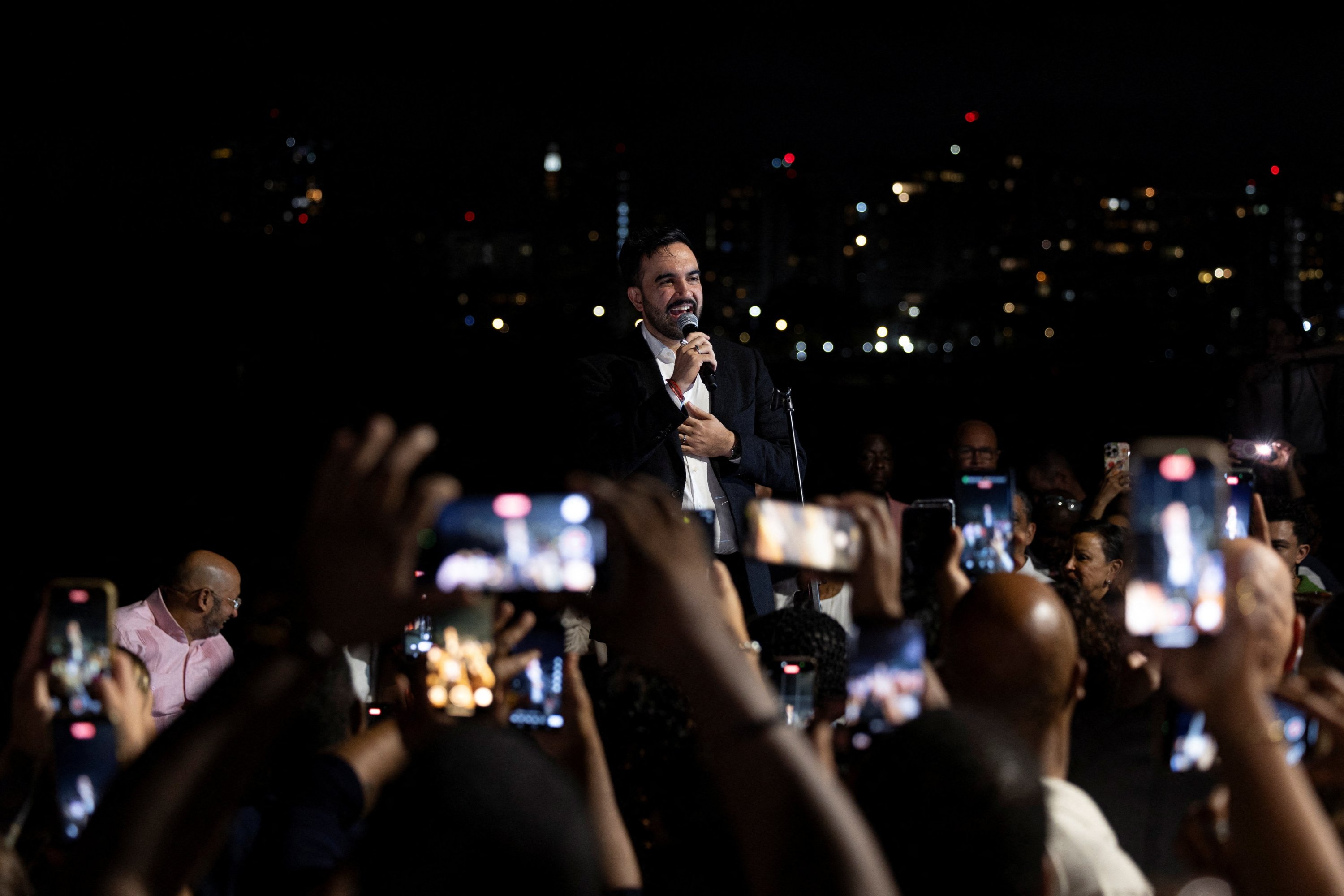
As is widely known, municipal elections were held in New York, and Zohran Mamdani, with a concrete voter support, defeated his rivals to become the mayor of New York City. To date, the U.S. has held dozens of municipal elections, with many mayoral candidates winning and many losing. However, no local election has captured the world's attention like this one.
What carried this election onto the global stage can be interpreted as American society, long perceived as constrained under a Zionist monopoly, taking a collective, national breath with Mamdani's candidacy.
When the Oct. 7 attacks began, no one could have foreseen the consequences of Israel's decision to transform this conflict into a massacre and a genocide.
Significant protests against this genocide initially emerged on the streets of Scandinavian countries, European nations and Muslim-majority countries.
In my view, the most pivotal protests unfolded on American university campuses. Students at leading institutions representing the intellect and future of the U.S. – such as Harvard, MIT and NYU – staged protests, often facing severe police brutality. These students persisted, continuing their demonstrations even at the risk of their academic futures and diplomas.
What was the objective of people worldwide taking to the streets to protest Israel? Was it solely to protest Israel, or were there other, underlying issues at play?
The debates surrounding the Oct. 7 attacks and Israel's massacre in Gaza have laid bare a stark reality: a singular political entity, driven by Zionist ideology, effectively holds influence over the major powers of the West. The U.S., the U.K., France and a subordinated Germany are not merely allies; their policies demonstrate they are directly governed by a shared Zionist interest that supersedes their own national sovereignties.
Suppose one asks what the conflict between Hamas and Israel and the subsequent Israeli genocide has achieved. In that case, one aspect is that it pulled back the curtain on Zionism, allowing people in all countries to see the reality. While we can analyze shifting internal dynamics state by state, the most significant change has occurred within the U.S.
First, let's consider the perspective of the Make America Great Again (MAGA) movement: Composed of people who believe in a greater America, prioritize American interests and support Donald Trump, MAGA supporters have begun to ask: Are we, a nation of 350 million, being governed by a country of 9 million? Or is the U.S. governing Israel and the Zionists? Influential figures like Tucker Carlson have given voice to this sentiment, asking, "Are we not a free nation?"
On another front, Israel's condemnation and diminished standing at the U.N. have, by extension, dragged its chief ally, the U.S., into a similar predicament. The aftermath of the U.N. session, which saw Israel condemned and isolated, combined with the subsequent strategic impact of the Sumud Fleet, created a situation that forced the U.S. to step in and resolve the problem.
While campus protests were suppressed and the conventional media largely maintained a pro-Zionist narrative, the social media revolution ignited a global shift. One can truly silence a media channel. You can hide Israel's massacres and genocide in the newspapers. The world is no longer limited to conventional media, which is often controlled by Zionist interests. Today, every individual on the street has become a media outlet. Everyone can access information and share it. This represents nothing short of a social media revolution, or even a social revolution itself.
When the Democratic primary race began, candidates were asked where to go on the day they were elected. Five of them replied that they would go to Tel Aviv or the Holy Land. Only one candidate stated: "On the day I am elected, I will become the Mayor of New York and I will remain in the streets of New York."
Even during the Democratic primary, it became clear what kind of candidate Mamdani would be, and he rode that wave to victory.
In his legendary victory speech on election night, after stating that New York, a city built by immigrants, would now be governed by them, Mamdani said, “I am young, despite my best efforts to grow older,” in one of several laugh lines of the night. He underlined: “I am Muslim. I am a democratic socialist. And most damning of all, I refuse to apologize for any of this.”
Sometimes, a single sentence from a skilled speaker and politician can resonate across the globe. If you were to ask for the most influential address globally, it would be the victory speech of Mamdani, which has become the most trending topic internationally.
In effect, the Gaza war created conditions that could have led to Democratic losses and directly paved the way for Trump's election. Conversely, at the New York level, Mamdani has provided an answer to the problem of political inertia within the Democratic Party's established clique.
On the other hand, despite the silence of the American administration regarding Israel's genocide and all the efforts of Jewish capital, Mamdani won the election.
Zionists, who position themselves as God and believe they are doing God's work, have been exposed. The exposure of a problem and the public's recognition of it mark the beginning of the struggle to address it. From today onward, it is the nations and the people who will win, and Zionism that will lose.