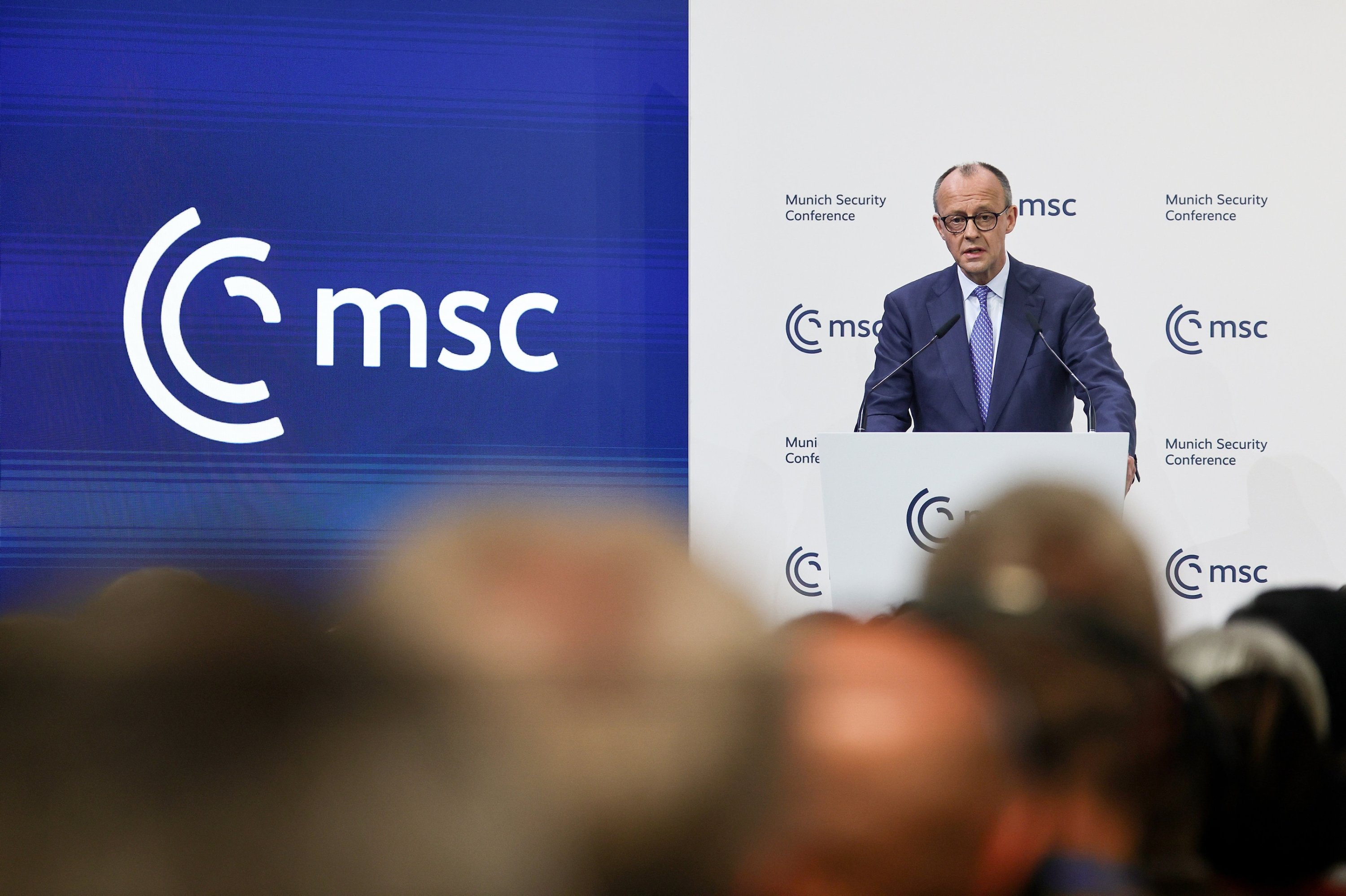
Something significant happened at the Munich Security Conference last week, and it wasn't just another round of hand-wringing about the rules-based international order. German Chancellor Friedrich Merz stood before an audience of global leaders and said, plainly, what Ankara has argued for years: that ideals alone will not keep Europe safe. More importantly, he named Türkiye as a key partner in confronting the new strategic reality. Coming from Berlin, that statement carries weight, and it deserves scrutiny.
Let's be clear about what Merz was really saying. His declaration that "the rule-based order has eroded" and that "power politics and major-power competition are back" is not a revelation. Anyone who has watched Russia's war in Ukraine, China's assertiveness in the Indo-Pacific, or the volatility of American foreign policy under successive administrations already knows this. The revelation is that a German chancellor, representing the country that has most stubbornly clung to the idea that integration and multilateralism can solve everything, is now publicly admitting it.
For Türkiye, the subtext matters more than the text. Germany has long treated its relationship with Ankara as conditional, contingent on value alignment, EU accession benchmarks, and a kind of paternalistic expectation that Türkiye would fall in line with Brussels. Merz's Munich speech broke with that tradition. His acknowledgment that strategic partnerships "do not require complete value alignment" is, in diplomatic terms, a quiet earthquake. It concedes what Türkiye's foreign policy establishment has maintained throughout a decade of strained ties: that effective partnership is built on shared interests and mutual respect, not on ideological conformity.
And the shared interests are substantial. Türkiye sits at the crossroads of virtually every security challenge Europe faces, from migration flows and energy transit to counterterrorism and Black Sea stability. It controls critical maritime chokepoints, maintains NATO's second-largest army, and has developed an indigenous defense industry that European capitals can no longer afford to dismiss. When Merz spoke of "reducing dependencies and managing risks," he was implicitly acknowledging that Türkiye offers something Europe desperately needs: strategic depth that any other partner cannot replicate.
There is also an economic dimension that deserves attention. Germany's push for sovereign supply chains and economic resilience dovetails neatly with Türkiye's industrial modernization ambitions. Defense technology, energy infrastructure, and critical minerals are areas where Berlin and Ankara could build durable, mutually beneficial cooperation that goes well beyond the transactional dealings of the past. In fact, defense is where the complementarity is most vivid. This very week, a Bayraktar TB3 drone launched from TCG Anadolu and executed a precision dual-salvo strike against naval targets in the Baltic Sea during NATO's Steadfast Dart 2026 exercise, the alliance's largest drill this year. It was the first time a shipborne combat drone had been operationally employed in a NATO context. That capability did not materialize overnight; it is the fruit of strategic decisions Ankara made in the early 2000s to invest in indigenous defense production when most allies were content to buy off the shelf. Now, through ventures like Baykar's joint production partnership with Italy's Leonardo, that Turkish know-how is flowing into European defense supply chains. This is not charity. It is exactly the kind of mutual reinforcement Merz was calling for in Munich. The question is whether both capitals have the political will to move from rhetoric to architecture.
It would be naive, however, to treat Merz's speech as a wholesale embrace of Ankara. It isn't. Germany is diversifying its strategic portfolio, and Türkiye is one card in a broader hand. The chancellor was careful to reaffirm NATO and the transatlantic bond, even as he candidly acknowledged their insufficiency. What has changed is not Germany's commitment to the West, but its recognition that the West, as currently configured, is not enough. That is an opening, not a guarantee.
For Turkish policymakers, the right response is neither triumphalism nor skepticism, but strategic seriousness. If Europe is genuinely ready to engage Türkiye as a partner rather than a supplicant, Ankara should meet that moment with concrete proposals on defense cooperation, energy security, sustainable migration management, and stabilizing their shared neighborhood. But partnership is a two-way street. If European leaders like Merz truly mean what they say about Türkiye's indispensability, the time has come to back that rhetoric with tangible commitments: modernizing the customs union, which has remained frozen in its 1995 framework while the economic relationship has transformed beyond recognition, and delivering on the long-promised visa liberalization that would finally treat Turkish citizens as the partners Europe claims to want them to be. These are not favors; they are the minimum architecture of a serious strategic relationship. Without them, talk of Türkiye as a "key partner" risks sounding like another round of European convenience, where Ankara is expected to shoulder burdens without reaping benefits. The window for reshaping this relationship will not stay open indefinitely.
What Munich 2026 revealed is something broader than any single bilateral relationship. It showed a Europe that is, belatedly, growing up, shedding the comfortable illusion that rules and institutions alone can secure a continent in an age of power politics. Merz's willingness to name Türkiye as part of the answer, rather than part of the problem, suggests that at least some European leaders are beginning to see the world as it is, not as they wish it were. For a relationship that has endured decades of mutual frustration, that realism may be the most promising foundation yet.