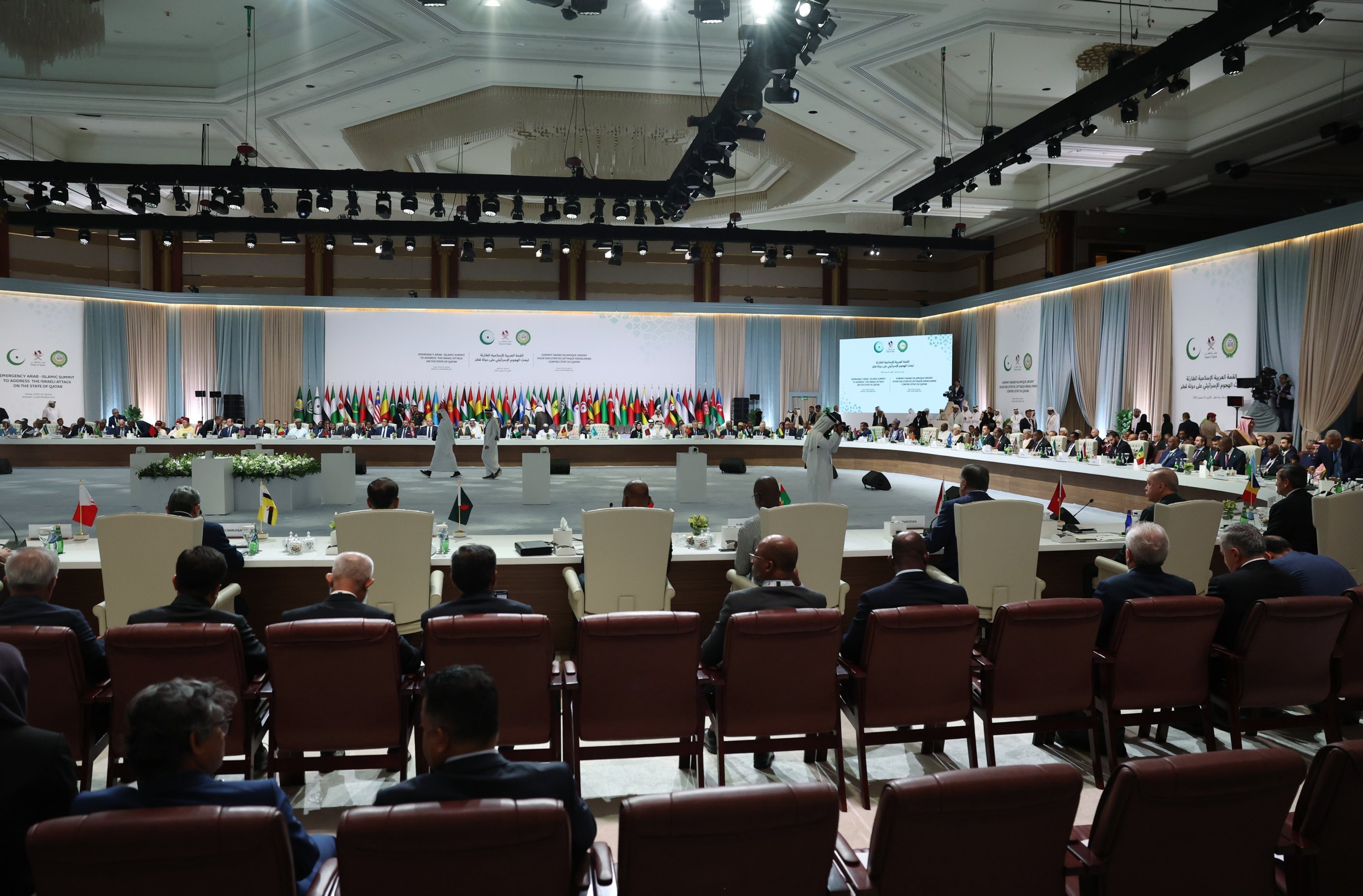
Following Israel’s attack on Doha, the Organisation of Islamic Cooperation (OIC) and the Arab League convened an extraordinary meeting in Qatar. The meeting was held at Qatar’s request and with the support of Türkiye, which currently chairs the OIC Council of Foreign Ministers.
The OIC today has 57 members. It is the second-largest intergovernmental organization after the U.N. It was founded on Sept. 25, 1969, in direct response to the arson attack on Al-Aqsa Mosque – meaning it was established precisely to confront the Israeli issue.
The Arab League, meanwhile, has 22 members. It was founded in the same year as the U.N. All Arab League members are also OIC members. The organization’s stated purpose is to safeguard the independence and sovereignty of Arab states, defend the interests of the Arab world and ensure coordination on matters of common security and foreign policy.
Over the decades, these organizations have held countless summits. From those summits, declarations condemning Israel and calling on the international community to act have been issued. Yet while the communiques were many, concrete action was scarce. No deterrent sanctions against Israel or other enemies of Islam emerged and the discussions often centered on whether the wording of the statements was harsh or mild.
In response to Israel’s genocidal campaign against the Palestinians, these organizations had previously held two joint meetings. At one of them, the OIC, the Arab League and the African Union Commission even established a trilateral mechanism to coordinate efforts in support of the Palestinian cause.
Nevertheless, whether convening separately or jointly, the organizations have so far failed to produce a common strategy against Israel or to mobilize the international community with a unified policy.
This remains puzzling when one considers that the member states, taken together, represent enormous potential influence: their populations, economic weight, role in global energy markets, investment capacity in Western economies and ability to steer international funds all point to a high capacity for shaping world politics. Yet their diverging foreign policy priorities and the nature of their relations with major powers have constrained effective decision-making from the outset.
It is time for the Islamic and Arab countries to recognize that Israel’s ambitions in the Middle East are not limited to the Palestinians. In just the past year, Israel has directly attacked six different countries, violating their sovereignty. The most recent attack on Qatar showed that regional states must develop joint defense and security policies against Israeli aggression without further delay.
Türkiye had long warned that Israeli aggression would not remain confined to Palestine and that its expansionist policies posed a threat to the entire region. The course of events has proved Türkiye right.
The Israeli issue is deepening globally. Regional states, with this awareness, should work to highlight Israel’s genocide more forcefully at the upcoming U.N. summit this month. They should also push harder for the recognition of Palestine as a full member of the U.N.