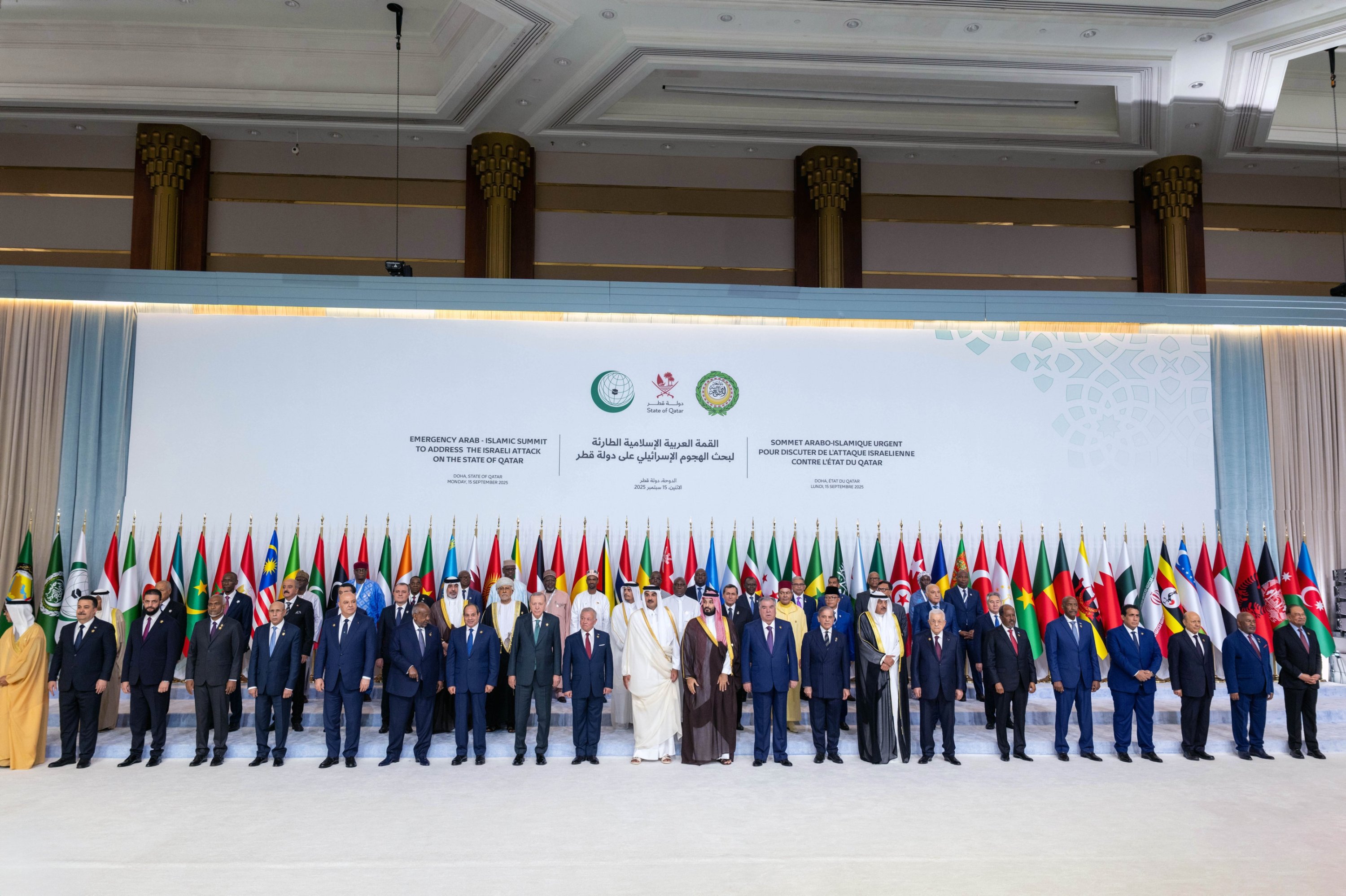
The Emergency Arab-Islamic summit held in Doha recently, to discuss a joint response to Israel’s attack on Qatar on Sept. 9, concluded on Monday with a Joint Communique without suggesting any diplomatic, economic or financial measures against Israel to deter further attacks by Israel on Arab and Islamic states.
On the same day, in a media briefing in Jerusalem, standing alongside the visiting U.S. Secretary of State, Marco Rubio, Israel’s Prime Minister boasted that Israel will again attack Qatar or any country if it shelters Palestinian "terrorists," and that there will be no Palestinian State in the territories under Israel’s control.
The 25-paragraph communique was robust in Arab-Islamic countries’ support to Qatar and condemned Israel in the strongest terms for violating the sovereignty of Qatar on Sept. 9, and killing six people in Doha in airstrikes. The summit, however, did not express disappointment on the part of the U.S., Washington’s refusal to prevent the Israeli attack on its biggest military ally in the Gulf region, or to blame Jerusalem for sabotaging its cease-fire deal on offer, which envisaged the return of all Israeli hostages.
The summit “reaffirmed absolute solidarity with Qatar in all measures that it may take in response to the treacherous Israeli aggression to safeguard its security, sovereignty and stability of its citizens in accordance with the U.N. Charter,” but gave no indication what these measures would be and how Qatar would implement them. After the Israeli strike on Sept. 9, Qatar’s prime minister had ruled out a swift tit for tat response against Israel, saying that it would provide a collective response to Israel in consultation with other Arab countries. So, while Qatar passed the ball to the summit to decide a response, the summit passed it back to Qatar, saying leaders would support Qatar’s action against Israel.
Instead of taking note of how Israel had been encouraged by the U.S. to flout international law and use starvation and deprivation of medicines as weapons of war in its genocide of the Palestinians in Gaza, the summit appreciated the U.S.’s role as a mediator in conjunction with Qatar and Egypt to seek to reach a cease-fire in Gaza. The summit also did not urge the U.S. to reject the possible renewed targeting of Qatar and other Arab and Islamic countries by Israel, and condemn the Israeli Prime Minister’s repeated threats in the strongest possible terms.
While reaffirming the concept of collective security and the necessity of unity of Arab and Islamic states in facing common challenges and threats in the region, the summit called for ridding the Middle East of nuclear weapons and all other weapons of mass destruction, but did not indicate if this call was addressed specifically to Iran, Israel or the U.S. bases in the region, or all three of them suspected of having or trying to develop them.
In their concluding statements, many heads of state and Government called for a concrete plan of action comprising diplomatic, economic and other measures against Israel, but the summit left such decisions to individual states without agreeing on a set of measures that could be announced and implemented immediately against Israel. The summit did not ask its members who have signed the Abraham Accords with Israel to put these in abeyance until Israel agreed to end the war in Gaza, complied with international law and accepted the U.N. formula for a two-state solution. The summit, however, asked member states that are state parties to the Rome Statute to implement the arrest warrants of the International Criminal Court issued in the context of Israel’s war crimes in Gaza.
The summit also did not agree on moving a joint resolution on behalf of the Arab and Islamic countries in the current session of the United Nations General Assembly (UNGA) to suspend the membership of Israel in the U.N. for violating the provisions of the U.N. Charter, disregarding the resolutions of the U.N. Security Council on Jerusalem and illegal settlements, violating the U.N. Genocide Convention and engaging in war crimes. Instead, it asked member countries to examine this question and decide if, in their individual assessment, Israel stood a chance of suspension from the U.N. membership.
The summit welcomed the adoption by the UNGA of the New York Declaration on Palestine and, by doing so, buried Hamas 6 feet under without even requiring any input from Israel and the U.S. The New York Declaration calls on Hamas to end its role in Gaza, hand over its weapons to the Palestine Authority and submit itself to a security mechanism set up by Israel whereby it stays demilitarized in the future. Hamas is already proscribed as a "terrorist organization" by the U.N., but some Arab and Islamic countries maintain links with its political leadership.
The summit reiterated that the Al-Aqsa Mosque and Haram al-Sharif in Jerusalem, in its entirety of 144,000 square meters, is a place of worship exclusively for Muslims. It also reaffirmed the custodianship of the holy Muslim and Christian sites in Al-Quds, traditionally exercised by the King of Jordan. However, it did not express concern about the repeated violations of the Islamic holy site by the far-right ministers of the Netanyahu government, who have intentionally visited the place to provoke Palestinian and Muslim sentiments around the globe.
So, if the summit left out a lot of important action points that the public in many Arab and Islamic countries was expecting to see, it did give one solid message to Israel and the U.S., both of which remain opposed to a two-state solution based on the pre-1967 borders, which the summit has also referred to in the communique. This message was that contrary to the blame traded on Arab and Islamic countries as undemocratic and insensitive to human rights, they stood firmly in support of international law and the established norms on interstate conduct. The summit gave a clear message that Israel’s aggression and disrespect of international law would not go unnoticed, but it would be done legally, peacefully and within the charter of the U.N.
The gathering of two camps on the same day, a majority camp in Doha, and a minority camp in Jerusalem, the former without military muscle and the latter with all the sophisticated armaments one could wish to have, painted a clear picture. It was a picture of two forces coming face to face on the page of history. One needs to look back in history to see which force held the high moral ground and was on the right side.