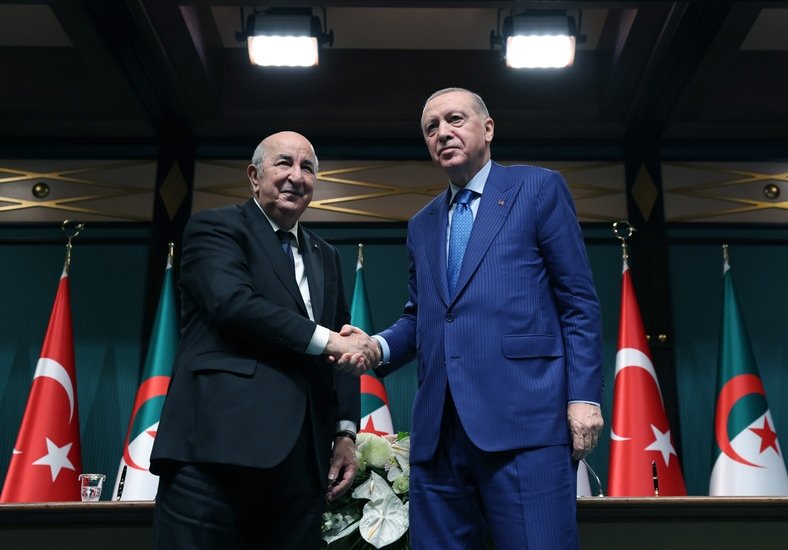
Algeria-Türkiye ties date back to 1516, when the Barbarossa brothers, under the Ottoman Sultan Selim I, defended Algeria’s shores from the expansionist and colonial ambitions of European Christian powers. Over 500 years, relations between Algeria and Türkiye have been shaped by Mediterranean geopolitics, economics and military developments, fostering shared cultural values from east to west. Algerian President Abdelmadjid Tebboune’s third state visit to Türkiye demonstrates that Algeria-Türkiye relations are on their strongest and most historic path yet.
This visit comes amid a paradigm shift in the Middle East and North Africa (MENA) and Gulf regions, provoked by the ongoing U.S.-Israeli aggression against Iran. The diplomatic roles of both countries carry increasing weight in the regional geopolitical landscape, particularly Algeria’s energy diplomacy, which remains a pillar of its foreign policy of building strategic alliances. Consequently, a new balance of power is emerging, which will shape regional peace, security and stability.
A pivotal geopolitical axis appears to be forming in the MENA region, led by a powerful quartet: Egypt, Pakistan, Saudi Arabia and Türkiye. Within this framework, Algeria’s position could help sustain and strengthen broader strategic cooperation across the region.
Why is the timing of this visit important? Algeria occupies a central position in the region, and its evolving foreign policy reflects a pragmatic approach while maintaining its core principles of sovereignty and non-alignment. Its role in the international energy market has significantly enhanced its standing in global energy markets. The country ranks among the world’s top 10 holders of natural gas reserves after Russia, Iran and Qatar, and remains one of the largest gas exporters to Africa and Europe.
This geoeconomic strength adds strategic depth to the recent rapprochement between Türkiye and Saudi Arabia. Algeria enjoys excellent relations with both regional powers and could therefore play a role in reinforcing the Ankara-Riyadh axis. Algeria’s longstanding diplomacy, at the regional and international levels, has earned it credibility in mediation, political reconciliation and conflict resolution processes, whether in the MENA region, the Horn of Africa or the African Sahel.
By integrating more closely into the Ankara-Riyadh axis, Algiers could help consolidate a regional core capable of reshaping the geopolitical and economic trajectory of the MENA region through evolving military, diplomatic and economic alliances. Such developments may also slow Israel's normalization process initiated under the so-called Abraham Accords, which many critics view as undermining the Palestinian cause.
Tebboune’s visit to Türkiye further strengthened the bilateral relationship, as confirmed during the first meeting of the Türkiye-Algeria High-Level Strategic Cooperation Council. The 2006 Treaty of Friendship and Cooperation between Algiers and Ankara remains the key diplomatic framework underpinning the political and economic strategic partnership between the two nations.
Signed during then-Prime Minister Recep Tayyip Erdoğan’s visit to Algeria, the treaty aimed to deepen dialogue across political, economic and cultural spheres. Today, the agreement has evolved into a broad framework supporting multiple bilateral economic and military accords that continue to strengthen strategic ties. Bilateral trade reached a record $5.3 billion in the latest full year, while Türkiye has set a target of $10 billion by 2030.
Approximately 1,400 Turkish companies currently operate in Algeria, making Türkiye Algeria’s largest investor outside the hydrocarbon sector. Turkish firms provide thousands of jobs for Algerians, with some estimates exceeding 5,000 positions. Among the most notable projects are the extension of Algerian gas exports to Türkiye until 2027, cooperation in iron and steel, textiles and agriculture, and the entry of Ziraat Bank into the Algerian banking market.
Tosyalı Holding’s subsidiary, Tosyalı Algerie, is one of the largest steel producers in Africa. Located in the Bathioua Industrial Zone in Oran, it operates a massive integrated steel complex using direct reduced iron (DRI) technology to produce rebar, wire rod and flat steel products. The company is also heavily involved in developing and utilizing the Gara Djebilet iron ore mine in southwestern Algeria, in Tindouf Province. This partnership forms part of Algeria’s broader strategy to boost domestic steel production and reduce dependence on imported iron ore.
In the energy sector, Türkiye aims to increase its purchases of Algerian liquefied natural gas (LNG) from 4.4 billion cubic meters annually to between 6 and 6.5 billion cubic meters to meet growing energy demand. The agreement may also be extended for an additional five to ten years to reinforce long-term energy stability between the two countries.
Energy cooperation also includes the potential transportation of Algerian LNG to Southeast Europe and the Balkans through Türkiye. Both countries could work jointly to establish these strategic energy corridors.
On the diplomatic stage, the strong personal rapport between the two leaders has strengthened unity between the two countries. Algeria and Türkiye increasingly align on regional and international issues, including the African Sahel, the crisis in Sudan, tensions involving Iran and the ongoing war in Gaza.
As the world evolves toward a multipolar order, both countries have historically supported non-Western-aligned and South-South diplomatic approaches. Algeria, which served as a non-permanent member of the United Nations Security Council for 2024-2025, has reinforced its diplomatic support for causes such as Palestine and Western Sahara. Algeria has also played a leading role in shaping international counterterrorism policy, particularly regarding Africa and the financing of terrorism in the region.
President Erdoğan’s well-known slogan, “The world is bigger than five,” criticizes the structure of the UNSC and the veto power held by its five permanent members: the United States, the United Kingdom, France, Russia and China. His call for a more representative and reformed U.N. system echoes similar positions advocated by his Algerian counterpart during annual sessions of the U.N. General Assembly.
Previously, Tebboune visited Türkiye in May 2022 and again in July 2023, with the latter visit focusing primarily on trade and economic cooperation. Erdoğan, meanwhile, visited Algeria in January 2020 and November 2023. These visits represent a qualitative leap in Algerian-Turkish relations, transforming longstanding historical and friendly ties into a solid strategic partnership institutionalized through the High-Level Strategic Cooperation Council.
In sum, this warm visit created strong political chemistry between the two leaders and underscored the importance of leadership in opening new geopolitical horizons. Both countries increasingly find common ground in counterbalancing French influence and the influence of other global and regional powers in the African Sahel and across the African continent more broadly. The two leaders are using this shared strategic vision to deepen bilateral ties and align regional policies, emphasizing humanitarian diplomacy focused on peace, security, stability, sustainable development and shared prosperity.