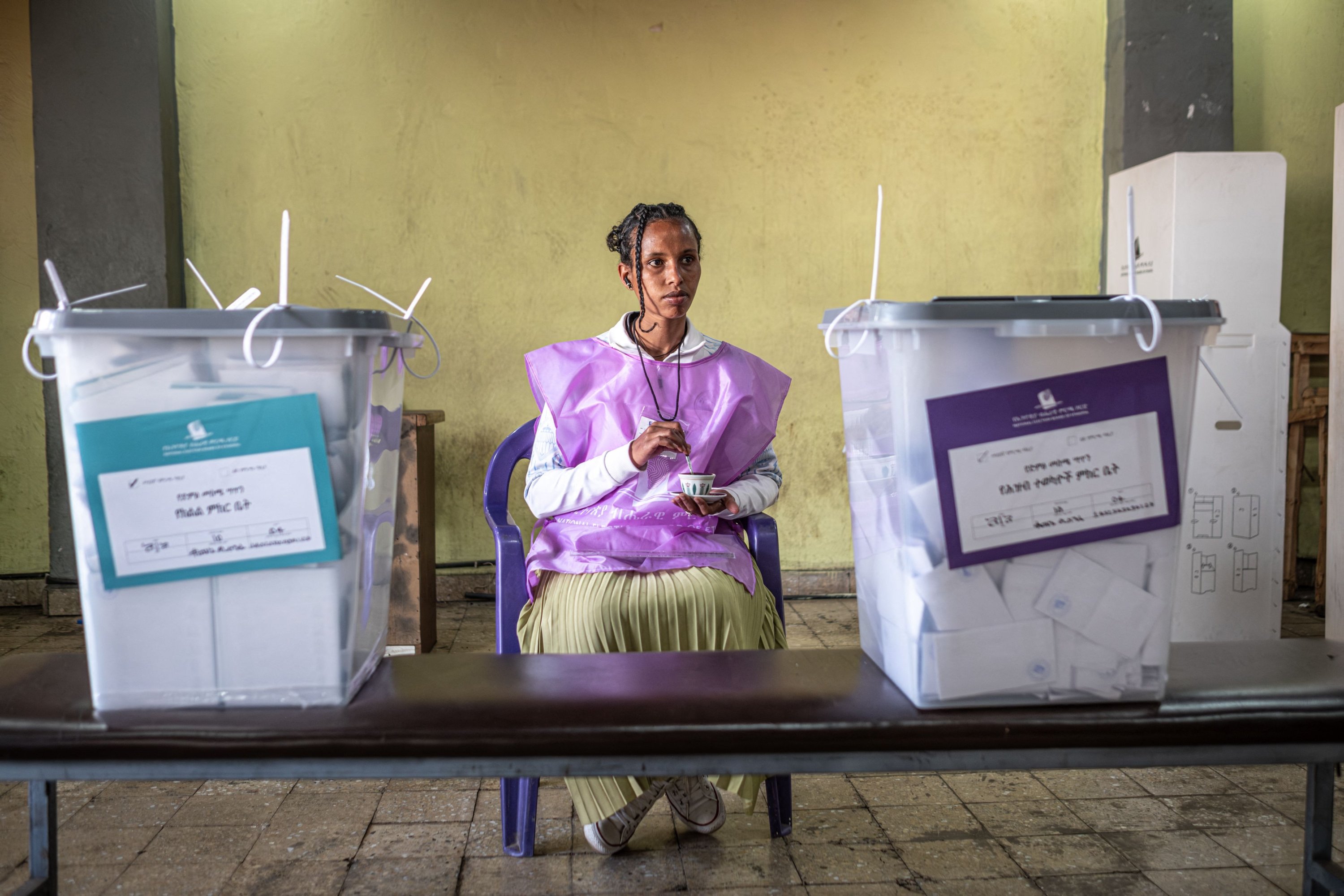
With the general elections held on June 1, Ethiopia formally completed another chapter in its democratic process. While official results have not yet been announced, the expectation that Prime Minister Abiy Ahmed's Prosperity Party would secure a landslide victory was already a widely held view among political observers. Yet, the true significance of this election lies not so much in the outcome at the ballot box, but in the structural realities the process itself has laid bare, and in the implications of those realities for Africa's second most populous country and the broader region.
The Ethiopian Electoral Board suspended or cancelled voting in dozens of constituencies, citing "unfavorable conditions." In Tigray, the epicenter of the 2020-2022 civil war, no elections were held at all. The region continues to grapple with mass displacement, and in recent months, clashes between the federal government and the Tigray People's Liberation Front (TPLF) have flared once again. Violence by Fano militias in Amhara and armed conflict in Oromia persisted throughout election day. Dozens of civilians are reported to have been killed in armed attacks carried out on the day of the vote itself.
This picture raises direct questions about the election's legitimacy. The extreme fragmentation of opposition parties and their inability to build meaningful organizational capacity at the national level have rendered the Prosperity Party's unchallenged dominance at the polls an almost structurally inevitable outcome. Restrictions on independent media, harassment and detention of journalists, and the severe narrowing of freedom of expression are among the factors reinforcing this uncompetitive environment.
The Prosperity Party built its campaign on a narrative of robust economic growth. Officials repeatedly highlighted indicators such as the liberalization of foreign exchange markets, the shift to a floating exchange rate for the Ethiopian birr, and record-level exports of gold and coffee. The projected growth rate of 10.2% for the 2025-2026 fiscal year sits well above the continental average. These figures are real, but they do not stand on their own. The sustainability of this economic growth hinges on the security environment in conflict-affected regions such as Tigray and Amhara, on global commodity prices, and, perhaps most critically, on regional political stability.
One of the most consequential developments overshadowed by the elections is the effective collapse of the 2022 Pretoria Agreement. In April, the TPLF announced it would reassume control of the regional administration, and subsequently declared new administrative and judicial appointments to replace the existing transitional government. This move amounts to the emergence of two competing parallel governing structures in Tigray. The unraveling of the agreement risks returning Ethiopia to the brink of a civil war it escaped at enormous cost, a prospect that makes it imperative for external actors, first and foremost the African Union, to re-engage their mediation capacities.
On the foreign policy front, Ethiopia's bid for Red Sea access is drawing regional dynamics onto increasingly tense terrain. Having become a landlocked country following Eritrea's independence in 1993, Ethiopia, under Abiy, has framed this ambition as an "existential necessity." Yet this framing has accelerated a de facto alignment among Eritrea, Somalia and Egypt against Addis Ababa.
The long-running Egyptian tension over the Grand Ethiopian Renaissance Dam (GERD) is pushing an already fragile dispute over Nile waters in an ever more security-driven direction. Relations with Eritrea carry their own striking contradictions: Abiy received the Nobel Peace Prize in 2019 for ending two decades of war with Eritrea, yet that same Eritrea became Ethiopia's de facto partner in the Tigray war. Today, Eritrea's insistence on maintaining its military presence in Western Tigray and the deep divergence over the Red Sea issue have once again placed the two countries on a collision course.
While Abiy Ahmed appears set to secure a new five-year term, the absence of elections in Tigray, sweeping suspensions across Amhara and Oromia, and a suppressed opposition environment significantly constrain the representational value of whatever result emerges from the ballot box. An electoral victory achieved without addressing these structural vulnerabilities risks deepening internal political polarization and sharpening the appetite of regional actors to treat Ethiopia as an arena for great power competition. Whether the Tigray issue can be brought to a diplomatic resolution, whether a new framework can replace Pretoria, and whether the Red Sea bid can advance through diplomatic means without courting the risk of regional war, these questions will continue to define Ethiopia's agenda regardless of what the ballot box produces.
In this context, a regional inconsistency also deserves attention. In April, Djibouti held general elections in which every citizen cast their own vote directly; Ethiopia followed suit. Kenya is scheduled to hold a similar direct-participation election in August 2027. These processes, for all their flaws, represent a model in which the individual is directly engaged in the political process.
In Somalia, the picture is different. Elections are still conducted through a system in which clan leaders cast indirect votes on behalf of a limited number of delegates. The roots of this model run deep. Clan structures are a genuine and functional element of Somali politics. The problem, however, is that the same international and regional actors who readily criticize electoral shortcomings in Ethiopia simultaneously treat the indirect representation system in Somalia as a given, and go further, legitimizing it under the banner of "local contextual appropriateness." That position is difficult to defend with any credible consistency.
Discussions about transitioning Somalia to a direct electoral system based on the "one person, one vote" (1P1V) principle are not new. Steps taken in that direction, however incremental, have met resistance in some quarters, dismissed as external imposition. Yet no democratic system arrives fully formed.
Every country that holds direct elections today began somewhere imperfect, contested and unfinished. What mattered was not that the first election was flawless, but that it happened. Somalia does not need a perfect system before it starts. It needs a start from which a better system can grow. Direct participation, even in its earliest and most imperfect form, generates accountability, builds civic experience, and creates the conditions for self-correction over time. The alternative, indefinitely deferring universal suffrage on the grounds that the conditions are not yet right, is not a neutral position. It is a choice to keep the door closed.