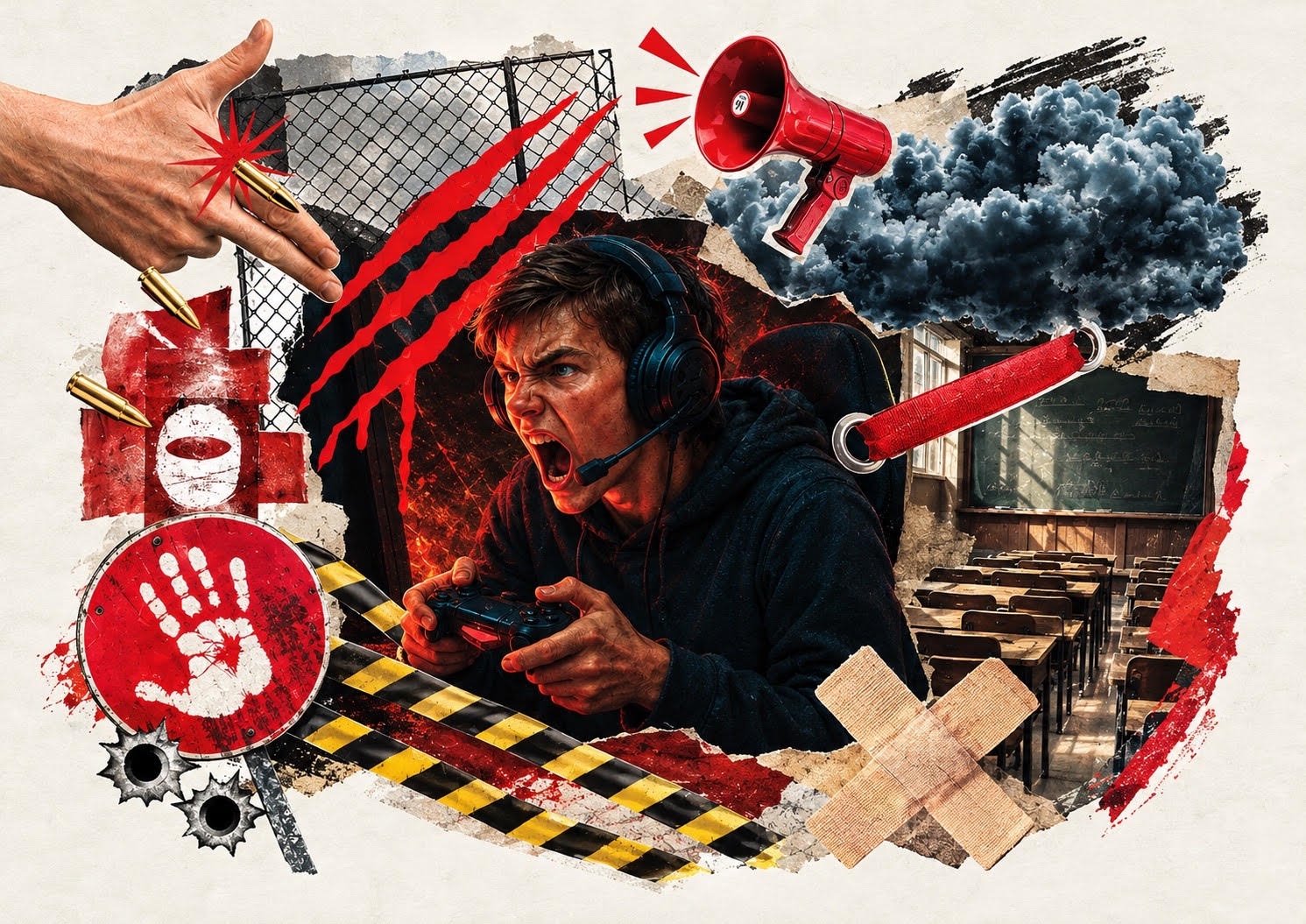
Türkiye has recently witnessed a series of incidents of violence. On Sept. 22, 11 students were injured in a shooting outside a school building in Manisa in Western Türkiye, while on their way to school. Two of them were reported to be in critical condition. Following the incident, family members were also detained in connection with the weapon used in the attack. A few days later, on Oct. 6, a student attacked other students with a knife at the entrance of a school in Istanbul.
Similar reports have emerged from other countries. On Sept. 3, a 15-year-old student stabbed a teacher in the classroom in Wales. In a similar incident in Rome, on Sept. 18, a 13-year-old student incapacitated his 66-year-old teacher with pepper spray before stabbing him. These recurring reports suggest that school violence is a global problem rather than a regional one.
During my own school years, it seemed that we witnessed fewer such violent incidents, whether in schools or in the news. Today, it feels as though violent behavior is increasing and spreading like an epidemic. Why might this be happening?
From a psychological perspective, violent behavior among young people can stem from several underlying factors, including childhood exposure to violence and the influence of collective consciousness.
When a person grows up in a household where verbal, psychological or physical violence is present, the likelihood of reproducing such behavior may increase. Those who experience violence during childhood may be more likely to inflict similar forms of violence on others during adolescence and adulthood.
Sometimes, individuals may not be direct victims of violence themselves, but they may witness significant figures in their households engaging in violence against one another or against others. In such cases, they may identify with one of the perpetrators and perpetuate the same cycle.
Our character and attitudes toward life begin to take shape during the first seven years of our lives. Subsequent life experiences build upon this foundation. Our unconscious minds are shaped by the emotional intensity of the relationships we experience as we grow up, influencing who we become. Unconsciously, an individual may perceive the perpetrator of violence as the bully, the victim as the wronged party, and the protector as the savior. These perceptions can influence whether the individual later identifies with the role of the victim, the savior, or the bully.
Both the literature and my clinical experience suggest that individuals who engage in violent behavior may prefer to feel "powerful" by taking on the role of the bully rather than risk feeling worthless in the position of the victim. Those who adopt the role of the bully may initially display such behavior in their interactions with toys and stray animals. As they grow older, this behavior may extend to their peers and other people. On the other hand, those who are able to transform the difficulties they experience may instead assume a relatively protective or rescuing role, striving to bring goodness into their surroundings and the wider world.
The emotional climate of the society in which a person lives, in other words, its collective memory and reflexes, also influences individual development. Persistent exposure to verbal, psychological, and physical violence through social media, news coverage, street encounters, and public transportation can lead people to perceive violence not as a dangerous behavior that must be prevented, but as a socially accepted norm. Over time, this can lower an individual's threshold for violence.
Witnessing violent behavior across different areas of life, from the content of daytime television programs to bullying disguised as "jokes" on social media, may weaken an individual's problem-solving skills. Over time, violence may come to be perceived as the only available means of resolving conflicts.
Moreover, the psychological impact of violence extends beyond everyday encounters. Wars, invasions and genocides continue to unfold around the world. Being exposed to news reports and images of these events can have a secondary traumatic effect.
As we know, social media contains an abundance of content and news that can undermine trust between people. Thus, individuals may gradually lose their perception of the world as a safe and predictable place because of the constant stream of distressing news they encounter.
The loss of this sense of security can lead to heightened feelings of insecurity, fear, anger and helplessness. It may also increase the tendency to perceive even neutral or ambiguous events and individuals as threats. As this sense of threat intensifies, the ability to empathize with the feelings and circumstances of others may weaken. Individuals may then become increasingly likely to justify violent behavior on the grounds of self-defense, retribution or the belief that others deserve to be punished.
A study published in the Journal of Personality and Social Psychology in 2024 found that the positive or negative emotional states of a large group can influence the emotions of individuals. The study also indicated that the emotional influence of a crowd may be more intense than the emotional expressions of an individual.
Therefore, addressing violence, particularly in schools, solely as a "behavioral problem among children" may be insufficient. Children are a mirror of both society and the family, its smallest social unit.
The good news is that children quickly imitate the emotions and behaviors of those around them. They can also readily adopt positive behaviors modeled at school, within the family, and throughout society.
Educators and school administrators should not be viewed solely as individuals responsible for intervening after violent behavior occurs. Rather, they should be recognized as essential contributors to creating a school climate that actively prevents violence.
Adolescence is a particularly important period because the brain continues to develop and undergo significant changes. This creates an opportunity to revisit and reshape patterns established during early childhood. Research indicates that both the first seven years of life and adolescence play important roles in character development. The guidance provided by school counselors and teachers during these periods is therefore vital.
Psychological resilience programs should become an integral part of school life, benefiting not only students, but also educators and parents. These programs should provide psychoeducation tailored to children's developmental needs at different stages of life, with age-specific needs addressed on an ongoing basis. Since emotion regulation and empathy are not determined by age or educational attainment alone, support should be extended to everyone involved in students' lives. Student guidance programs should also incorporate social-emotional learning, coping with post-traumatic stress, problem-solving, fostering healthy peer relationships, preventing bullying, and promoting mental health.
We should not forget that building connections saves lives. In my clinical experience as a high school counselor, I observed the dynamics between teachers and students. Particularly during adolescence, I found that teachers who maintained a firm yet gentle approach, balancing warmth with appropriate authority, were better positioned to build strong relationships with their students.
Building healthy family relationships at home is just as important as fostering strong connections at school. Children who grow up in a secure, supportive, and emotionally present home environment, where they feel seen, heard, and included, are less likely to engage in violent behavior. Parents have a significant role to play in this process. Establishing routines such as one-on-one time between each parent and child, as well as shared family time, creates space for meaningful interactions and strengthens family relationships. These connections can reduce children's vulnerability to violence and make them less likely to turn to harmful groups simply to fulfill their need for belonging.
As psychoanalyst John Bowlby argued, the need to form deep emotional bonds with others is fundamental to human development and rooted in our innate drive for attachment and survival.
These preventive efforts should also extend to digital life. The content of television programs should be reviewed and updated, while social media platforms should reassess both their content policies and age restrictions. Television series, films, and other productions that portray violence as a normal part of everyday life should also be reconsidered.
If society's general perception of violence changes, children's perceptions can change as well. Let us not forget that a child is first a mirror of their family and then of society.