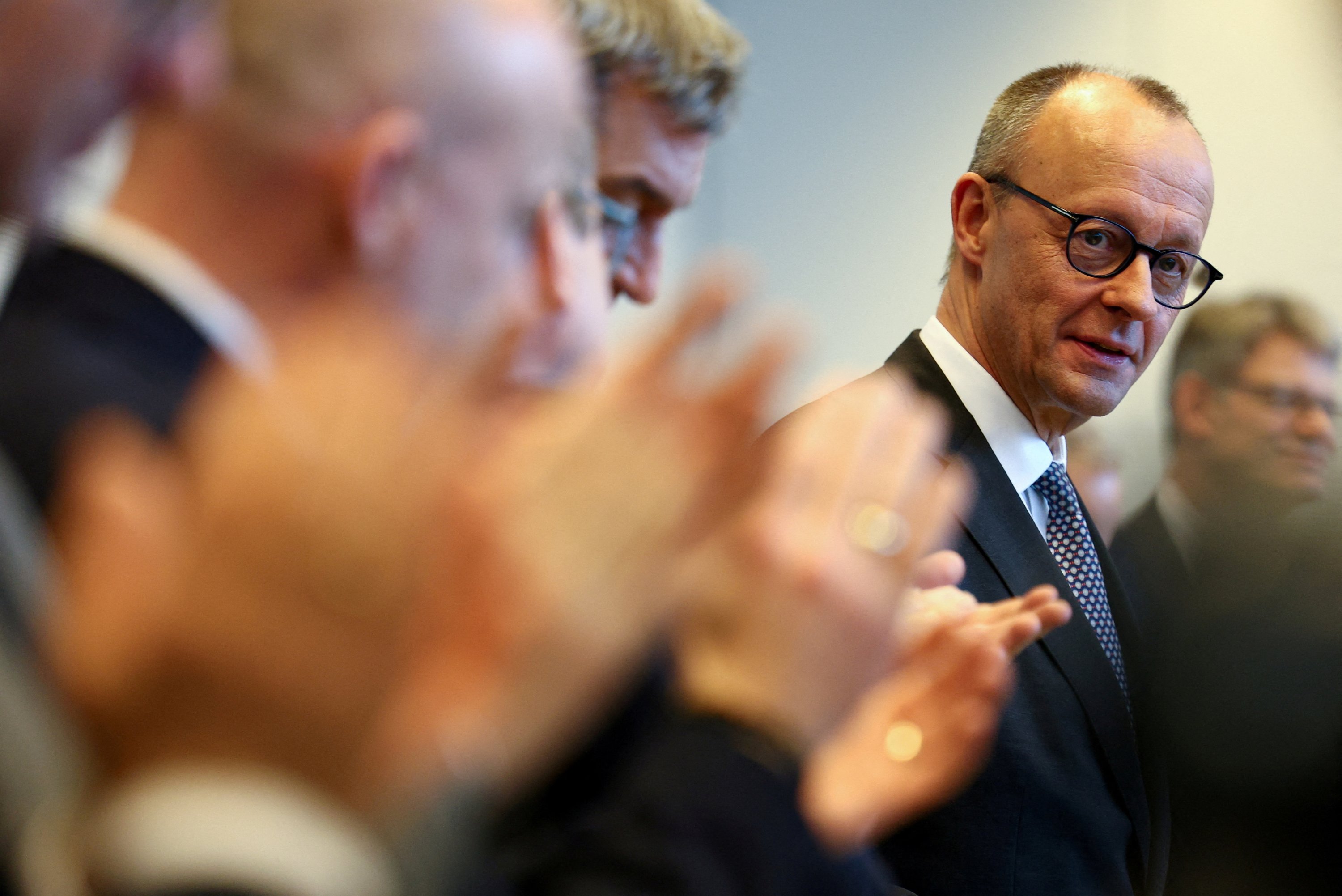
The elections held in Germany on Feb. 23 yielded results that reshaped the political future of the country. The coalition of the Christian Democratic Union Party (CDU) and the Christian Social Union Party (CSU) won 28.6% of the vote. The Social Democratic Party (SPD), the current ruling party and coalition partner of the previous government, came third with a record loss of votes. In a result that was expected and not really a surprise, the rise in the far-right party's votes created a new political environment in Germany. However, according to the election results, none of the parties could secure the majority to govern alone. This paves the way for a coalition government between the CDU/CSU and the Social Democratic Party (SPD), the so-called grand coalition. The elections were marked by the rise of the far-right Alternative for Germany (AfD) party, the increased representation of lawmakers of Turkish origin and Friedrich Merz's statements on European independence.
The Christian Union bloc CDU/CSU coalition came first with 28.6% of the vote. However, at least 316 parliamentary seats are needed to form a government in the Bundestag, making it necessary for the CDU/CSU to form a coalition government with the other parties that managed to enter the Bundestag. The far-right AfD came second with 20.8% of the vote, up 10.4% from the previous election. This was the best result for the AfD, or rather the far-right ideology, since World War II.
The SPD, the party of former coalition chancellor Olaf Scholz, came third with 16.4% of the vote, while the Green Party came fourth with 11.6%. The Left Party increased its share of the vote by 3.9% to 8.8%. The Free Democratic Party (FDP), which had been a partner in the government before the elections but withdrew from the coalition, leading to early elections, failed to pass the threshold with 4.3% of the vote. The “Saharan Wagenknecht Alliance” (BSW), which participated in the elections for the first time, narrowly missed the threshold with 4.9% of the vote.
Merz, leader of the election-winning CDU party, plans to form a new government by Easter. Merz has about forty days for coalition talks before Easter, which will be celebrated on April 20. According to the election results, apart from a coalition between the CDU and the SPD, a coalition between the CDU and the far-right AfD is also possible. Another, albeit very unlikely, possibility is a tripartite coalition of the CDU, the Greens and the Left Party. In this equation, the Greens and the Left Party seem the least likely to participate in the new government. This is because the Greens believe that the party has been worn out in the coalition in which it is a partner in the current government and that the voters have given them the task of opposition. Therefore, it will not take part in any government formation process.
As for the coalition with the far-right AfD, CDU leader Merz had announced before the elections that they would not form a government with this party due to the current conjuncture of the country. In this case, the most likely and expected coalition seems to be the CDU/SPD coalition, which is known as the “Grand Coalition” in German political terminology.
The distribution of deputies in the 630-seat German Bundestag will be CDU/CSU 208, AfD 152, SPD 120, Greens 85 and Left Party 62. In this case, the 316 parliamentary seats required to form a government can only be reached with a coalition government. This distribution shows that in the event of a possible “Grand Coalition” between the CDU/CSU and the SPD, intense negotiations will take place in the next month. This is because the CDU and the SPD, the likely partners of a grand coalition, are known to be the two most powerful factions that have been fighting for the chancellorship for years. The CDU's harsh immigration policies do not coincide with the SPD's social democratic values, and there is a possibility of a joint government between two parties with different perspectives on enlargement policies concerning the European Union as well as on the Russian-Ukrainian issue.
In addition, if the far-right AfD party is in the opposition as the second party in the Bundestag, it is clear that the government policies would not be in line with the principles of the Social Democrats. Moreover, the SPD would have to make many concessions in the negotiations for a CDU-led government and coalition. Before the elections, SPD leader Olaf Scholz had been the chancellor of the federal government, which was heavily criticized for its domestic and international policies. As a result, the party lost a record number of votes in the March 23rd elections and fell to third-party status.
CDU leader Friedrich Merz will likely face pressure from several sources, such as the need to form a government as soon as possible, the far-right AfD's presence in the opposition, and the obligatory coalition talks with the SPD. Moreover, having lost the post-Merkel chancellorship to the SPD, the CDU will be challenged to reassert itself in the new era.
Before and after the elections, CDU/CSU leader Friedrich Merz argued that Europe should be freed from the pressure of the United States and other international neighbors and re-enter a process of “true independence.” It is well known that Germany, as the locomotive of the European Union, also has a de facto leadership over other EU countries. This means that Merz's steps in foreign policy will require him to make joint decisions on behalf of the EU beyond the views of his party or Germany. Especially in the Russian-Ukrainian crisis, the CDU's pro-Ukraine stance raises questions about how relations with Russia will be. Chancellor candidate Merz, who also sees the U.S. influence on Germany and the EU as unfavorable in foreign policy, is a politician who criticizes the U.S. President Donald Trump administration's impact on the political climate of Germany and EU countries. Important issues such as economic policy, migration and foreign and security policies will be on Merz's agenda, and he will be expected to take quick and effective steps on these issues.