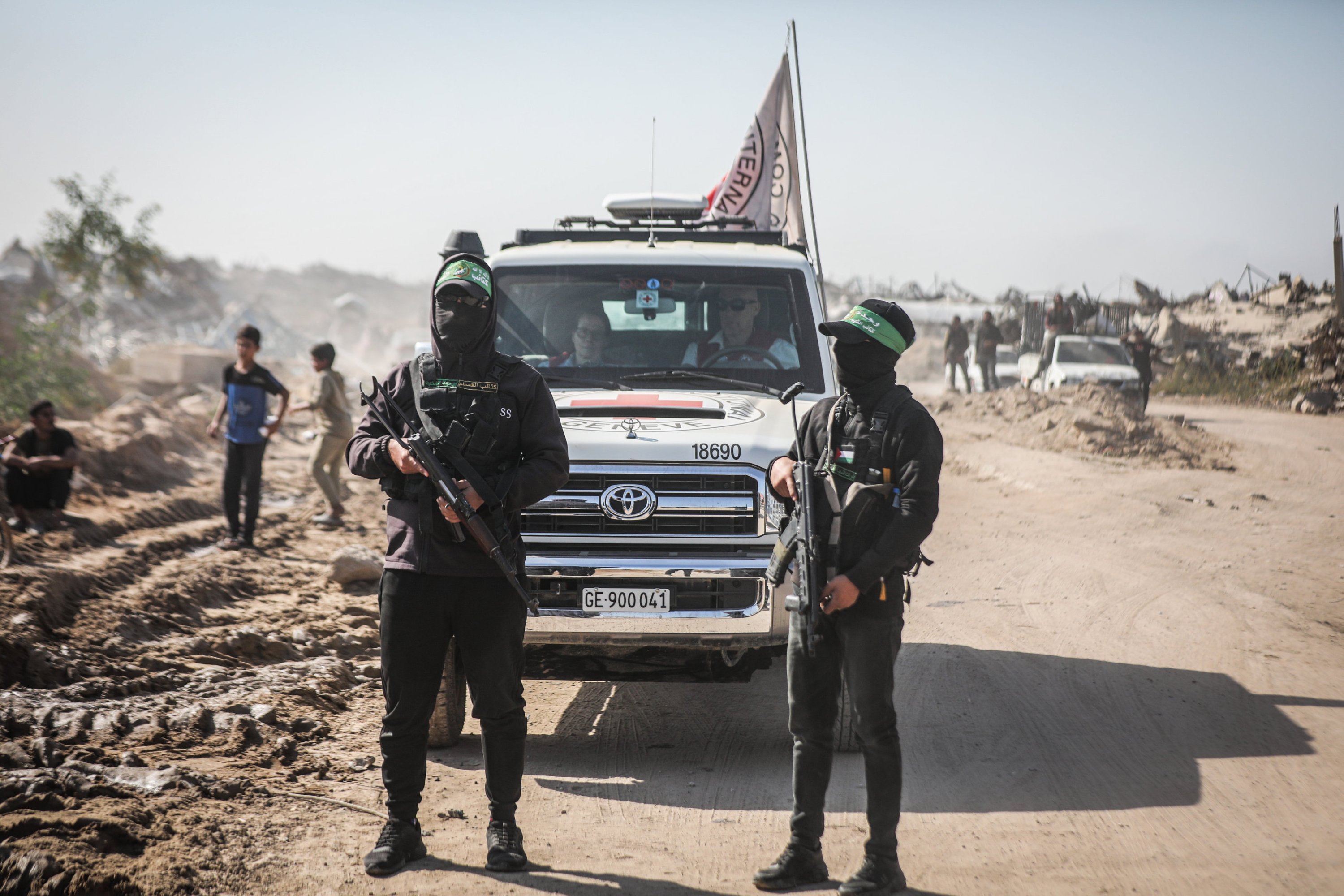
There is a widespread perception that Hamas is an improvised insurgent movement that responds to situations. However, the trajectory of the Gaza war since October 2023 paints a different picture.
Throughout the conflict's multiple stages – political, military, informational and diplomatic – Hamas has demonstrated a long-range strategic capacity not typically associated with fragmented non-state militias, but rather with political entities that think decades ahead. Even in the face of mass displacement, collapsed infrastructure and genocidal violence, its conduct reveals a disciplined, patient and state-like mode of planning. This understanding is essential not only for interpreting Hamas' behavior but also for reassessing how international institutions, regional actors and Western governments have misunderstood or underestimated the organization's strategic depth.
Although Operation Al-Aqsa Flood was immediately framed by the West as irrational violence, its broader implications destabilized a political architecture that had long insulated Israel from public scrutiny. It exposed a widening gap between Western governments and their societies. International legal bodies, human rights organizations and expert institutions began to classify Israeli actions in Gaza as genocidal, yet Western governments intensified their support. Throughout Europe and North America, mass mobilizations erupted as a result of this disconnect, revealing the disappearance of normative foundations underlying Israel's exceptional status.
In this sense, Hamas’ actions forced into visibility what had long existed beneath the surface: Western governments’ willingness to suppress public opinion, silence dissent and violate their own professed commitments to human rights to maintain their strategic alliance with Israel. As a result of the crisis, the notion of the West as a bastion of freedom of thought was exposed as fragile, and the concept of Israeli exceptionalism was illuminated in a way previously unimaginable. This unintended but politically consequential outcome shows how Hamas' operations triggered geopolitical and ideological reverberations far beyond the battlefield, disrupting established narratives about the conflict and reshaping the political vocabulary of Western publics.
The second demonstration of strategic acuity occurred during the final stages of the war when U.S. President Donald Trump proposed a 20-point cease-fire. It was believed that the proposal, designed as an ultimatum, would be rejected outright by Hamas. A rejection would serve to depict Hamas as a threat to peace, allowing Israel and its allies to claim moral and diplomatic leadership.
Instead of falling into this trap, Hamas adopted a state-like approach. The movement held internal consultations, engaged its regional partners and presented conditional acceptance accompanied by revision recommendations. The strategic premise of the plan was nullified by this maneuver. As Tel Aviv and Washington had anticipated an immediate rejection, they were left without narrative leverage. Hamas demonstrated an understanding of diplomatic theater – how proposals are staged, narratives circulate and legitimacy is asserted. It reversed the burden of proof when it responded with procedural maturity and political confidence by exposing Israel as the party not willing to commit to a verifiable cease-fire or prisoner exchange.
The behavior described above is not typically associated with fragmented militant groups facing existential threats. Rather, it reflects leadership capable of evaluating multilayered diplomatic incentives, anticipating international responses and shaping the media environment surrounding a negotiation process.
The third example of state-level strategy concerns Hamas' control of internal unrest during the war's most violent phases. A localized anti-Hamas protest broke out in Gaza in mid-May, which was quickly interpreted by Western media as evidence of a legitimacy crisis. It was widely believed that Gazans were turning against Hamas and demanding its removal from power. Later evidence – such as testimonies from released Israeli captives and footage released by Hamas – revealed a more complex picture.
Hamas monitored and shaped these protests, redirecting some to advance its strategic objectives on the battlefield. Demonstrations were used by Hamas as a form of operational camouflage, in which prisoners were relocated, units were relocated, and units were moved. A maneuver such as this demonstrates an organization's ability to integrate civilians into wartime planning, not as human shields, as Israel often claims, but as part of a broader strategy to maintain political optics and operational flexibility.
Furthermore, the ability to maintain internal cohesion despite genocide-level violence suggests a resilient command structure and an amazingly stable hierarchy. Despite bombardment and displacement, Hamas retained the ability to direct civilian dynamics, reposition fighters and support long-term strategic objectives. It is rare for non-state armed groups operating in similar environments of destruction to maintain such a level of organizational continuity.
Fourth, Hamas' battlefield performance provides additional evidence. Hamas conducted a series of highly targeted ambushes in areas Israel claimed to have cleared and secured throughout the war. In addition to advanced intelligence gathering, these operations required a high level of operational discipline. These operations, timed to coincide with Israeli troop movements, were conducted in neighborhoods deemed "under full IDF control" and executed with minimal resources. Although Hamas faces overwhelming military pressure, it maintains an intelligence network.
The ambushes surprised Israeli and Western analysts since they contradicted assumptions that Hamas' military command structure had collapsed. Rather, they demonstrated an organization capable of adapting quickly, exploiting terrain and coordinating dispersed units throughout an urban battlefield. Hamas has shown the ability to rebuild operational capabilities even after suffering catastrophic losses, which is a trait shared by state militaries with deep institutional memories.
Hamas executed a deception operation targeting Israel's surveillance apparatus during the cease-fire and hostage negotiations. The organization staged a deliberate misdirection, knowing that Israel used drones and advanced monitoring technologies to track the movement of bodies and captives. Israeli and Western media interpreted the footage as evidence that Hamas is hiding or relocating corpses to manipulate negotiations.
Afterward, Hamas released video evidence proving that this had been a calculated deception to expose Israel's continued surveillance and violations of the cease-fire agreement. It exposed Hamas' extensive study of Israeli surveillance methods and adaptations to them, an embarrassment for Israeli intelligence.
A larger point was also reinforced by this move: Hamas isn't just fighting militarily, but also competing in the informational arena, shaping global narratives, exploiting the missteps of its adversaries and eroding Israel's legitimacy through selective use of transparency. Modern hybrid actors master multi-platform information warfare, not isolated insurgent cells.
Taken together, these examples challenge the notion that Hamas behaves as a desperate or purely reactive militant organization. On the contrary, the movement has demonstrated an ability to think strategically across multiple domains – diplomatic, political, military and informational. It has preserved organizational coherence under Israeli genocidal war in Gaza, maintained a long-term vision in the face of extreme uncertainty and executed plans that anticipate the reactions of both regional governments and global powers. It has demonstrated strategic intellect and institutional discipline that surpass those of many state structures in the region, regardless of whether one views it favorably or unfavorably.
In the rubble of Gaza, under conditions designed to annihilate its leadership and break its social base, Hamas has acted with a level of calculated patience, self-confidence and strategic foresight that forces scholars and policymakers to reconsider established assumptions about non-state actors in protracted conflicts. By illuminating these patterns, the Gaza war reveals a movement that does not function as a chaotic insurgency, but rather as a political organization with a durable strategic compass – a movement that seeks to shape the long-term trajectory of the Palestinian struggle rather than just surviving it.