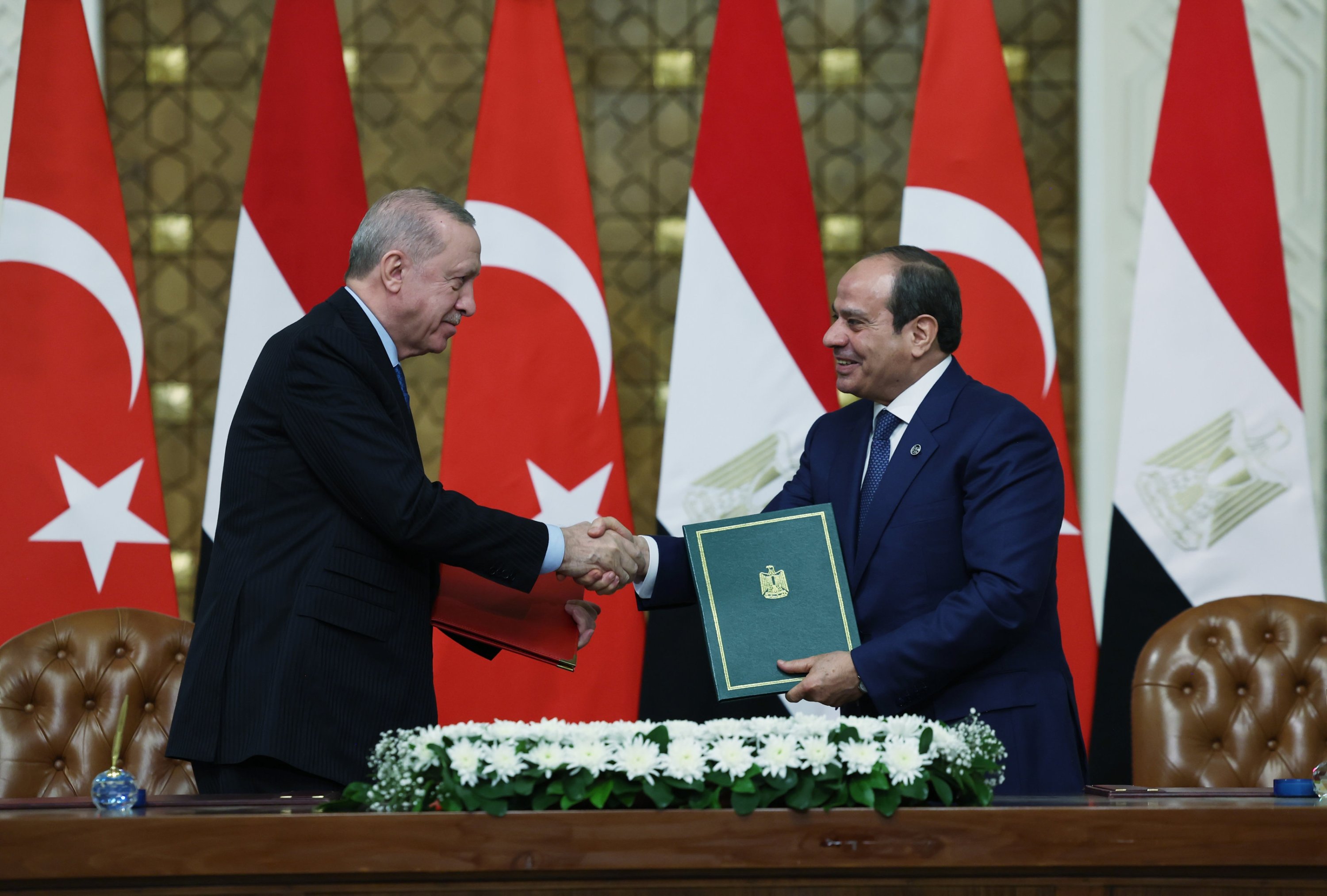
President Recep Tayyip Erdoğan’s two-day visit to Saudi Arabia and Egypt on Feb. 3-4 came at a moment of profound regional turbulence. After two years of sustained Israeli aggression, overlapping conflicts, and growing uncertainty across the Middle East, the tour did not signal the formation of a new political bloc. Rather, it reflected an ongoing effort by key regional actors to reclaim agency over regional order, stability and cooperation at a time when external interventions have increasingly proven destabilizing.
As the Turkish president’s visit was designed as a two-country tour rather than a bilateral visit to a single state, its implications are better understood in regional rather than purely bilateral terms.
Official statements released following the first leg of the tour in Saudi Arabia emphasized alignment between the future visions of both countries, Türkiye’s Century Vision and Saudi Arabia’s Vision 2030, highlighting opportunities to foster economic development and contribute to regional stability. One of the most tangible outcomes was Saudi Arabia’s $2 billion investment in renewable energy in Türkiye, announced within an agreement to supply electricity at exceptionally favorable rates, as highlighted by Türkiye’s Minister of Energy and Natural Resources. This investment is expected to strengthen Türkiye’s green energy agenda while supporting Saudi Arabia’s non-oil economic diversification efforts.
Erdoğan’s visit to Egypt on Feb. 4, meanwhile, should be seen as complementary to his earlier trip to Saudi Arabia rather than a separate diplomatic initiative. In line with discussions in Riyadh, both Ankara and Cairo emphasized that regional stability requires deeper cooperation between Egypt and Türkiye. Beyond their stated intention to expand bilateral trade to $15 billion, the two sides also signed a military framework agreement. In addition, further defense cooperation appears likely, particularly following the opening of a representative office by Türkiye’s defense giant Aselsan in the North African country.
First, the visits highlight shifting regional dynamics that began to emerge after Oct. 7 and accelerated following the fall of the Assad regime in Syria, the 12-day war between Israel and Iran, as well as Israel’s strike on Doha. As part of an ongoing alignment, regional middle powers appear to be deepening ties across multiple fronts. Israel’s ongoing aggression, combined with Iran’s weakening both at home and through its proxy networks, has fueled a shared sense of threat among Türkiye, Saudi Arabia and Egypt. Their joint response to Israel’s recent diplomatic move to recognize Somaliland underscores a common view of Israel as a destabilizing force in the region. Türkiye’s call for regional stability, echoed by Egypt and Saudi Arabia, signals a growing focus on stronger central governments and closer regional cooperation.
Secondly, U.S. President Donald Trump’s foreign policy preferences, often described as a “Donroe Doctrine” approach, have created greater space for regional powers. Strong personal ties between Trump and regional leaders have also heightened the need for closer coordination among these states. For example, while the U.S. has at times supported Türkiye’s position in Syria, the Trump administration has simultaneously maintained robust trade relations with Saudi Arabia. In this context, as repeatedly emphasized by Foreign Minister Hakan Fidan, Ankara’s view that regional problems should be addressed primarily by regional actors has gained even more traction.
Finally, ongoing conflicts in Sudan and Yemen are seen as direct national security threats by both Egypt and Saudi Arabia. At the same time, Egypt is focused on strengthening its economy, while Saudi Arabia continues to diversify its economic base. Against this backdrop, the renewed rapprochement of both countries with Türkiye has become both more necessary and potentially more productive.
This regional stability-oriented approach has already delivered results in two key areas. Following the fall of Assad, Türkiye and Gulf countries, particularly Saudi Arabia, Qatar and the United Arab Emirates (UAE), have supported the new Syrian government’s efforts to reestablish state institutions and secure international recognition. Saudi Arabia and Qatar have covered Syria’s World Bank debt and invested across multiple sectors, including energy, transportation and health care, while Türkiye has remained closely engaged on issues of Syria’s territorial integrity and security challenges.
Secondly, the prospect of U.S. intervention against Iran has emerged as another issue on which regional actors are seeking consensus, accelerating diplomatic efforts to prevent escalation. The core argument is that any intervention in Iran would risk widespread regional destabilization and undermine the prospects for peaceful cooperation. So far, this focus on regional stability and opposition to military action appears to have helped avert direct confrontation, at least for now.
Beyond formal agreements and official statements, Erdoğan’s remarks to Arabic daily, Asharq Al-Awsat, provide insight into the future trajectory of regional cooperation. He emphasized Türkiye’s commitment to narrowing conflict zones, reducing tensions and strengthening regional harmony through cooperation. His references to Türkiye’s humanitarian engagement in Sudan and the importance of Somalia’s integration suggest the potential for deeper collaboration in conflict-affected areas such as Yemen, Sudan, Somalia and Gaza. It is increasingly likely that cooperation among these countries will continue in these theaters until conflicts subside or at least reach a stable status quo.
Separately, expectations regarding a trilateral defense agreement involving Saudi Arabia, Türkiye and Pakistan have yet to materialize. Nevertheless, Saudi Arabia’s continued interest in Türkiye’s defense industry remains strong. Potential deals could emerge, particularly concerning Saudi interest in the Kaan fighter jet, fifth-generation aircraft and Aselsan-produced air defense systems. As Türkiye’s advanced defense industry seeks to expand its export markets and Saudi Arabia aims to diversify its military capabilities and reduce external dependency, such cooperation would offer a complementary and mutually beneficial framework, resulting in a clear win-win outcome for both sides.
Taken together, Erdoğan’s visits to Saudi Arabia and Egypt signal less a move toward formal alliance-building than the gradual consolidation of a regional stability framework led by middle powers. As conflicts in Gaza, Yemen, Sudan and beyond continue to expose the limits of external intervention, Türkiye, Saudi Arabia and Egypt appear increasingly committed to managing regional crises through coordination, economic interdependence and selective security cooperation. While this approach remains pragmatic rather than institutionalized, it reflects a broader change toward regional problem-solving that prioritizes stability, limits escalation and re-centers the Middle East’s future in the hands of its own actors.