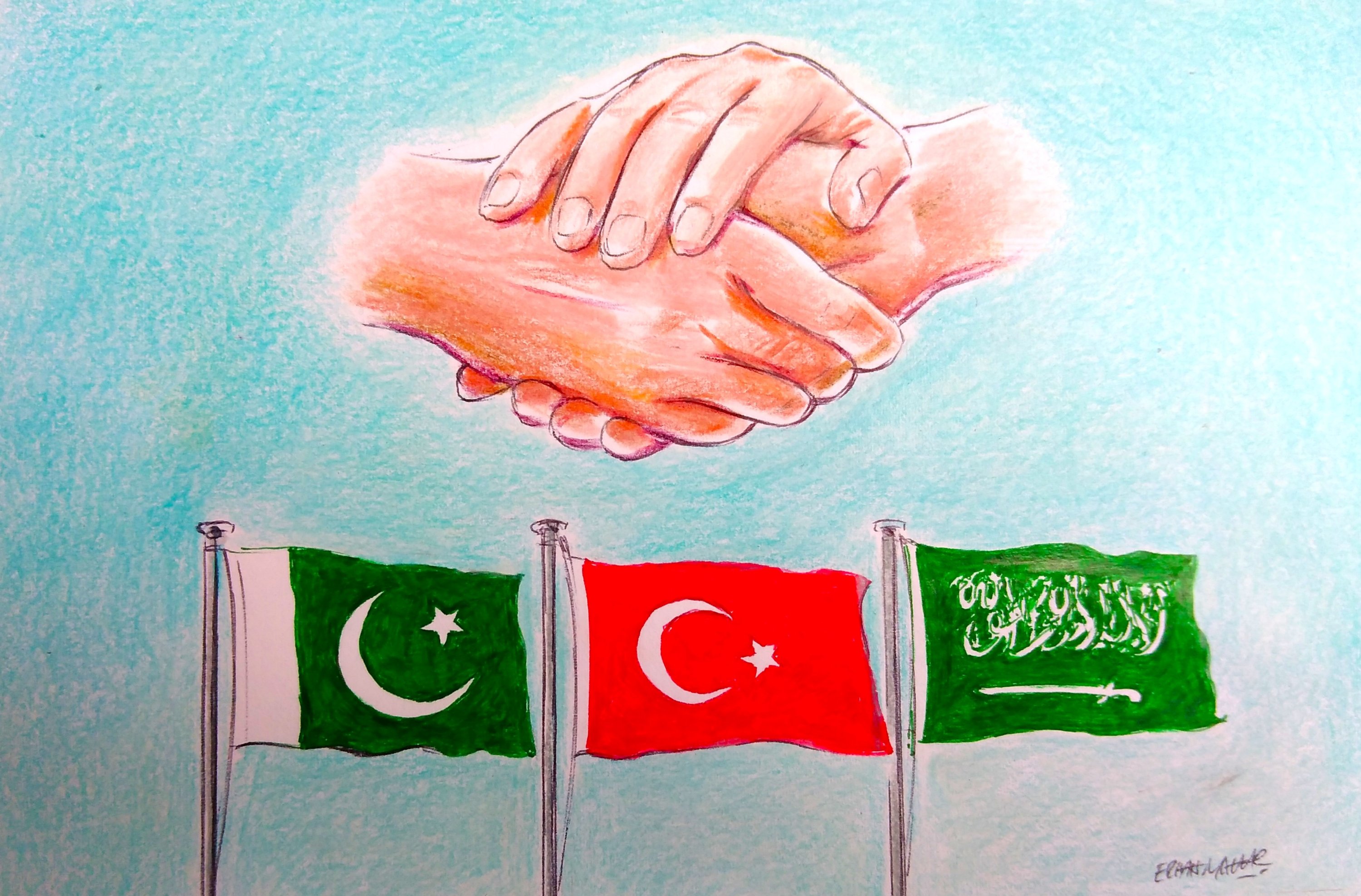
Reports that Türkiye, Saudi Arabia and Pakistan are exploring the formation of a trilateral defense pact have been met with considerable interest across diplomatic and strategic circles. While Foreign Minister Hakan Fidan has confirmed that discussions are ongoing, Pakistan’s minister of Defense Production, Raza Hayat Harraj, stated that nearly a year of negotiations has already produced a draft framework agreement. Taken together, these statements point not to speculative diplomacy but to a structured and deliberate process.
In the aftermath of Oct. 7, the Middle East has entered a period of rapid transformation, marked by heightened uncertainty and recalibrated alliances. Therefore, the prospect of a Türkiye-Saudi Arabia-Pakistan defense pact stands out as a potentially consequential development, one that reflects not only shared regional visions but also the maturation of existing, multidimensional partnerships into a more institutionalized form.
Israel’s conduct, ranging from the devastation in Gaza and the continued entrenchment of its occupation of the Golan Heights to its willingness to escalate tensions with Iran from proxy confrontation toward direct engagement, even striking targets as far afield as Doha, has reinforced a sense of strategic volatility across the region. This pattern of rule-breaking assertiveness and regional expansionism, alongside a deep trust deficit between Gulf capitals and Washington, constitutes a legitimate concern for many.
Compounding these anxieties are persistent risks associated with separatist activities and terrorism, stretching from the Arabian Peninsula to the Horn of Africa. When viewed together, Israeli military aggression and the proliferation of fragmentation-driven conflicts represent twin sources of instability. It is precisely here that the shared outlook of Türkiye, Saudi Arabia and Pakistan begins to take shape.
Two principled positions underpin this convergence. First, all the three actors are firmly opposed to separatism and terrorism in the region. Second, they increasingly view sustainable defense-industrial cooperation as a strategic necessity rather than a commercial luxury. What is meant by defense cooperation is not simply arms purchases but long-term partnerships encompassing coproduction, technology transfer and capacity-building.
Türkiye’s posture here is illustrative. Ankara favors the preservation of unitary state structures and positions itself against projects that fuel fragmentation or empower nonstate armed actors. Recent examples of this policy can be seen in cases such as Syria, Yemen and Somalia. At the same time, Türkiye’s considerable progress in the defense-industrial ecosystem, from unmanned aerial vehicles (UAVs) to naval platforms, has elevated it into a formidable regional actor. This combination of political stance and industrial capability has significantly shaped its relations with both Riyadh and Islamabad.
From a Saudi perspective, Türkiye’s opposition to separatist agendas aligns closely with its regional vision. The kingdom has little tolerance for centrifugal forces in the Arabian Peninsula or the Horn of Africa. Its military and diplomatic backing of Yemen’s internationally recognized government against the separatist actors like the Southern Transitional Council (STC), as well as its clear opposition to any international recognition of a breakaway Somaliland, underscores this position. Recent efforts to deepen military cooperation with Egypt and Somalia further signal that separatist projects have no place in Saudi Arabia’s regional calculus. Moreover, in strategically sensitive waterways such as the Red Sea and the Gulf of Aden, Riyadh’s Vision 2030-driven ambitions depend on secure maritime routes that are not monopolized by a single power or threatened by nonstate actors.
Pakistan, for its part, brings a parallel set of concerns. Long grappling with Baloch separatism, particularly the insurgency carried out by the Balochistan Liberation Army (BLA), Islamabad shares Ankara’s and Riyadh’s regional vision against separatism.
Equally important is the growing priority all three actors assign to defense-industrial development. Türkiye has emerged as a major exporter, with annual defense exports exceeding several billion dollars and a portfolio that includes UAVs, naval vessels, armored vehicles and precision munitions. Crucially, Ankara tends to frame cooperation with partners such as Pakistan and Saudi Arabia not as one-off sales, but as components of a shared strategic vision. This mindset, rooted in sustainability rather than transactionalism, is a powerful driver pushing the three countries toward a more comprehensive framework.
First and foremost, a trilateral defense pact among Türkiye, Saudi Arabia and Pakistan should not be misconstrued as the construction of an aggressive bloc or a “mini-NATO.” Such criticisms miss the point. None of the parties has articulated ambitions of forming a rigid military alliance aimed at containment. Rather, the objective appears to be the institutionalization of already robust relationships and the creation of a concrete structure through which shared regional visions can be operationalized. Having shared regional outlooks and prioritizing defense industry development are two key motives that laid the grounds for the making of a pact.
Türkiye’s defense ties with Pakistan provide a clear precedent. In 2020, the two countries signed an agreement for the construction of four PN MILGEM corvettes for the Pakistan Navy, a deal valued at roughly $1.5 billion. The first vessel has already been delivered, with subsequent ships progressing steadily, symbolizing not only naval modernization but also deep industrial cooperation. Beyond naval platforms, Ankara and Islamabad have collaborated on aircraft modernization programs and drone technologies, reflecting a breadth of engagement that extends well beyond simple procurement.
Saudi Arabia, meanwhile, has emerged as a significant customer for Turkish defense products, particularly in the UAV domain. Deals involving systems such as the Bayraktar platforms have been accompanied by discussions on localized production, training and long-term maintenance, again pointing toward partnership rather than mere acquisition. A trilateral framework would provide an umbrella under which such bilateral initiatives could be synchronized, scaled and strategically aligned.
The potential of a trilateral arrangement extends well beyond defense industrial cooperation. Türkiye, Saudi Arabia and Pakistan occupy pivotal positions on the region’s evolving connectivity map. Türkiye stands at the heart of the Development Road Project, with Iraq, positioning itself as a critical hub that links the Gulf to European markets. Pakistan hosts the China-Pakistan Economic Corridor (CPEC), one of the flagship initiatives of China’s Belt and Road Initiative (BRI), connecting western China to the Arabian Sea. Saudi Arabia, through Vision 2030, combines strategic geography along the Red Sea with substantial financial capacity, making it a natural partner for large-scale connectivity and diversification projects.
Building on such a connectivity synergy could allow all three actors to anchor their regional visions in expanding economic cooperation. In other words, defense cooperation may represent the starting point, but connectivity could well become the next strategic horizon.
In sum, the alignment of Türkiye, Saudi Arabia and Pakistan’s regional outlooks, combined with already advanced bilateral relationships, helps explain the logic behind exploring a trilateral defense pact. Shared threat perceptions and converging visions naturally draw like-minded actors closer together. If realized, such a pact would stand as one of the most tangible manifestations of this convergence, signaling not a turn toward bloc politics, but a pragmatic effort to translate common principles into structured cooperation in many fields.